Defections in Normandy and Philip VI’s Efforts…
1347 CE
Defections in Normandy and Philip VI’s Efforts to Secure a Truce (1345–1347)
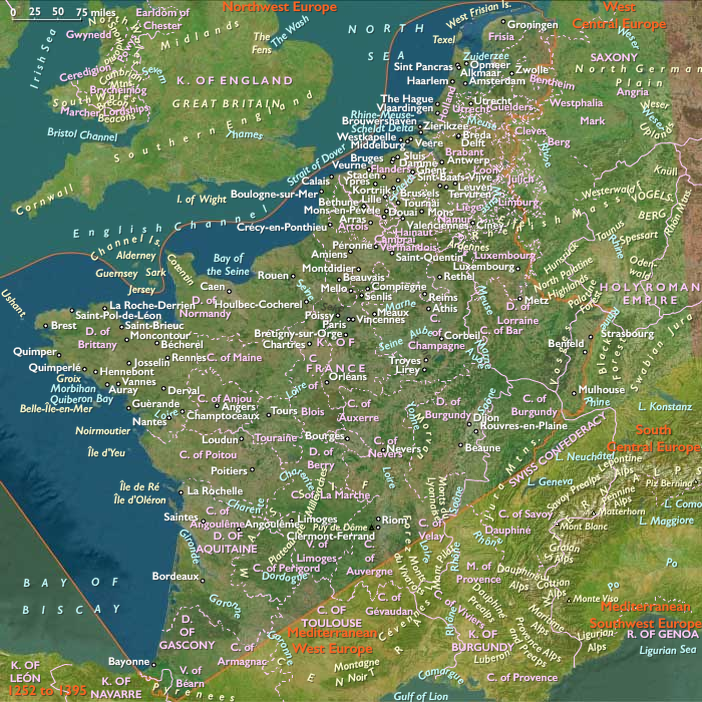
By 1345, increasing numbers of Norman nobles had begun to shift their allegiance to Edward III of England, posing a serious threat to the legitimacy of the Valois monarchy. The French defeat at the Battle of Crécy (1346)and the fall of Calais (1347) further damaged royal prestige, intensifying noble defections, particularly in northern and western France, where the economy was closely tied to England’s maritime trade.
Philip VI Seeks a Truce to Stabilize His Authority
- Facing growing opposition and struggling to secure support among his vassals, Philip VI sought to negotiate a truce to prevent further destabilization.
- As part of this effort, Duke John (the future John II of France) was tasked with rebuilding royal support in Normandy, where loyalty was wavering.
The Reconciliation with Geoffroy d’Harcourt
- Geoffroy d’Harcourt, a prominent Norman noble, had previously rebelled against Philip VI and allied himself with Edward III.
- To regain his loyalty, John met with Geoffroy, and Philip VI agreed to return all confiscated lands and titles.
- In a remarkable gesture of reconciliation, Geoffroy was appointed sovereign captain in Normandy, giving him authority over the duchy’s military affairs.
The Alliance with the Tancarville Family
- To further solidify royal influence in Normandy, John approached the powerful Tancarville family, whose support was crucial for maintaining control over the region.
- A dynastic marriage was arranged between John, Viscount of Melun, and Jeanne, the sole heiress of the County of Tancarville.
- This marriage ensured that the Melun-Tancarville faction remained loyal to John and the Valois crown.
The Dual Role of Geoffroy d’Harcourt
- While Geoffroy had reconciled with Philip VI, he continued to act as a defender of Norman freedoms, positioning himself as a leader of the reforming party in the duchy.
- His role highlighted the delicate balance between royal authority and regional autonomy, which remained a persistent issue in Valois rule over Normandy.
Impact and Consequences
- Philip VI’s efforts to secure a truce in 1347 temporarily stabilized the situation, but Normandy remained politically fragile.
- The defections of Norman nobles reflected broader dissatisfaction with Valois rule, which would continue to weaken French authority in the region.
- The truce did not resolve the underlying conflict, and Edward III’s influence in France remained strong, ensuring that the Hundred Years’ War would continue.
The defections in Normandy (1345–1347) and Philip VI’s attempts to restore loyalty were critical moments in the Hundred Years’ War, revealing the fracturing of French noble allegiances and the increasing vulnerability of Valois rule.
Locations
Groups
Commodities
Subjects
Regions
West Europe
View →Subregions