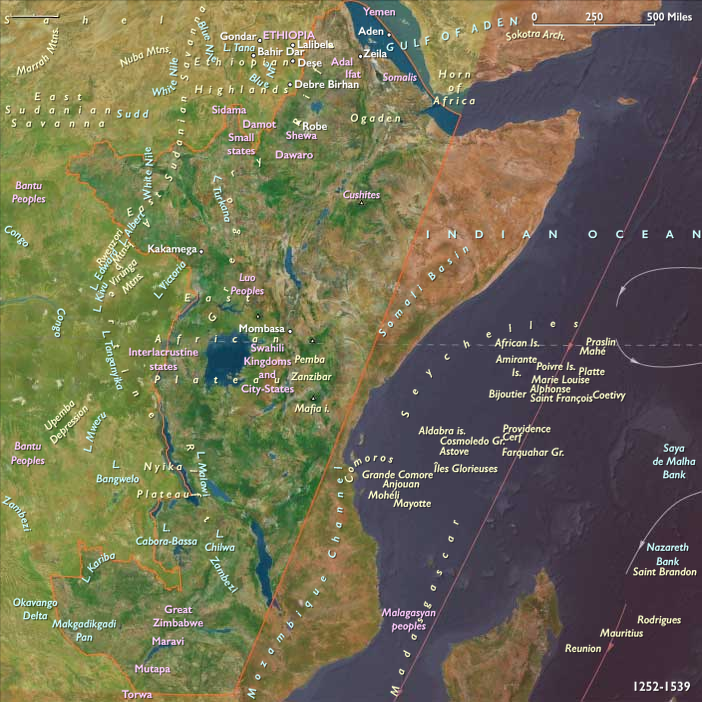
Interior East Africa (1528–1539 CE): Conflict and…
1528 CE to 1539 CE
Interior East Africa (1528–1539 CE): Conflict and Transformation—Ahmad ibn Ibrahim's Jihad and Portuguese Intervention
Rise of Ahmad ibn Ibrahim al-Ghazi
The early sixteenth century in Interior East Africa was marked by escalating conflict between Christian and Muslim powers. Ahmad ibn Ibrahim al-Ghazi, a charismatic and skilled military leader known as "Gragn" ("the Lefthanded"), rose to prominence in the Sultanate of Adal by uniting diverse Muslim groups including the Afar and Somali peoples. Gragn successfully galvanized these groups around a religiously motivated campaign—declaring jihad against the Christian kingdom of Ethiopia, aiming to decisively end Christian dominance in the region.
Military Campaigns and Christian Defeat
Starting his campaign in earnest around 1525, Gragn's forces swiftly became renowned for their effective and brutal tactics. In 1529, at the pivotal Battle of Shimbra Kure, Gragn delivered a devastating defeat to Ethiopian emperor Lebna Dengel (Dawit II), effectively shattering the backbone of Ethiopian resistance. Following this triumph, Gragn’s armies penetrated deeper into the Christian heartlands—including the vital regions of northern Shewa, Amhara, and Tigray. Here, they razed churches, took prisoners, and systematically reduced much of Ethiopia to tributary status under Muslim governors.
The Portuguese Intervention
Facing existential threats, Ethiopian leaders sought external assistance. This plea coincided with Portuguese ambitions and their quest for the legendary Christian kingdom of "Prester John." Consequently, Portugal dispatched a military expedition under Cristóvão da Gama, son of famed explorer Vasco da Gama. Arriving by sea, these Portuguese forces decisively changed the military balance. Utilizing firearms and cannons, the joint Portuguese-Ethiopian forces managed to halt the Muslim advance, culminating in the death of Imam Ahmad ibn Ibrahim al-Ghazi on the battlefield in 1543, although final victory was not achieved until after this era.
Key Historical Developments
-
Ahmad ibn Ibrahim al-Ghazi's consolidation of power in the Sultanate of Adal and declaration of jihad against Christian Ethiopia.
-
Devastating defeat of Ethiopian forces at the Battle of Shimbra Kure (1529), severely undermining Christian control.
-
Penetration of Muslim forces into Ethiopia's central highlands, leading to significant territorial losses for the Christian kingdom.
-
Portuguese military intervention under Cristóvão da Gama, crucially bolstering Ethiopian resistance against Muslim forces.
Long-Term Consequences and Historical Significance
This period marked a significant turning point in the history of Interior East Africa, dramatically reshaping the geopolitical landscape. Ahmad ibn Ibrahim al-Ghazi's military campaigns caused profound disruptions, permanently altering the regional balance of power between Muslim and Christian polities. Additionally, Portuguese intervention laid the groundwork for increased European involvement in Ethiopian affairs, shaping future diplomatic and military interactions. The era solidified the complex religious and cultural divisions within the region, setting the stage for enduring tensions and alliances in subsequent centuries.
People
Groups
Commodities
Regions

East Africa
View →Subregions