Middle America (1684 – 1827 CE) Colonial…
1684 CE to 1827 CE
Middle America (1684 – 1827 CE)
Colonial Gateways, Silver Routes, and the Age of Revolutions
Geography & Environmental Context
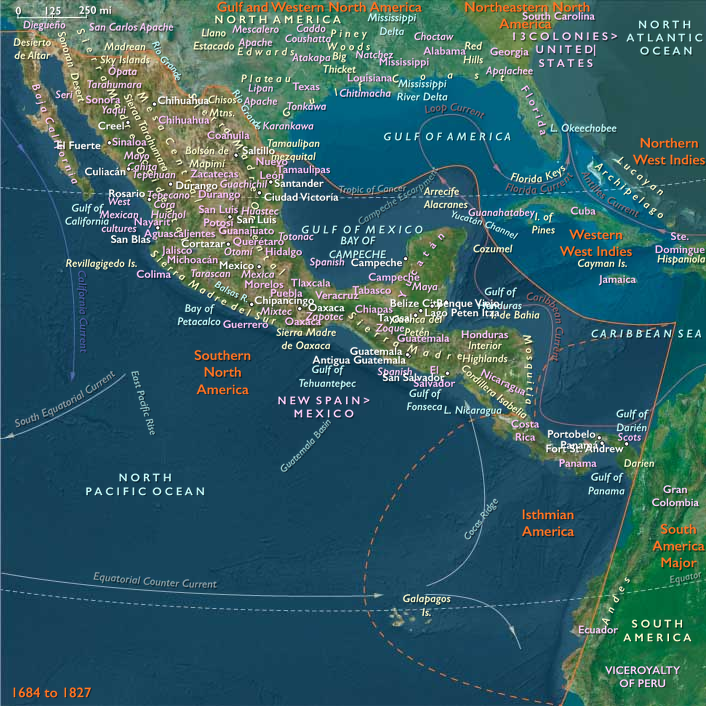
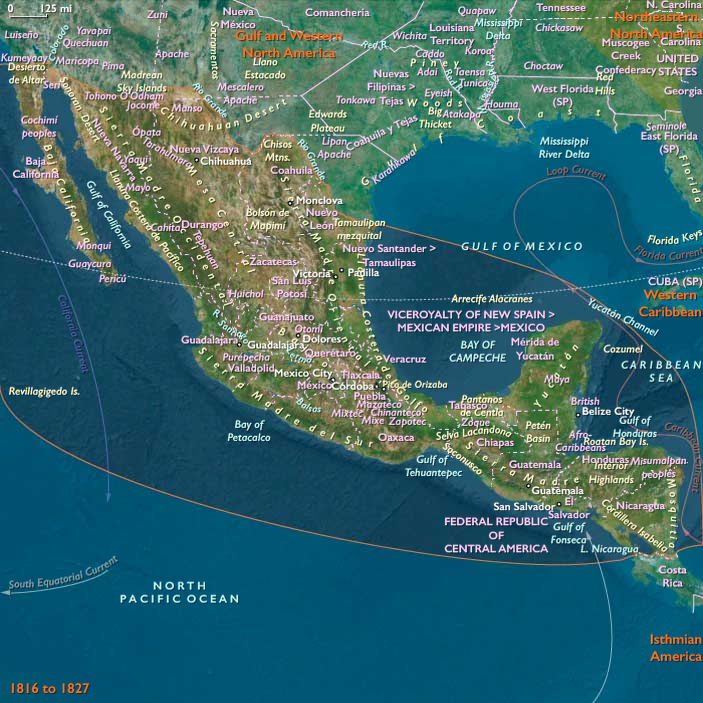
Middle America joined two critical subregions: Isthmian America—the narrow link of Costa Rica, Panama, the San Andrés Archipelago, and the Galápagos—and Southern North America—the vast lands of Mexico, Guatemala, Belize, Honduras, El Salvador, and Nicaragua. Anchors ranged from the Valley of Mexico and Guatemalan highlands to the Panama Isthmus and Galápagos outposts, bridging the Atlantic and Pacific worlds. The region’s volcanoes, tropical forests, and overland passes made it both a corridor of empire and a crucible of Indigenous persistence.
Climate & Environmental Shifts
The Little Ice Age lingered, bringing cooler highland nights, unpredictable rains, and periodic droughts. Frosts struck the Valley of Mexico, while hurricanes ravaged the Caribbean and Yucatán. Floods swelled rivers through the Chagres and Motagua basins; volcanic eruptions (notably in Ecuador and Guatemala) and earthquakes repeatedly reshaped towns. Disease—malaria, yellow fever, smallpox—haunted the Isthmian tropics, while the highlands retained dense populations through terracing and irrigation.
Subsistence & Settlement
-
Southern North America:
-
Indigenous communities maintained maize–beans–squash milpas, integrating Spanish crops and livestock.
-
Encomienda and hacienda systems organized tribute and labor, while Maya regions (Yucatán, Chiapas) preserved autonomy and resistance.
-
Cities like Mexico City, Puebla, and Guatemala City became imperial hubs linking mines, ports, and markets.
-
-
Isthmian America:
-
Panama’s Chagres corridor linked Portobelo (Caribbean) and Panama City (Pacific), provisioning mule trains with maize and cassava.
-
Costa Rica remained a modest agrarian province of cacao, cattle, and smallholders.
-
The San Andrés Archipelago and Galápagos Islands served as maritime supply points for whalers and pirates.
-
Across both regions, Indigenous farmers, enslaved Africans, and mestizo peasants sustained economies beneath Spanish and later Creole elites.
Technology & Material Culture
-
Transport and infrastructure: Mule caravans, dugout canoes, and fortified Camino Reales bound interior to coast; Panama’s Portobelo fortresses guarded treasure routes.
-
Agricultural innovations: Terracing, irrigation, and hybrid crops balanced maize and wheat.
-
Architecture and crafts: Baroque cathedrals rose beside Indigenous workshops; stone aqueducts and plazas reshaped colonial cities.
-
Shipping and trade: Spanish galleons and later British merchantmen plied the coasts, feeding global circuits.
Movement & Interaction Corridors
-
Silver and commerce: Bullion from Potosí and Zacatecas passed through Acapulco–Manila and Portobelo–Seville routes, making Panama the empire’s bottleneck.
-
Smuggling and piracy: The Bahamas, Darién, and Gulf of Honduras hosted English, Dutch, and French privateers; the failed Scottish Darién Scheme (1698–1700) exposed the Isthmus’s dangers.
-
Religious and Indigenous networks: Franciscan and Jesuit missions threaded highlands; maroon and Indigenous trade circuits persisted in forests and mountains.
-
Atlantic–Pacific links: Whalers provisioned at Galápagos; Caribbean slave routes and Asian cargo lines converged through Mexico and Panama.
Cultural & Symbolic Expressions
Catholicism permeated public life—festivals, processions, and saint cults—but beneath the surface, Indigenous and African cosmologies endured.
-
Syncretism: Maya and Nahua rituals blended with church feasts; Afro-descended cofradías preserved drum-based devotion.
-
Creole Enlightenment: Universities in Mexico City and Guatemala spread secular learning; Creole elites began crafting identities distinct from Spain.
-
Urban cosmopolitanism: Portobelo fairs, Mexico’s printing presses, and Panama City’s merchants infused the region with global goods and ideas.
Environmental Adaptation & Resilience
Terracing, irrigation, and polyculture buffered highland famine; cacao and coffee diversified lowland exports; communal labor (tequio, mita) rebuilt after floods and quakes. Along coasts, African-descended farmers introduced cassava and rice techniques; maroon communities used tropical ecologies for defense and survival.
Political & Military Shocks
-
Colonial reform: The Bourbon Reforms (18th century) tightened taxes and monopolies, sparking resentment.
-
Uprisings: Indigenous revolts and conspiracies (e.g., Yucatán, Nicaragua) flared alongside smuggling and banditry.
-
Wars of Independence (1810–1821):
-
Mexico’s Hidalgo and Morelos launched mass uprisings invoking the Virgin of Guadalupe and Indigenous justice.
-
Guatemala and Central America followed suit, declaring independence in 1821.
-
Costa Rica and Panama joined the short-lived United Provinces of Central America (1823–1838) and Gran Colombia (1821–1831) respectively.
-
The Isthmus remained a coveted transit route under new republican flags.
-
Transition
By 1827 CE, Middle America had shifted from the keystone of the Spanish Empire to a patchwork of independent republics. Mexico, Central America, and Gran Colombia’s Panama stood sovereign, though fragile, their economies still tied to old routes. Portobelo’s galleons were gone, replaced by smugglers, coffee traders, and republican dreamers. Indigenous communities endured behind mountain walls; Costa Rican and Panamanian farmers tended new export crops; mariners from San Andrés and whalers at Galápagos linked the coasts to global seas. The age of empire had ended, but the isthmus—true to its nature—remained the hinge between oceans and histories.
Images

Isthmian America (with civilization) ©2024-25 Electric Prism, Inc. All rights reserved.
Groups
Topics
Commodities
Subjects
Regions