
Ivan has expressed an interest in establishing…
1581 CE
Ivan has expressed an interest in establishing diplomatic and trade relations with England, even suggesting his readiness to marry an English noblewoman.
He seems to have abdicated in 1575 for about a year in favor of a Tatar prince, Simeon Bekbulatovich.
He had married five wives in succession in only nine years during the 1570s.
Finally, in a fit of rage, he murders his only viable heir, Ivan, in 1581.
People
Groups
Subjects
Regions
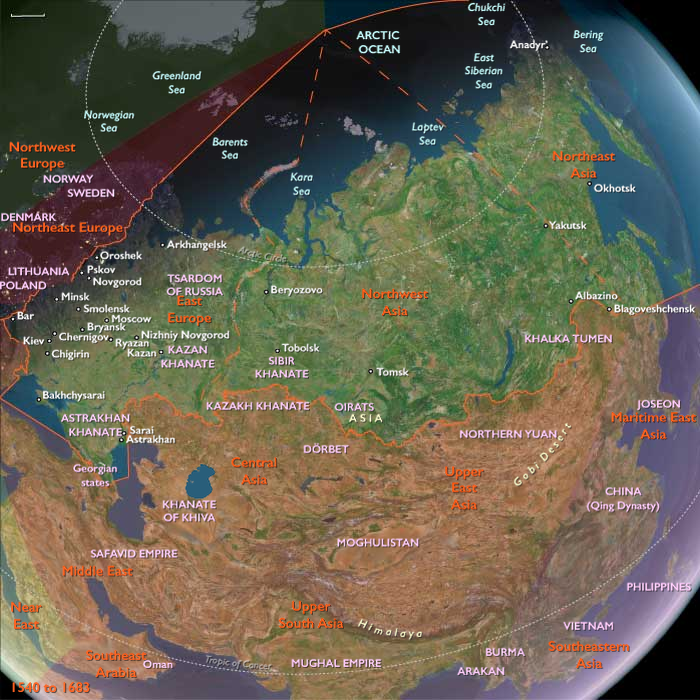
Northeastern Eurasia
View →Subregions
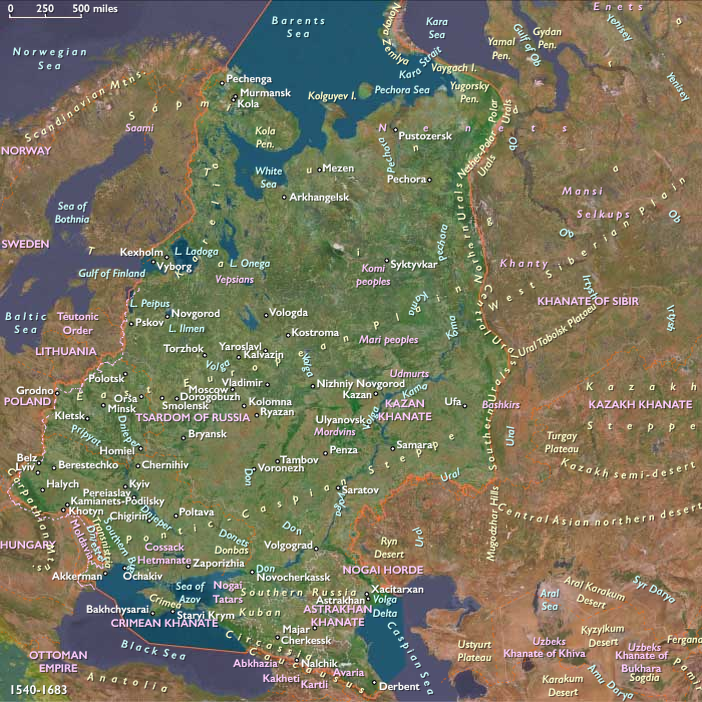
East Europe
View →Related Events
No active filters.
Showing 10 events out of 34922 total
Báthory’s series of military victories between 1579 an 1581 over Russia’s Ivan IV (”the Terrible”), one of which is the sack, in 1581, of Velikiye Luki, a city on the Lovat River, is the most spectacular achievement of his reign.
It is likely that the king's eastern policies are inspired by the ultimate goal of liberation of Hungary, which is not necessarily a Polish concern.
The Finnish tribes, under Swedish sovereignty, have gradually developed a sense of unity, which the bishops of Turku have encouraged.
Study in universities has brought Finnish scholars into direct touch with the cultural centers of Europe, and Mikael Agricola, who lived from about 1510 to 1557, the creator of the Finnish literary language, had brought the Lutheran faith from Germany.
As part of medieval Sweden, Finland has been drawn into the many wars and domestic battles of the Swedish nobility.
King John III in 1581 raises Finland to the level of a grand duchy to irritate his Russian rival, Tsar Ivan IV the Terrible.
Riga is incorporated into the Polish-Lithuanian Commonwealth in 1581.
Ivan had captured Narva in 1558 and penetrated deep into Estonia, bringing devastation with him.
It is not until 1581 that the Swedes are able to expel the Russians.
Zamosc, a city in eastern Poland and one of the few large communities in the Lublin Uplands, is founded on the estates of Polish chancellor Jan Zamoyski that lie on the trade route between the Black Sea and northern and western Europe.
The Paduan architect Bernardo Morando in 1578 conceives and implements the city's modern design, which remains a fine example of grid-based urban planning.
Italianate Renaissance architecture dominates the main square, with uniform but ornate two-story houses clustered around Town Hall.
Bartholomaeus Spranger had assisted in completing an interrupted fresco project during a ten-year period spent in Rome and Parma.
While working in Paris around 1565, the Antwerp native had been influenced by the work of Francesco Primaticcio and Niccolò dell' Abbate.
Returning to Rome in 1567, he had become an assistant to Taddeo Zuccari, and had later worked for the emperor Maximilian II in Vienna, where he had made a successful career.
Maximilian's son, Rudolf II, Holy Roman Emperor, is to prove an even better patron than his father would have been, and Spranger will never leave his service.
The court had soon transferred to Prague, safer from the regular Turkish invasions.
He had in 1581 been appointed court painter in Prague by Rudolf, and will remain in this city hereafter.
Rudolf is to become an obsessive collector of old and new art, his artists mixing with the astronomers, clockmakers, botanists, and "wizards, alchemists and kabbalists" who Rudolf also gathers around him.
A certain Deacon Coresi had printed Romanian translations of the Acts of the Apostles in 1563.
Other publications of his that survive are the Tîlcul Evangheliilor si Molitvenic (“Sermons and Book of Prayers”) and Evanghelia cu învatatura (1581; “Commentary on the Gospels”); these all encourage the use of Romanian.
The secular literature produced in this period consists mainly of translations from Greek, Slavonic, Byzantine, and Oriental books.
Akbar, in an effort to forge the diverse religious groups in the service of the state into one cohesive political community, in 1581 creates a new order commonly called the Din-i Ilahi (“Divine Faith”), which is modeled on the Muslim mystical Sufi brotherhood.
The new order, which is to be based on reason and ethical teachings common to all religions and which is to be free from priestcraft, has its own initiation ceremony and rules of conduct to ensure complete devotion to the emperor; otherwise, members are permitted to retain their diverse religious beliefs and practices.
Din-i Ilahi as propounded by Akbar combines mysticism, philosophy and nature worship, also recognizing no gods or prophets.
Various Muslim clerics respond by declaring this to be blasphemy.
Raja Man Singh, Akbar’s commander-in-chief, refuses conversion, saying that he recognizes only two religions, Hinduism and Islam.
Ram Das, also called Bhai Jetha, is fourth Sikh Guru and founder of the great Sikh center of Amritsar, now headquarters or capital of the religion.
He has from 1574 continued as Guru the missionary endeavor begun by his predecessor, Amar Das.
On land given to him by Akbar, he had built a holy tank, or pool; then, wishing to build a community around it, he had invited businessmen and traders to settle there.
The town was first named Ramdaspur and then Amritsar.
Following the tradition of his saintly forerunners, Ram Das has urged Akbar to punish graft among his officials and to endow charitable undertakings of all kinds.
He is noted for his humility, piety, and service to others.
Shortly before his death in 1581, his son Arjun succeeds him as Guru.
The huge Allahabad Fort, constructed in 1583, stands on the banks of the Yamuna near the site of confluence with river Ganges.
The largest fort built by Akbar, with three galleries flanked by high towers, it is unrivaled for its design, construction and craftsmanship.