David next creates creates The Lictors Bring…
November 1789 CE
The work has tremendous appeal for the time.
Before the opening of the Salon, the French Revolution had begun.
The National Assembly has been established, and the Bastille has fallen.
The royal court does not want propaganda agitating the people, so all paintings have to be checked before being hung.
David's portrait of Lavoisier, who is a chemist and physicist as well as an active member of the Jacobin party, had been banned by the authorities for such reasons.
When the newspapers report that the government has not allowed the showing of The Lictors Bring to Brutus the Bodies of His Sons, the people are outraged, and the royals are forced to give in.
The painting is hung in the exhibition, protected by art students.
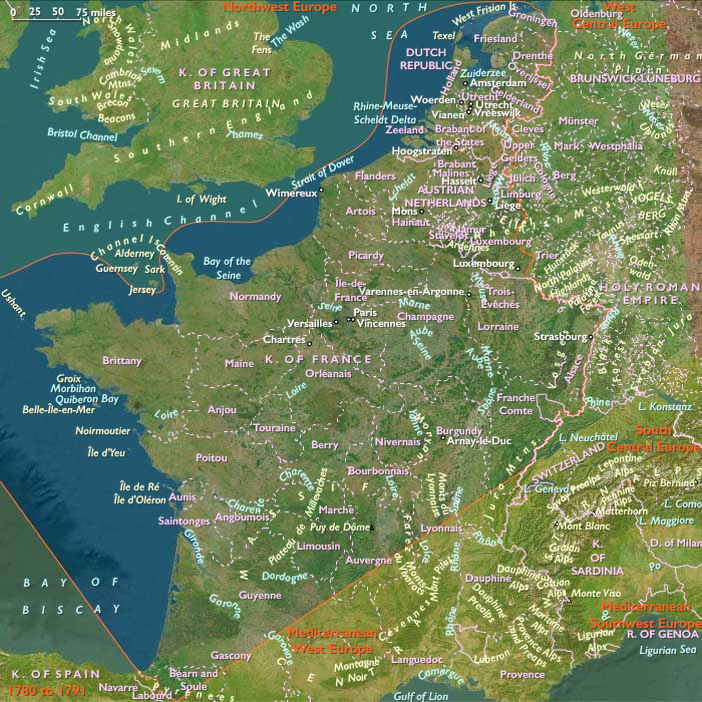
The painting depicts Lucius Junius Brutus, the Roman leader, grieving for his sons.
Brutus's sons had attempted to overthrow the government and restore the monarchy, so the father ordered their death to maintain the republic.
Thus, Brutus was the heroic defender of the republic, at the cost of his own family.
On the right, the Mother holds her two daughters, and the nurse is seen on the far right, in anguish.
Brutus sits on the left, alone, brooding, seemingly dismissing the dead bodies of his sons, and knowing what he did was best for his country, but the tense posture of his feet and toes reveals his inner turmoil.
The whole painting is a Republican symbol, and obviously has immense meaning during these times in France.
Images

Jacques-Louis David: The Lictors Bring to Brutus the Bodies of His Sons (1789); oil on canvas; 323 × 422 cm (127.2 × 166.1 in); Louvre Museum
Locations
Regions
West Europe
View →Subregions