Jacques Pantaléon, the son of a cobbler…
1264 CE
Jacques Pantaléon, the son of a cobbler of Troyes, France, had studied theology and common law in Paris and had been appointed a canon of Laon and later Archdeacon of Liège.
At the First Council of Lyon (1245) he had attracted the attention of Pope Innocent IV, who had sent him on two missions in Germany.
One of the missions had been to negotiate the Treaty of Christburg between the pagan Prussians and the Teutonic Knights.
He had become Bishop of Verdun in 1253, and in 1255, Pope Alexander IV had made him Patriarch of Jerusalem.
He had returned from Jerusalem, which was in dire straits, and was at Viterbo seeking help for the oppressed Christians in the East when Alexander IV died.
After a three-month vacancy, Pantaléon had been chosen by the eight cardinals of the Sacred College to succeed him in a papal election that concluded on August 29, 1261.
He had chosen the regnal name of Urban IV.
A fortnight before Urban IV's election, the Latin Empire of Constantinople, founded during the ill-fated Fourth Crusade against the Eastern Roman Empire, had been abolished after the recapture of the city by the Nicaean Greeks led by general Michael VIII Palaiologos.
Urban IV has endeavored without success to stir up a crusade to restore the Latin Empire.
He institutes the festival of Corpus Christi ("the Body of Christ") in 1264.
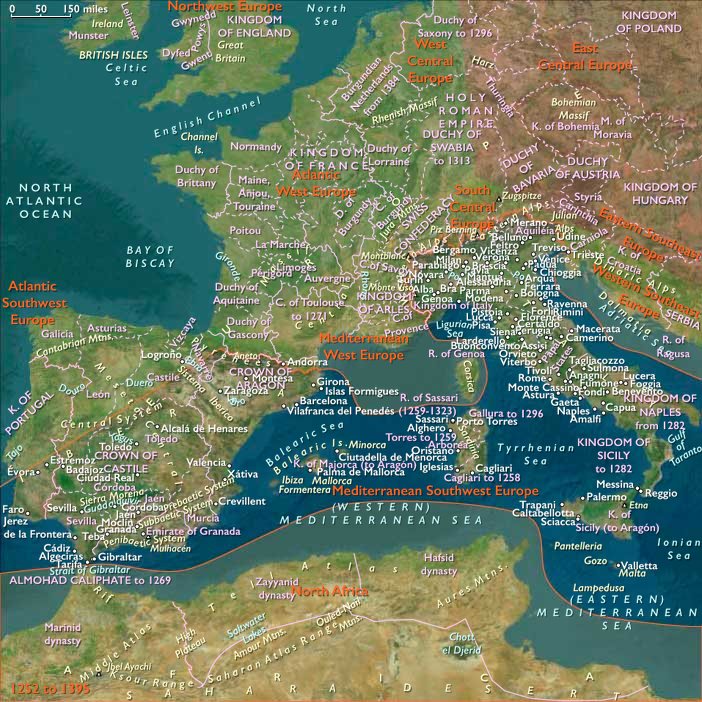
Italy commands Urban IV's near full attention: the long confrontation with the late Hohenstaufen German Emperor Frederick II had not been pressed during the mild pontificate of Alexander IV, during which it had devolved into interurban struggles between nominally pro-Imperial Ghibellines and even more nominally pro-papal Guelph factions.
Frederick II's heir Manfred is immersed in these struggles.
Urban IV's military captain is the condottiere Azzo d'Este, nominally at the head of a loose league of cities that includes Mantua and Ferrara.
Any Hohenstaufen in Sicily is bound to have claims over the cities of Lombardy, and as a check to Manfred, Urban IV has introduced Charles of Anjou into the equation to place the crown of the Two Sicilies in the hands of a monarch amenable to papal control.
Charles is Count of Provence by right of his wife, maintaining a rich base for projecting what will be an expensive Italian war.
For two years, Urban IV has negotiated with Manfred regarding whether Manfred would aid the Latins in regaining Constantinople in return for papal confirmation of the Hohenstaufen rights in the realm.
The papal pact had meanwhile solidified with Charles a promise of papal ships and men, produced by a crusading tithe, and Charles's promise not to lay claims on Imperial lands in northern Italy, nor in the Papal States.
Charles had promised to restore the annual census or feudal tribute due the Pope as overlord, some ten thousand ounces of gold being agreed upon, while the Pope would work to block Conradin, son of the late Conrad IV, from election as King of the Germans.
Before the arrival in Italy of his candidate Charles, Urban IV dies at Perugia on October 2, 1264.
His eventual successor, Pope Clement IV, will immediately take up the papal side of the arrangement.
Locations
People
Groups
Commodities
Subjects
Regions
Southwest Europe
View →Subregions