
Jean-Baptiste Dutrou-Bornier has tried to persuade France…
1876 CE to 1887 CE
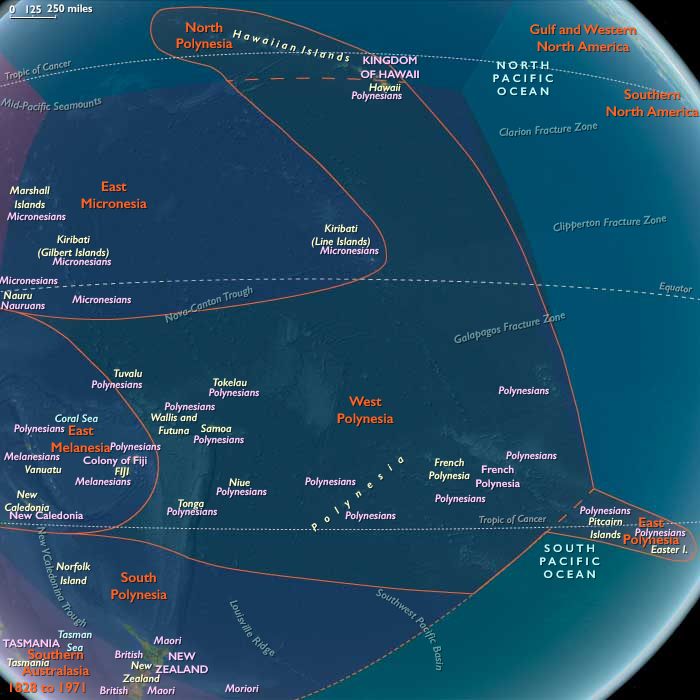
Jean-Baptiste Dutrou-Bornier has tried to persuade France to make Easter Island a protectorate, and has recruited a faction of Rapanui whom he has allowed to abandon their Christianity and revert to their previous faith.
With rifles, a cannon, and hut burning, he and his supporters have run the island for several years as "governor", appointing as Koreto Queen. (The title has no legitimacy behind it and is not recognized by the Rapanui or modern historians. He had seized Koreto, the wife of a Rapanui, in 1869 and married her.)
Dutrou-Bornier aims to cleanse the island of most of the Rapanui and turn the island into a sheep ranch.
He has bought up all of the island, apart from the missionaries' area around Hanga Roa, and had moved a couple hundred Rapanui to Tahiti to work for his backers.
In 1871, the missionaries, having fallen out with Dutrou-Bornier, had evacuated all but one hundred and seventy-one Rapanui to the Gambier islands.
Those who remained were mostly older men.
Six years later, there are just one hundred and eleven people living on Easter Island, and only thirty-six of them have any offspring.
Dutrou-Bornier is killed in 1876 in an argument over a dress, though his kidnapping of pubescent girls may also have motivated his killers.
The island's population will slowly recover from this point on and into the present day, but with over ninety-seven percent of the population having died or departed in less than a decade, much of the island's cultural knowledge has been lost.
To the present day, much of the island will be a ranch controlled from off-island, and for more than a century real power on the island will usually be exercised by resident non-Rapanui living at Mataveri, on the Chilean mainland.
An unusual number of shipwrecks has left the island better supplied with wood than for many generations, while legal wrangles over his land deals are to complicate the island's history for decades to come.
Neither Dutrou-Bornier's first wife back in France, who is heir under French law, nor his second wife on the island, who briefly installs their daughter Caroline as Queen, are to keep much from his estate.
Dutrou-Bornier had served as an artillery officer in the Crimean War, and by 1860 had become a master mariner.
He had abandoned his wife and young son in France, and in 1865 had bought a one-third share in the schooner Tampico.
He had sailed to Peru, where he was arrested, accused of arms-dealing and sentenced to death.
Released on the intervention of the French consul, he had then sailed to Tahiti, where he began recruiting labor from the islands of East Polynesia for coconut plantations.
In November 1866, Dutrou-Bornier had transported two missionaries, Kaspar Zumbohm and Theodore Escolan, to Easter Island.
He had visited the island again in March 1867 to recruit laborers, but he then amassed huge gambling debts and, as a result of some fraudulent deals, forfeited his share of the Tampico.
He acquired the yacht Aora'i, and had arrived on Easter Island in April 1868, where the yacht was burnt.
He had set up residence at Mataveri, began buying up land from the Rapanui.
Locations
Commodities
Regions
Polynesia
View →Subregions
