
Joan Dusai, the noted doctor of laws, …
Years: 1461 - 1461
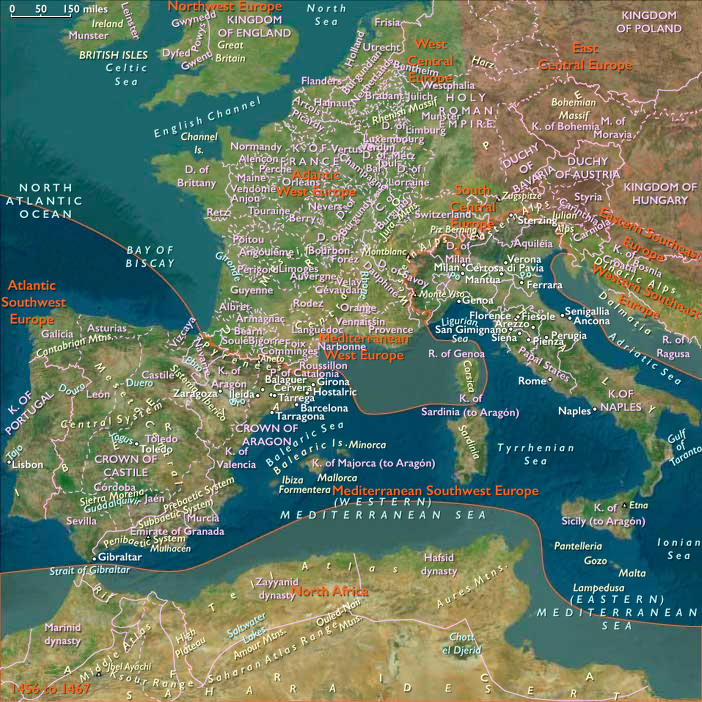
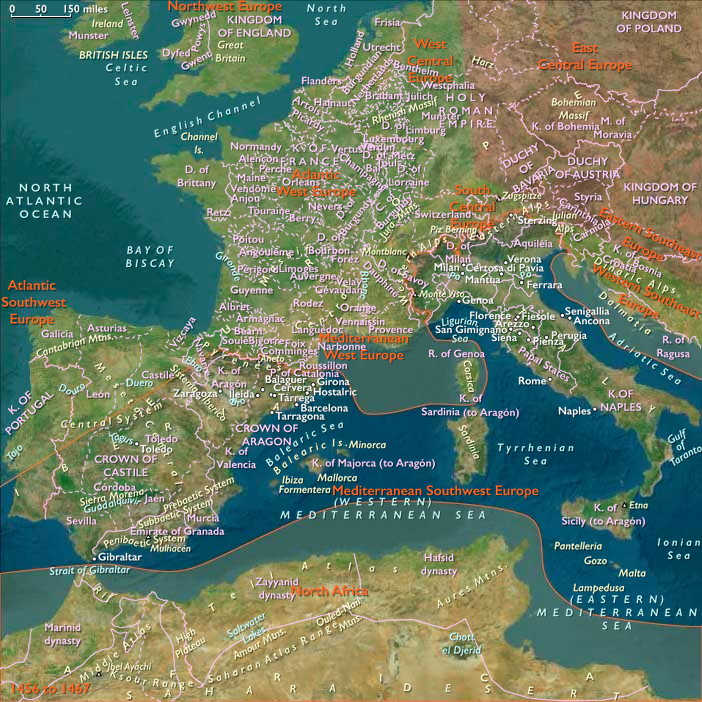
Joan Dusai, the noted doctor of laws, rules at the parliament, that King John II has violated four of the Usatges de Barcelona, four of the Constitucions de Catalunya, and the Furs de Lleida.
The parliament now demands that John name Charles as his first-born son and heir.
This he refuses, and the parliament assembles an army under the Count of Modica.
The army quickly captures Fraga and John capitulates in February.
He frees Charles on February 25, and, on June 21, signs the Capitulation of Vilafranca, whereby Charles is recognized as his first-born son, lieutenant in perpetuity, and heir in all his realms.
The king also surrenders his right to enter the Principality of Catalonia without the permission of the Generalitat.
He is also forced to surrender royal prerogatives.
The appointment of royal officials is to be done only on the advice of representative bodies.
The treaty is a victory for the Catalanists (who stress Catalan independence and preeminence), pactists (who stress the relationship between monarch and Catalonia as a mutual agreement), and the foralists (who stress the ancient privileges, the fueros, of Catalonia).
Charles dies of tuberculosis in Barcelona on 23 September, a fact that threatens the treaty of June.
While Charles had inspired unity, his death sparks the reemergence of factionalism.
Though the treaty allows for the young Ferdinand, only nine years old, to succeed John, Ferdinand's mother is conspiring with the Busca against the Biga to have the treaty overturned.
Locations
People
Groups
- Navarre, Kingdom of
- Burgundy, Duchy of
- Castile, Kingdom of
- Aragón, Kingdom of
- Castile, Crown of
- France, (Valois) Kingdom of
- Anjou, Duchy of
- Naples, Aragonese Kingdom of
- England, (Plantagenet, Yorkist) Kingdom of
Commodoties
Subjects
Regions
Subregions
Related Events
Showing 10 events out of 41234 total
Years: 1461 - 1461
Locations
People
Groups
- Navarre, Kingdom of
- Burgundy, Duchy of
- Castile, Kingdom of
- Aragón, Kingdom of
- Castile, Crown of
- France, (Valois) Kingdom of
- Anjou, Duchy of
- Naples, Aragonese Kingdom of
- England, (Plantagenet, Yorkist) Kingdom of
Commodoties
Subjects
Regions
Subregions