
Johan van Oldenbarnevelt had studied law at…
1578 CE
Johan van Oldenbarnevelt had studied law at Louvain, Bourges, and Heidelberg (where his ultimate conversion to Protestantism first germinated) and, probably, Padua.
After his return to the Netherlands he had settled down as an advocaat (“counsel”) at the Hof van Holland, roughly speaking, the court of appeal for the province of that name, established at The Hague.
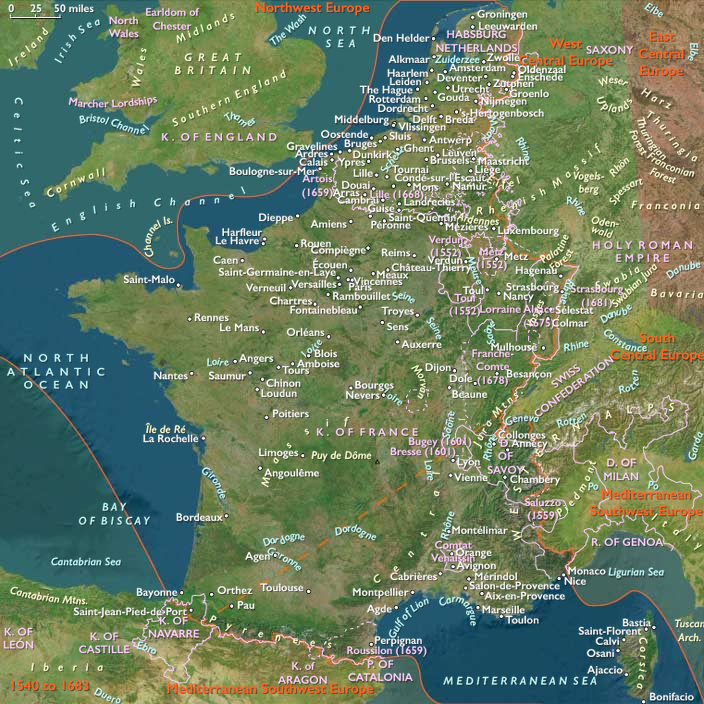
When, in 1572, two of the Netherlands provinces, Holland and Zeeland, succeeded in shaking off the Spanish rule from Brussels, the twenty-five-year-old Oldenbarnevelt had not followed the Court of Appeal, which fled to Utrecht, but had decided instead to throw in his lot with the movement of national liberation.
He had even taken part in an attempt to relieve the besieged towns of Haarlem and Leiden.
He had in 1576 been appointed pensionary (strictly, legal adviser, but as a full-time job) of Rotterdam, an office that automatically implies membership of the provincial states (assemblies), and, when the national revolt spreads to the other provinces, frequent attendance at the States-General in Brussels or Antwerp.
When in 1578 a total reconquest by the Spanish armies under the leadership of Alessandro Farnese, duke of Parma, threatens, Oldenbarnevelt is one of the negotiators of the proposed Union of Utrecht.
During the negotiations, it becomes apparent that Oldenbarnevelt is aiming at securing for Holland the politically unassailable position to which the strategically all-but-unassailable province considers itself entitled after having borne the brunt of the revolt alone with Zeeland for nearly seven years.
These activities also bring him into fairly close contact with William the Silent.
People
Topics
Commodities
Subjects
Regions
West Europe
View →Subregions
