
Johannes Oecolampadius was born in Weinsberg, at…
1525 CE
Johannes Oecolampadius was born in Weinsberg, at that time part of the Electorate of the Palatinate.
He had attended school at Weinsberg and Heilbronn, then, intending to study law, has gone to Bologna, but soon returned to Heidelberg and took up theology.
Enthusiastic about the new learning, he had passed from the study of Greek to that of Hebrew, in 1503 taking his bachelor's degree.
He had become cathedral preacher at Basel in 1515, serving under Christoph von Utenheim, the humanist bishop of Basel, where he became an editorial assistant and Hebrew consultant to Erasmus' first edition of the Greek New Testament, and wrote that edition's epilogue in praise of his master.
From the beginning, the sermons of Oecolampadius had centered on the atonement, and his first reformatory zeal showed itself in a protest (De risu paschali, 1518) against the introduction of humorous stories into Easter sermons.
He published his Greek Grammar in 1520.
He had received an invitation in the same year to become preacher in the high church in Augsburg.
Germany was ablaze with the questions raised by Martin Luther's theses, and Oecolampadius's introduction into this environment, when he championed Luther's position, especially in his anonymous Canonici indocti (1519), seems to have compelled him to severe self-examination, which ended in his becoming a monk.
A short experience had persuaded him that this was not for him the ideal Christian life ("amisi monachum, inveni Christianum" — "I have lost the monk; I have found the Christian"), and in February 1522 he had made his way to Ebernburg, near Creuznach, where he acted as chaplain to a little group of men holding the new opinions who had settled there under the leadership of Franz von Sickingen.
Oecolampadius had returned to Basel in November 1522, as vicar of St Martin's, and in 1523 had become reader of the Holy Scripture at the University of Basel.
Lecturing on Isaiah, he had condemned current ecclesiastical abuses, and in a public disputation on August 20, 1523, had gained such success that Erasmus, writing to Zürich said, "Oecolampadius has the upper hand amongst us."
He had become Huldrych Zwingli's assistant, and after more than a year of earnest preaching and four public disputations in which the popular verdict had gone in favor of Oecolampadius and his friends, the authorities of Basel have begun to see the need for Reformation.
Oecolampadius is at last able to refrain from some practices he believed to be superstitious.
Basel is slow to accept the Reformation; the news of the Peasants' War and the inroads of Anabaptists prevent progress; but by 1525, it seems as if the authorities are resolved to listen to schemes for restoring the purity of worship and teaching.
People
Groups
Regions
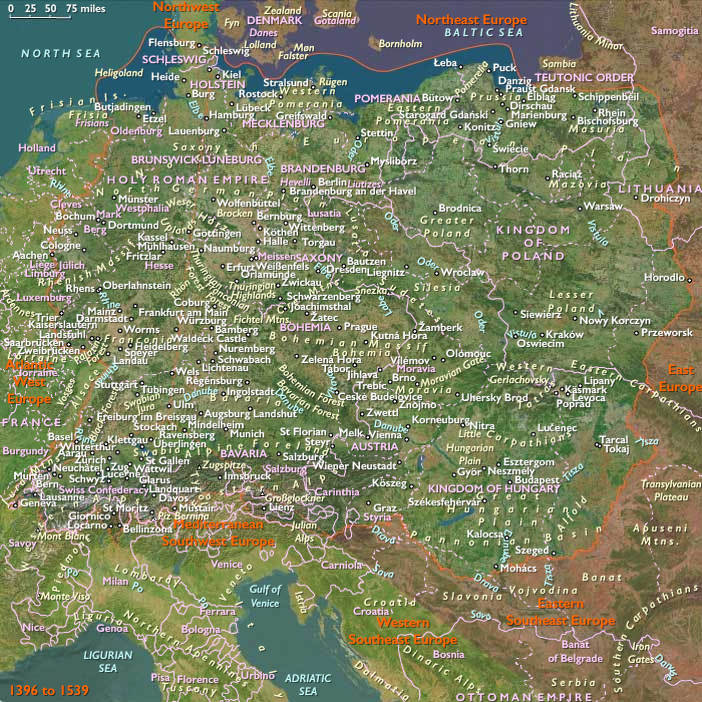
Central Europe
View →Subregions
