
John Constable was born in East Bergholt,…
1803 CE
John Constable was born in East Bergholt, a village on the River Stour in Suffolk, to Golding and Ann (Watts) Constable.
His father is a wealthy corn merchant, owner of Flatford Mill in East Bergholt and, later, Dedham Mill in Essex.
Golding Constable also owns his own small ship, The Telegraph, which he moors at Mistley on the Stour estuary and uses to transport corn to London.
He was a cousin of the London tea merchant, Abram Newman.
Although Constable is his parents' second son, his older brother is mentally handicapped and so John is expected to succeed his father in the business, and after a brief period at a boarding school in Lavenham, he had been enrolled in a day school in Dedham.
Constable worked in the corn business after leaving school, but his younger brother Abram eventually took over the running of the mills.
In his youth, Constable had embarked on amateur sketching trips in the surrounding Suffolk and Essex countryside that is to become the subject of a large proportion of his art.
He was introduced to George Beaumont, a collector, who showed him his prized Hagar and the Angel by Claude Lorrain, which had inspired Constable.
Later, while visiting relatives in Middlesex, he had been introduced to the professional artist John Thomas Smith, who advised him on painting but also urged him to remain in his father's business rather than take up art professionally.
In 1799, Constable had persuaded his father to let him pursue art, and Golding had even granted him a small allowance.
Entering the Royal Academy Schools as a probationer, he had attended life classes and anatomical dissections as well as studying and copying Old Masters.
Among works that particularly inspired him during this period were paintings by Thomas Gainsborough, Claude Lorrain, Peter Paul Rubens, Annibale Carracci and Jacob van Ruisdael.
He also read widely among poetry and sermons, and later proved a notably articulate artist.
By 1803, he is exhibiting paintings at the Royal Academy.
In 1802 he had refused the position of drawing master at Great Marlow Military College, a move which Benjamin West (then master of the RA) counseled would mean the end of his career.
In that year, Constable had written a letter to John Dunthorne in which he spelled out his determination to become a professional landscape painter.
His early style has many of the qualities associated with his mature work, including a freshness of light, color and touch, and reveals the compositional influence of the Old Masters he had studied, notably of Claude Lorrain.
Constable's usual subjects, scenes of ordinary daily life, are unfashionable in an age that looks for more romantic visions of wild landscapes and ruins.
He does, however, make occasional trips further afield.
For example, in 1803 he spends almost a month aboard the East Indiaman ship Coutts as it visits southeast coastal ports.
Images

Dedham Vale (1802) oil on canvas, Victoria and Albert Museum, London.
Regions
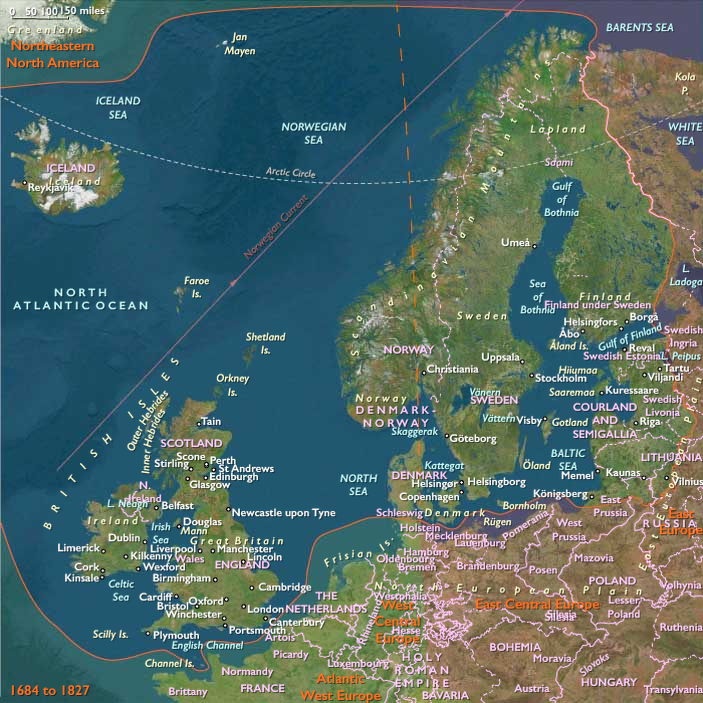
North Europe
View →Subregions
