John Henry Newman, the eminent and controversial…
October 1845 CE
After a furor in which the eccentric John Brande Morris preached for him in St Mary's in September 1839, Newman had begun to think of moving away from Oxford.
One plan that surfaced was to set up a religious community in Littlemore, outside the city of Oxford.
Since accepting his post at St. Mary's, Newman had had a chapel (dedicated to Sts. Nicholas and Mary) and school built in the parish's neglected area.
Newman's mother had laid the foundation stone in 1835, based on a half-acre plot and £100 given by Oriel College.
Newman had planned to appoint Charles Pourtales Golightly, an Oriel man, as curate at Littlemore in 1836.
However, Golightly had taken offense at one of Newman's sermons, and joined a group of aggressive anti-Catholics.
Thus, Isaac Williams became Littlemore's curate instead, succeeded by John Rouse Bloxam from 1837 to 1840, during which the school opened.
William John Copeland has acted as curate from 1840.
Newman had continued as a High Anglican controversialist until 1841, when he published Tract 90, which proved the last of the series.
This detailed examination of the Thirty-Nine Articles suggested that their framers directed their negations not against Catholicism's authorized creed, but only against popular errors and exaggerations.
Though this was not altogether new, Archibald Campbell Tait, with three other senior tutors, denounced it as "suggesting and opening a way by which men might violate their solemn engagements to the university."
Other heads of houses and others in authority joined in the alarm. At the request of Richard Bagot, the Bishop of Oxford, the publication of the Tracts came to an end.
Newman also resigned the editorship of the British Critic and was henceforth, as he later described it, "on his deathbed as regards membership with the Anglican Church".
He now considered the position of Anglicans to be similar to that of the semi-Arians in the Arian controversy.
The joint Anglican-Lutheran bishopric set up in Jerusalem was to him further evidence that the Church of England was not apostolic.
In 1842 Newman had withdrawn to Littlemore with a small band of followers, and lives in semi-monastic conditions.
The first to join him there was John Dobree Dalgairns.
Others are William Lockhart on the advice of Henry Manning, Ambrose St John in 1843, and Frederick Oakeley and Albany James Christie in 1845.
The group had adapted buildings in what is now College Lane, Littlemore, opposite the inn, including stables and a granary for stage coaches.
Newman calls it "the house of the Blessed Virgin Mary at Littlemore" (now Newman College).
This "Anglican monastery" had attracted publicity, and much curiosity in Oxford, which Newman tried to downplay, but some nicknamed it Newmanooth (from Maynooth College).
Some Newman disciples wrote about English saints, while Newman himself worked to complete an Essay on the development of doctrine.
In February 1843, Newman published, as an advertisement in the Oxford Conservative Journal, an anonymous but otherwise formal retractation of all the hard things he had said against Roman Catholicism.
Lockhart became the first in the group to convert formally to Catholicism.
Newman had preached his last Anglican sermon at Littlemore, the valedictory "The parting of friends" on September 25, and had resigned the living of St Mary's, although he did not leave Littlemore for two more years, until his own formal reception into the Catholic Church.
An interval of two years then elapsed before Newman is received into the Roman Catholic Church on October 9, 1845 by Dominic Barberi, an Italian Passionist, at the college in Littlemore.
The personal consequences for Newman of his conversion are great: he suffers broken relationships with family and friends, attitudes to him within his Oxford circle becoming polarized.
The effect on the wider Tractarian movement is still debated, since Newman's leading role is regarded by some scholars as overstated, as is Oxford's domination of the movement as a whole.
Tractarian writings will have a wide and continuing circulation after 1845, well beyond the range of personal contacts with the main Oxford figures, and Tractarian clergy will continue to be recruited into the Church of England in numbers.
Locations
People
Groups
Subjects
Regions
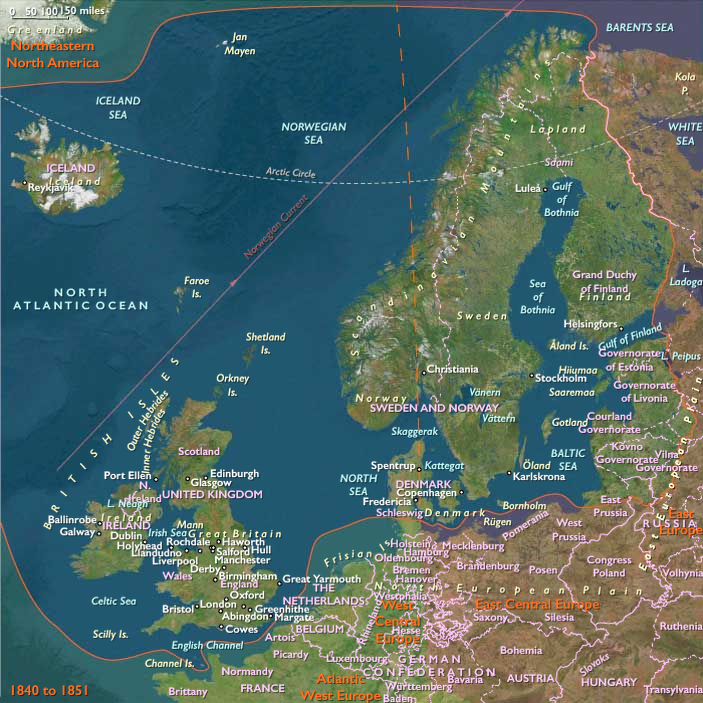
North Europe
View →Subregions