The Imprisonment and Disappearance of Arthur of…
1202 CE
The Imprisonment and Disappearance of Arthur of Brittany (1202–1203 CE)
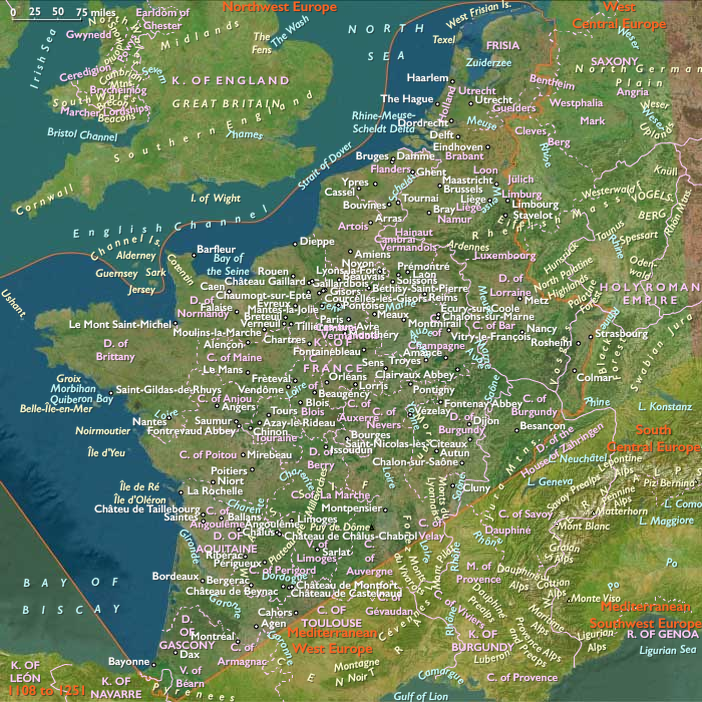
Following his capture at Mirebeau on August 1, 1202, Arthur of Brittany was imprisoned by King John of England at the Château de Falaise in Normandy, under the guard of Hubert de Burgh. His captivity marked the final collapse of his claim to the Angevin inheritance, but his fate remains one of the great historical mysteries of the medieval period.
Arthur’s Imprisonment at Falaise (1202–1203)
- At Château de Falaise, Arthur was closely guarded by Hubert de Burgh, a loyal officer of John.
- According to Ralph of Coggeshall, John ordered two of his servants to mutilate Arthur, likely intending to blind or castrate him, making him unfit to rule.
- Hubert de Burgh refused to carry out the order, sparing Arthur from physical disfigurement.
Arthur’s Transfer to Rouen and His Mysterious Disappearance (April 1203)
- In early 1203, Arthur was transferred from Falaise to Rouen, placed under the charge of William de Braose, another of John’s trusted vassals.
- By April 1203, Arthur vanished from historical records, and his fate remains unknown.
Theories on Arthur’s Death
Since no official record of Arthur’s execution exists, various chroniclers provide conflicting accounts of his demise:
-
Murder by John’s Own Hand
- The most famous account, reported by later chroniclers such as William de Braose’s wife, claims that John personally killed Arthur in a drunken rage, stabbing him and throwing his body into the Seine.
-
Secret Execution at Rouen
- Other sources suggest that John ordered Arthur to be quietly executed in Rouen, possibly by strangulation or starvation.
-
Escape or Long-Term Imprisonment
- Some rumors spread that Arthur escaped or was secretly kept alive, but no credible evidence ever emerged.
Consequences of Arthur’s Disappearance
- Arthur’s death (whether by execution or other means) shocked France, leading Philip II to declare John guilty of murder and confiscate Normandy in 1204.
- William de Braose, who had guarded Arthur in Rouen, later fell out with John, and his wife openly accused John of killing his nephew with his own hands.
- Arthur’s disappearance solidified John’s reputation as a tyrant, further alienating his French and English vassals, contributing to the eventual collapse of Angevin rule in France.
The vanishing of Arthur of Brittany in April 1203 remains one of the most infamous medieval mysteries, marking a turning point in the decline of John’s power and the dissolution of the Angevin Empire.
Locations
People
Groups
Commodities
Subjects
Regions
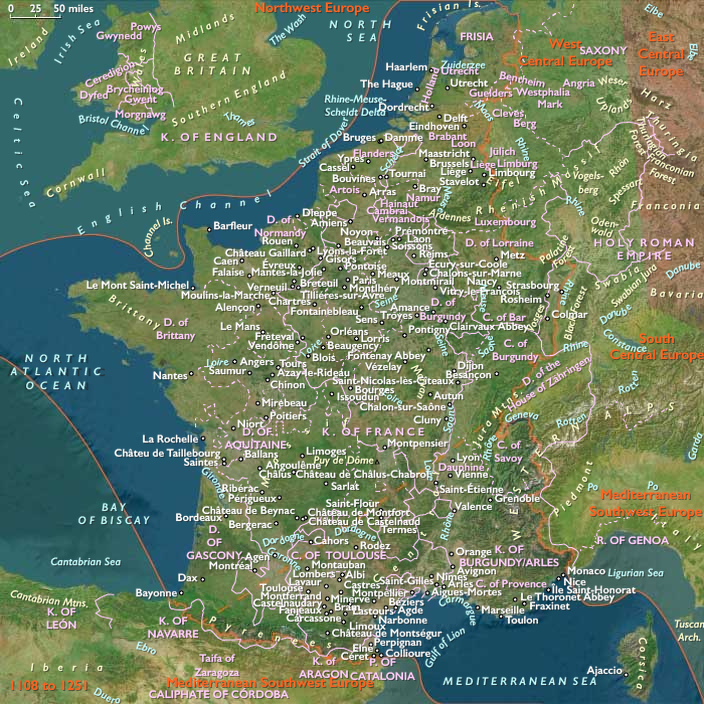
West Europe
View →Subregions