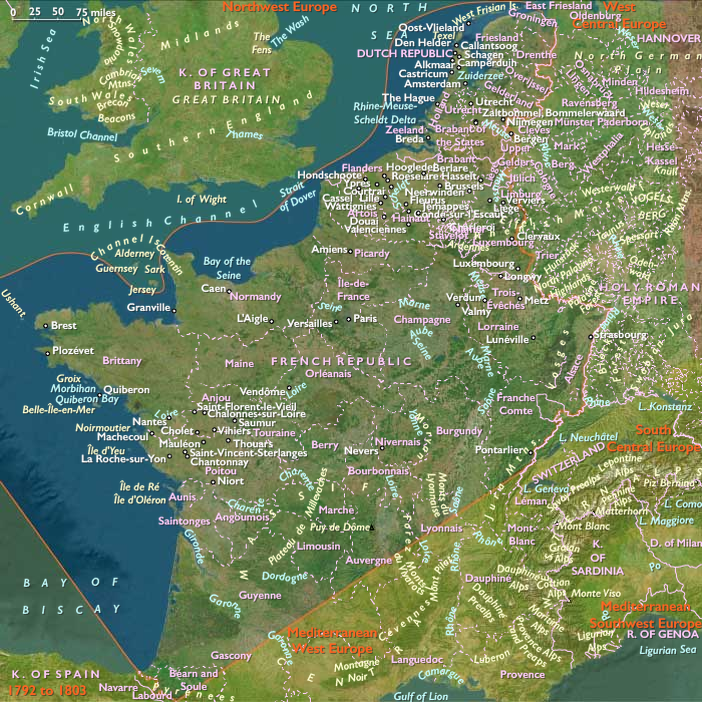
Joseph Fouché had been strongly in favor…
November 1793 CE
Joseph Fouché had been strongly in favor of the king's immediate execution, and had denounced those who wavered.
The crisis that resulted from the declaration of war by the Convention against Great Britain and the Dutch Republic (February 1793) and a little later against Spain, had made Fouché famous as one of the Jacobin radicals holding power in Paris.
While the armies of the First Coalition threaten the northeast of France, a revolt of the Royalist peasants in Brittany and La Vendée menaces the Convention on the west.
That body had sent Fouché with a colleague, Villers, as representatives on mission invested with almost dictatorial powers for the crushing of the revolt of "the whites" (the royalist color).
The vigor with which he had carried out these duties has earned him a reputation, and he soon holds the post of commissioner of the republic in the département of the Nièvre.
Together with Pierre Gaspard Chaumette, he helps to initiate the dechristianization (a term first coined by its enemies) movement in the autumn of 1793.
In the Nièvre department, Fouché ransacks churches, sends their valuables to the treasury, and helps establish the Cult of Reason.
He orders the words "Death is an eternal sleep" to be inscribed over the gates to cemeteries.
He also fights luxury and wealth, wanting to abolish the use of currenc
Fouché was born in Le Pellerin, a small village near Nantes.
His mother was Marie Françoise Croizet (1720–1793), and his father was Julien Joseph Fouché (1719–1771).
Educated at the college of the Oratorians at Nantes, had had shown aptitude for literary and scientific studies.
Wanting to become a teacher, he had been sent to an institution kept by brethren of the same order in Paris, where he had made rapid progress, and was soon appointed to tutorial duties at the colleges of Niort, Saumur, Vendôme, Juilly and Arras.
At Arras, he had had some encounters with Maximilien Robespierre both before the revolution and in the early days of the French Revolution (1789).
In October 1790, he had been transferred by the Oratorians to their college at Nantes, in an attempt to control his advocacy of revolutionary principles—however, Fouché became even more of a democrat.
His talents and anti-clericalism had brought him into favor with the population of Nantes, especially after he became a leading member of the local Jacobin Club.
When the college of the Oratorians was dissolved in May 1792, Fouché gave up the church, whose major vows he had not taken.
After the downfall of the monarchy on August 10, 1792 (following the storming of the royal Tuileries Palace), he was elected as deputy for the départment of the Loire-Inférieure to the National Convention—which met on 22 September and proclaimed the French Republic.
Fouché's interests had brought him into contact with the Marquis de Condorcet and the Girondists, and he had become a Girondist himself.
However, their lack of support for the trial and execution of King Louis XVI (December 1792 - January 21, 1793) has led him to join the Jacobins, the more decided partisans of revolutionary doctrine.
Locations
Topics
Regions
West Europe
View →Subregions