Joseph L. Proust's best known work is…
1799 CE
Joseph L. Proust's best known work is derived from a controversy with chemist Claude Louis Berthollet, who did not believe that substances always combine in constant and definite proportions as Proust did.
Proust eventually is able to prove Berthollet wrong in 1799 and publishes his own hypothesis.
Proust’s largest accomplishment in the realm of science is disproving Berthollet with the law of definite proportions, which is sometimes also known as Proust's Law.
Proust has studied copper carbonate, the two tin oxides, and the two iron sulfides to prove this law, doing so by making artificial copper carbonate and comparing it to natural copper carbonate.
With this experiment, he had shown that each had the same proportion of weights between the three elements involved (Cu, C, O).
Between the two types of the other compounds, Proust had shown that no intermediate indeterminate compounds exist between them.
Proust had published this paper in 1794, but the law will not be accepted until 1811, when the Swedish chemist Jöns Jacob Berzelius gives him credit for it.
There are, however, exceptions to the Law of Definite Proportions.
An entire class of substances that does not follow this rule are called non-stoichiometric compounds, or Berthollides, after Berthollet.
The ratio of the elements present in the compound can fluctuate within certain limits, such as in the example of Ferrous oxide.
The ideal formula is FeO, but due to crystallographic vacancies it is reduced to about Fe0.95O.
Proust is also interested in studying the sugars that are present in sweet vegetables and fruits.
Proust demonstrates how the sugar in grapes is identical to that found in honey—this will later become known as glucose— to his class in Madrid in 1799.
Joseph had studied chemistry in his father’s shop and later went to Paris where he gained the appointment of apothecary in chief to the Salpetriere; he had also taught chemistry with Pilâtre de Rozier, a famous aeronaut.
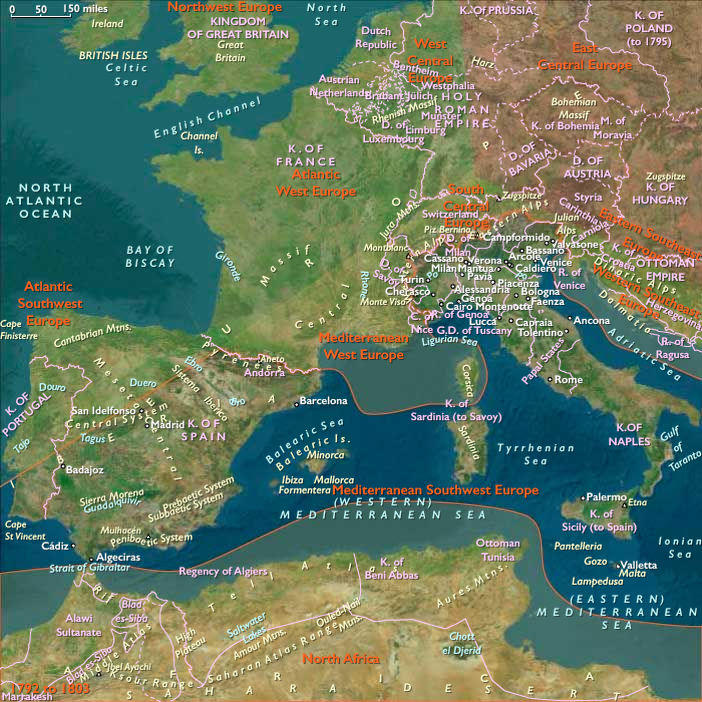
A the invitation of Charles IV, Proust had gone to Spain, where he teaches at the Chemistry School in Segovia and at the University of Salamanca.
Locations
Subjects
Regions
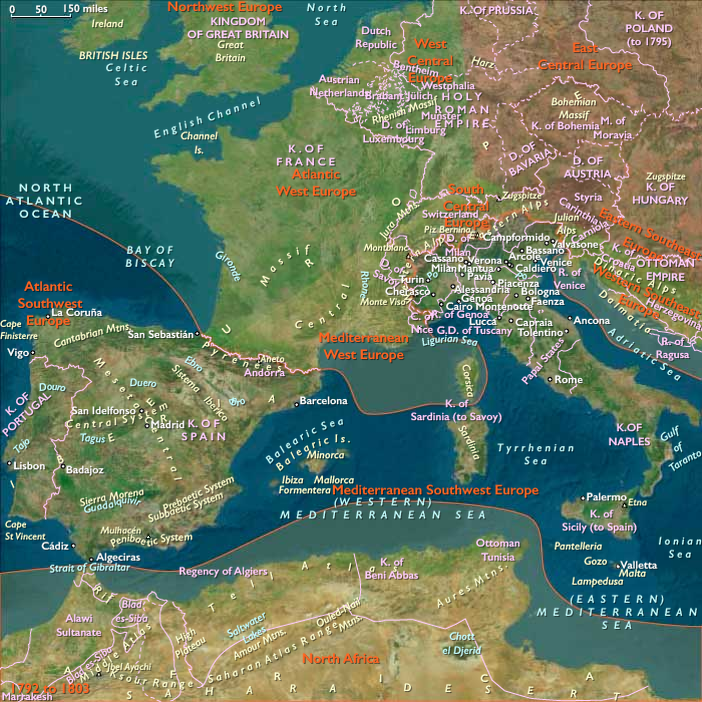
Southwest Europe
View →Subregions