
Judah Abravanel’s “Dialoghi d'Amore” (“Dialogues of Love”),…
1535 CE
Judah Abravanel’s “Dialoghi d'Amore” (“Dialogues of Love”), composed by 1502, are first published posthumously in 1535 to become one of the most widely circulated products of Renaissance Neoplatonism.
Locations
Groups
Regions
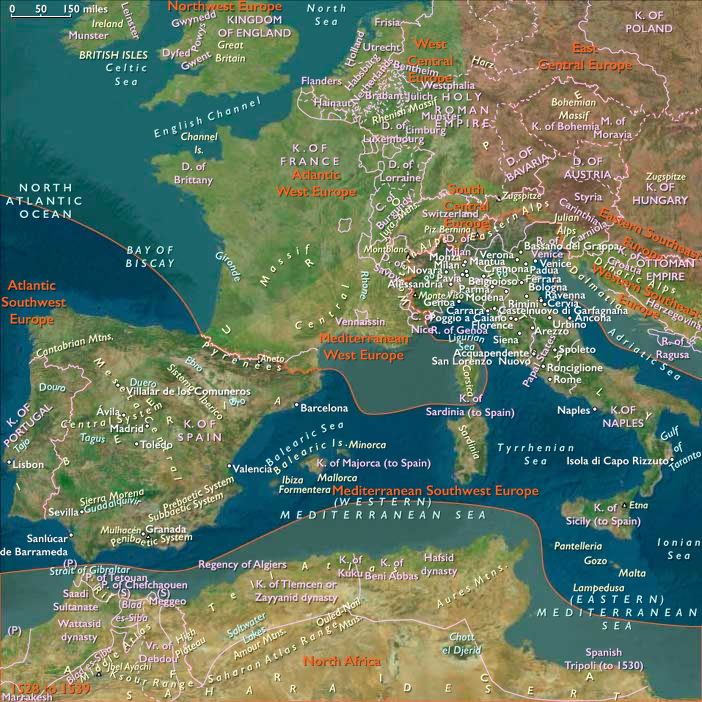
Southwest Europe
View →Subregions
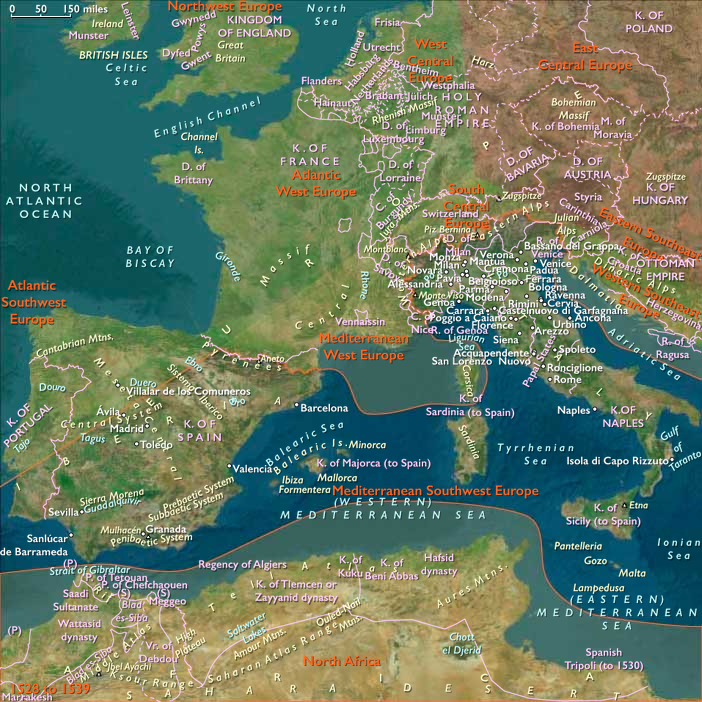
Mediterranean Southwest Europe
View →Related Events
No active filters.
Showing 10 events out of 37761 total
Ternate, in part as a result of its trade-dependent culture, was one of the earliest places in the region to which Islam spread, probably coming from Java in the late fifteenth century.
Initially restricted to Ternate's small ruling family, the new faith is spreading only slowly to the rest of the population.
The first Europeans to stay on Ternate were part of the Portuguese expedition of Francisco Serrão out of Malacca, which had been shipwrecked near Seram and rescued by local residents.
Sultan Abu Lais of Ternate heard of their stranding, and, seeing a chance to ally himself with a powerful foreign nation, brought them to Ternate in 1512.
The Portuguese had been permitted to build a fort (Kastella) on the island, construction of which began in 1522.
Relations between the Ternateans and Portuguese were strained from the start.
An outpost far from Europe generally only attracts the most desperate and avaricious, such that the generally poor behavior of the Portuguese, combined with feeble attempts at Christianization, have strained relations with Ternate's Muslim ruler, as have their efforts to monopolize the spice trade and dominate local politics.
The current ruler, Tabariji, is the son of Sultan Abulais and his first and primary wife, Nycili Boki Raja.
Nycili, the daughter of the king of Tidore, had inherited that realm from her father on his death in 1526.
Tabariji had been placed on the throne by his stepfather, Pati Serang, who then acted as regent.
In 1535, Tabariji is deposed by the Portuguese in favor of another brother and sent to Goa, where he soon converts to Christianity and takes as his baptismal name Dom Manuel.
Min Bin, within a year of his conquest of Bengal, had had to send a five thousand-strong army to Dhaka to defend against Tripuri raids.
After the rainy season of 1533, he personally led the army to drive out the Tripuri raiders.
He was successful, and returned to Mrauk-U on February 24, 1534.
Despite the success this time, Min Bin will never fully solve the problem of raids by Tripuris.
By Min Bin's reign, the Portuguese seamen and mercenaries have established themselves as a serious force in Asia.
They had seized trading ports of Goa since 1510 and Malacca since 1511, and controlled important sea lanes in South and Southeast Asia.
The Arakanese coastline had not escaped their raids, which by Min Bin's reign, have grown increasingly daring.
In 1535, the Portuguese bring war to the fortified capital of Mrauk-U itself.
According to Arakanese chronicles, a small but well-armed army of Portuguese mercenaries landed on February 22, 1535, and advanced to up the Kaladan river by boats, reaching Kandaza, a few miles away from Mrauk-U, by February 26.
After defeating an Arakanese force at Kandaza on February 27, the Portuguese then proceeded to attack Mrauk-U the following day.
With the king himself leading the defense, the Arakanese forces drive back the better armed but much smaller Portuguese army.
The Portuguese fall back to a few marches away, and stick around for another week until a combined army and flotilla of Arakanese forces drives them out to the sea on March 7.
Like many rulers in the region, Min Bin realized that the Portuguese problem is not going away, and decides to hire Portuguese mercenaries to his armed forces.
In the following years, Min Bin will enlist many Portuguese mercenaries and their firearms, and with their help, will establish well-armed naval and army forces.
To commemorate his victory in Bengal, Min Bin begins the construction of a massive temple complex that will become the Shitthaung Temple (eventually containing eighty thousand Buddha Images) on November 9, 1535.
The Lithuanian army under Hetman Radziwill, Andrei Nemirovich, Polish Hetman Jan Tarnowski, and Semen Belsky launches a powerful counterattack in 1535 and takes Homel and …
…Starodub.
A Danish-Swedish alliance, temporarily forged to combat the Hanseatic invaders, drives them from Copenhagen and ...
...Malmö and is eventually victorious over Lübeck.
While Christian III’s forces battle those of Count Christopher of Oldenburg in northern Jutland, Swedish forces, temporarily allied to Christian, besiege Malmö, ...
...Landskrona, and Zealand.
The Ottoman army takes Baghdad five months later, due in part to an unprecedented winter march to Mesopotamia by Süleyman.
This first major campaign against Persia waged by Süleyman has given the Ottomans control over the region of Erzurum in eastern Anatolia and witnesses the Ottoman conquest of Iraq, a success that rounds off the achievements of Süleyman’s father, Selim.
Under the Ottomans, Baghdad will continue into a period of decline, partially as a result of the enmity between its rulers and Iranian Safavids, who do not accept the Sunni control of the city.
The Persians had recaptured Tabriz in early 1535 while Süleyman’s forces occupied Baghdad, but the Turks, on their return to Istanbul later in the year, seize and sack it again.
Humayun, intent on expansion to the south and west, invades Malwa and Gujarat in 1535.
Seizing the forts of Mandu and Champaner, he drives Sultan Bahadur of Gujurat down the west coast to take refuge among the Portuguese.