
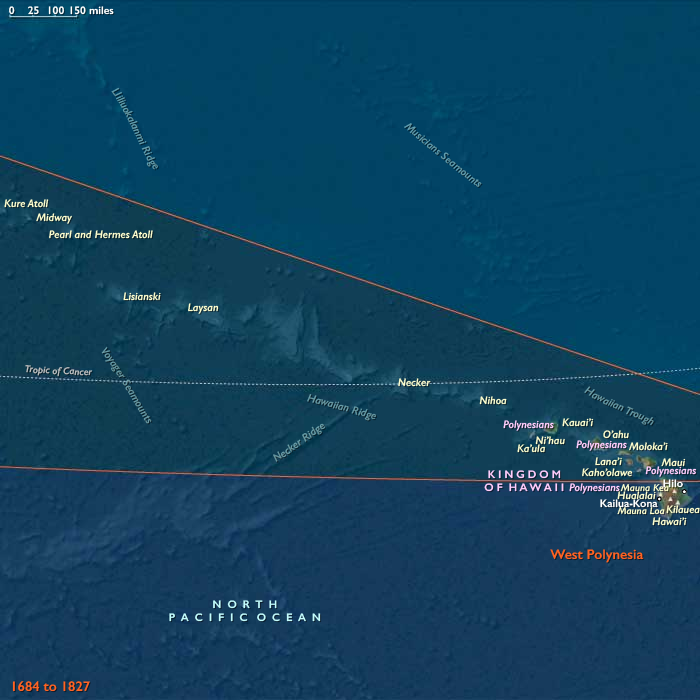
...Kaua'i in the Hawaiian Islands, which he…
November 1778 CE
...Kaua'i in the Hawaiian Islands, which he names the Sandwich Islands.
Locations
People
Topics
Subjects
Regions
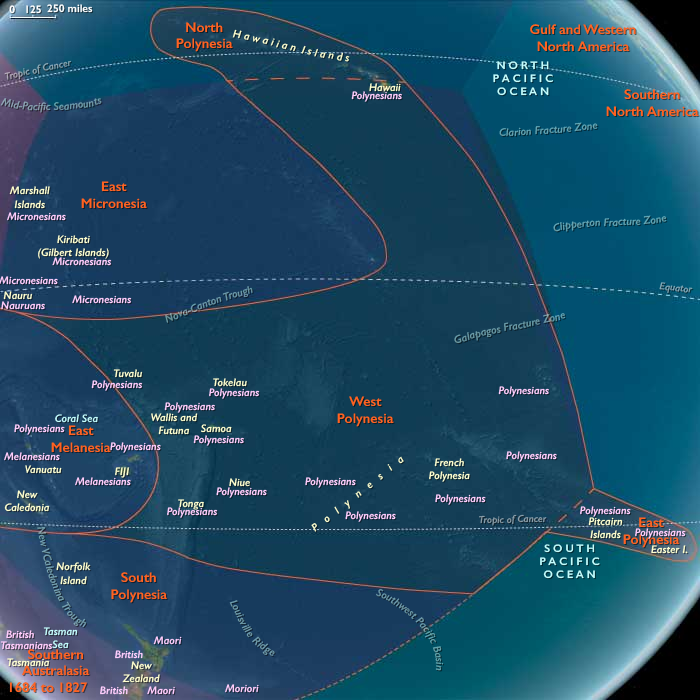
Polynesia
View →Subregions
North Polynesia
View →Related Events
No active filters.
Showing 10 events out of 25293 total
The British first reach the Pacific Northwest by sea in 1778, during James Cook's third voyage.
His exploration of the Pacific coast, Vancouver Island in particular, results in the beginnings of British participation in the Maritime Fur Trade.
While sailing north to search for the fabled Northwest Passage, Cook had discovered the Hawaiian Islands.
On the Northwest Coast, he spends a month in Nootka Sound, during which he and his crew trade with the Nuu-chah-nulth from the village of Yuquot.
They end up with over three hundred furs, mostly sea otter, but think them of no great value.
James Cook enters Prince William Sound in 1778 and names it Sandwich Sound, after his patron the Earl of Sandwich.
The editors of Cook's maps will later change the name to Prince William Sound, in honor of Prince William, who will later become King William IV.
The element molybdenum is not formally discovered and identified until 1778, when Scheele attacks pulverized molybdaina (now molybdenite, MoS2), long thought to be a lead ore or graphite, with concentrated nitric acid; he then evaporates the residue to dryness.
Scheele proves that the ore certainly contains sulfur and an oxide of, possibly, a previously unknown metal.
Danish physicians, on the king’s orders, move to open two major vaccination houses in Denmark in 1778.
The superimposition of a global struggle between European powers upon several localized Indian wars does unnerve the Company and seriously embarrass its presidencies.
Furthermore, the war exposes the rival geo-political ambitions of the French and these in turn provoke the more stolid, unreflecting British to formulate their own logic of empire.
When word reaches India in 1778 that France has entered the war, the British East India Company moves quickly to capture French colonial outposts there, notably capturing Pondicherry after two months of siege.
Johann Nikolaus von Hontheim, writing under the pseudonym of "Febronius", the chief German literary exponent of Gallican ideas of national Catholic Churches, is himself induced (not without scandal) publicly to retract his positions; but they are adopted in Austria nevertheless.
Neapolitan nurses inoculate infants in Italy in 1778 without the knowledge of their parents.
The British invoke a number of old treaties (1678, 1689, 1716) to have the Republic support them militarily, but as in the Seven Years' War the Dutch government refuses.
A Masonic Convention in Wilhelmsbad, a spa near Hanau, in 1782 (or Lyon in 1778?) organizes the Knights Beneficent of the Holy City, more commonly referred to as Chevaliers Bienfaisant de la Cité Sainte (CBCS).
The oldest order connected with freemasonry which has had a continuous existence, it is derived from the Rite of Strict Observance erected in 1754, the foundation of which was attributed to the late Baron von Hund; it propounds a theory that freemasonry was developed directly from the Crusading Templars, embodying a belief that the Order is ruled by ‘unknown superiors’.