
King Duras knowingly offers the kingship to…
87 CE
King Duras knowingly offers the kingship to Diurpaneus as a recognition of his diplomatic, military and leadership skills.
Diurpaneus accepts, dubbing himself Decebalus, meaning "with the strength of ten [men]" or simply "The Brave," and is crowned king of the Dacians.
Locations
Groups
Topics
Commodities
Subjects
Regions
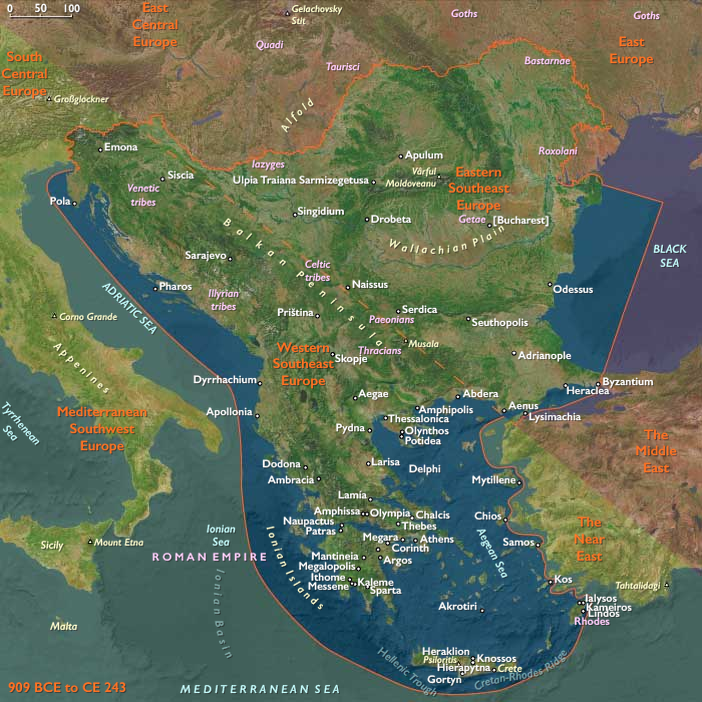
Southeast Europe
View →Subregions

Eastern Southeast Europe
View →Related Events
No active filters.
Showing 10 events out of 61498 total
Vestal Virgins are found in 87 to have broken their sacred vows of lifelong public chastity.
As the Vestals are regarded as daughters of the community, this offense essentially constitutes incest.
Accordingly, those found guilty of any such transgression are condemned to death, either by a manner of their choosing, or according to the ancient fashion, which dictates that Vestals should be buried alive.
Foreign religions are tolerated insofar as they do not interfere with public order, or could be assimilated with the traditional Roman religion.
The worship of Egyptian deities in particular flourishes under the Flavian dynasty, to an extent not seen again until the reign of Commodus.
Veneration of Serapis and Isis, who are identified with Jupiter and Minerva respectively, is especially prominent.
Fourth-century writings by Eusebius of Caesarea maintain that Jews and Christians were heavily persecuted toward the end of Domitian's reign.
The Book of Revelation is thought to have been written during this period.
However, no nonpartisan, secular convincing evidence exists of any widespread religious oppression under Domitian.
Although Jews are heavily taxed, no contemporary authors mention trials or executions based on religious offenses other than those within the Roman religion.
The Han-Xiongnu War war ends with the total victory of the Han empire over the Xiongnu state in 89 CE.
Small Scandinavian kingdoms are formed by various tribes, the most important of which, the Suiones (Svearna) in the Lake Malaren region, are mentioned by Tacitus in 98.
The Scandinavians share extensive trade with Rome from this point.
Emperor Domitian’s Dacian War concludes indecisively, and ends in a Romano-Dacian peace treaty.
Agricola, the Roman general responsible for much of the Roman conquest of Britain, is recalled to Rome by Domitian.
His successors are not named in any surviving source, but it seems they were unable or unwilling to further subdue the far north.
The Middle East: 88–99 CE
Consolidation of Parthian Authority and Continued Rivalries
The late first century witnesses continued Parthian political consolidation under Pacorus II, who, after securing power in about 78 CE, rules effectively until 105 CE. His lengthy reign offers a semblance of stability after prior periods of internal strife. Under Pacorus II, Parthian governance remains relatively stable, and he manages to curtail internal rebellions, maintaining Parthian territorial integrity and authority across Mesopotamia and Persia.
Meanwhile, the region continues to be defined by Roman-Parthian rivalry, particularly over Armenia. The Parthian policy of installing and supporting members of the Arsacid dynasty on the Armenian throne remains a constant irritant to Rome, which sees Armenia as a critical buffer state vital for protecting the Roman eastern frontier. Diplomatic exchanges and occasional skirmishes punctuate the relationship, but neither empire escalates tensions into full-scale war during this era.
The Parthian Empire under Pacorus II fosters an environment that sustains economic prosperity, notably benefiting from its strategic control of Silk Road routes linking the Mediterranean with East Asia. Trade flourishes, particularly in luxury goods like silk, spices, precious metals, and textiles, sustaining Mesopotamia as a vibrant economic crossroads.
Culturally, this era marks ongoing exchanges between Greco-Roman and Iranian traditions, although the earlier explicit rejection of Hellenistic customs under Vologases I is gradually softened by pragmatic policies that integrate diverse influences within the empire’s complex cultural tapestry.
Thus, from 88 to 99 CE, the Middle East experiences a period of relative internal stability under Parthian rule, while persistent diplomatic tensions and rivalries between Rome and Parthia continue to shape regional politics, laying the groundwork for continued geopolitical dynamics into the next century.
Near East (88–99 CE): Challenges to Orthodoxy and Consolidation of Rabbinic Authority
In the late first century CE, significant theological and organizational shifts shape religious communities across the Near East. Within emerging Christian circles, particularly those influenced by Hellenistic thought, a theological movement known as Docetism gains prominence. Docetists, influenced by Gnostic teachings, argue that Jesus Christ only appeared to have a physical body and did not truly suffer on the cross. Rooted in a dualistic worldview that regards matter as inherently evil, this belief system asserts that a divine being would never assume a genuine human form. These teachings provoke sharp opposition from mainstream Christian communities and are specifically addressed in texts such as the Johannine Epistles, composed in the Roman province of Asia (western Anatolia) around 95–110 CE. These epistles, traditionally attributed to the Apostle John, emphasize the incarnation of Christ as an essential doctrine and urge adherence to communal love and orthodoxy.
Simultaneously, in Jewish communities, the authority of Rabbinic Judaism continues to consolidate. Gamaliel of Jabneh, great-grandson of the earlier revered figure Gamaliel I, becomes head of the reconstituted Sanhedrin in Jabneh (Yavneh). Gamaliel significantly shapes religious practices by standardizing synagogue services and fixing the Jewish festival calendar. Notably, he petitions Roman Emperor Domitian in 95 CE to rescind an edict expelling Jews from the Roman Empire, reflecting ongoing Jewish negotiations with imperial authorities.
Legacy of the Era
The era from 88 to 99 CE marks critical theological and institutional consolidations within both Christian and Jewish communities. Docetist controversies compel early Christian leaders to clearly define orthodox doctrines of incarnation and redemption, significantly influencing later creeds and church teachings. Concurrently, Rabbinic Judaism, under influential leaders such as Gamaliel, strengthens its organizational and doctrinal foundations, ensuring the survival and continuity of Jewish religious life following the upheavals of the previous decades.
Some adherents of the growing Christian movement have begun to spiritualize Christ by denying his real humanity.
Docetist teachings concerning the person of Christ, based on a Hellenistic dualism that maintains that the material world is either unreal or positively evil, emerge in the later first century CE.
According to Docetism, the eternal Son of God did not really become human or suffer on the cross; he only appeared to do so.
Docetism is most commonly attributed to the Gnostics, many of whom believe that matter is evil, and as a result God would not take on a material body.
This statement is rooted in the idea that a divine spark is imprisoned within the material body, and that the material body is in itself an obstacle, deliberately created by an evil, lesser god (the demiurge) to prevent man from seeing his divine origin.
Docetism can be further explained as the view that since the human body is temporary and the spirit is eternal, the body of Jesus must have been an illusion and, likewise, his crucifixion.
Even so, saying that the human body is temporary has a tendency to undercut the importance of the belief in resurrection of the dead and the goodness of created matter, and is in opposition to this orthodox view.
Docetism is an aberrant form of early Christianity, developing around 50 CE, which is most prominently espoused by Gnostic sects.
Its origin within Christianity is obscure and it has been argued that its origins were in heterodox Judaism or Oriental and Grecian philosophies.
Some of the books of the New Testament condemn docetic teachings and the early creeds developed to counter docetic beliefs.
First-century Gnostic Christian groups develop docetic interpretations partly as a way to make Christian teachings more acceptable to pagan ways of thinking of divinity.
The Epistles of John (traditionally ascribed to John the Apostle), probably written in the Roman province of Asia (western Anatolia) toward the end of the first century CE or the beginning of the second, are addressed to a general readership rather than to specified churches or individuals.
These "Johannine Epistles" address the problem of Docetism several times.
The first epistle, written in Ephesus between the years 95–110, bears no indication of its authorship; the author of the second and third epistles styles himself "the elder."
The first, written to churches in Anatolia, conveys a series of standard tests by which people can know that they possess eternal life.
By the test of love, the true follower of Christ loves as Jesus loved.
The test of belief in the incarnation—that the eternal son of God, the second person of the Trinity, became man in the person of Jesus Christ—is meant to counter those, such as the Docetists, who claim special knowledge and deny that Christ came in the flesh.
The second epistle, a short note addressing the church as the "elect lady," cautions a local congregation against teachers claiming special knowledge and encourages members to be hospitable to one another.
The third epistle also brief, encourages Gaius, a follower of the truth, to display kindness to the traveling faithful who pass his way.
Gamaliel of Jabneh, a great-grandson of Gamaliel I who succeeds Johanan ben Zakkai as head of the Sanhedrin at Jabneh, organizes the synagogue service and standardizes the Jewish calendar, assigning fixed dates to festivals.
He petitions Emperor Domitian in 95 to rescind an edict expelling the Jews from the empire.
Christianity apparently comes in the late first century CE to the Illyrian-populated lands.
Writings attributed to Paul of Tarsus, the religion's founder, state that he preaches in the Roman province of Illyricum (and legend holds that he visited Durrës. Paul is said to have been born in Tarsus, perhaps around CE 10, and to have died at Rome in about 67, but there are no reliable sources for Paul's life outside the New Testament, in which the primary source is his own letters.)
Mediterranean Southwest Europe (88–99 CE): Domitian’s Authoritarianism and the Nerva Transition
The era 88–99 CE encompasses the later years of Emperor Domitian’s reign and the subsequent rise of Emperor Nerva, reflecting significant political shifts and enduring cultural developments within the Roman Empire.
Domitian’s Increasing Authoritarianism
By the late 80s CE, Domitian exhibits increasingly authoritarian and paranoid behavior, implementing severe measures against perceived political threats. His reign becomes marked by suspicion, extensive use of informants, and heightened senatorial persecution, deeply alienating Rome’s political elite.
Despite his authoritarian governance, Domitian continues significant administrative and infrastructural projects, including urban renewal and strengthening frontier defenses. These efforts reflect his commitment to maintaining imperial stability, albeit through increasingly oppressive means.
Domitian’s Assassination (96 CE)
In 96 CE, Domitian’s increasingly tyrannical rule culminates in his assassination through a conspiracy involving court officials and members of the Praetorian Guard. His death concludes the Flavian dynasty and ushers in a critical transitional period, demonstrating the volatility of imperial succession and the empire’s susceptibility to internal strife.
Rise of Nerva and Restoration of Stability
Following Domitian’s assassination, the Senate swiftly elevates the respected elder statesman Nerva as emperor. Nerva’s reign, beginning in 96 CE, marks a return to moderate governance, prioritizing reconciliation and political stability after the turmoil of Domitian’s final years.
Nerva initiates critical reforms aimed at restoring senatorial privileges, improving public welfare, and stabilizing financial administration. His conciliatory and balanced leadership significantly restores public and senatorial trust in imperial governance.
Cultural Continuity and Literary Developments
Culturally, the era continues to thrive, reflecting Rome’s resilience despite political uncertainties. Literary activity flourishes under Nerva’s brief but stabilizing rule, sustaining Rome’s rich intellectual tradition. Historians and writers of the period document and analyze these dramatic political transitions, shaping historical perspectives for subsequent generations.
Adoption of Trajan and Securing Imperial Succession
In a decisive political move, Nerva adopts the competent and popular general Trajan as his successor in 97 CE. This adoption establishes a precedent for choosing emperors based on merit rather than hereditary succession, significantly influencing imperial succession practices and future stability.
Legacy of the Era
The period 88–99 CE, marked by Domitian’s authoritarian final years and the stabilizing transition under Nerva, profoundly impacts Roman governance and succession traditions. The reforms initiated during this era, coupled with cultural continuity, lay crucial foundations for Rome’s subsequent imperial success and societal resilience.