
King Edward III bestows upon his sons…
1362 CE
King Edward III bestows upon his sons the first ducal coronets (smaller gold crowns that, in England, come to be worn by the five orders of nobility under the king: dukes, marquesses, earls, viscounts, and barons) in 1362.
People
Regions
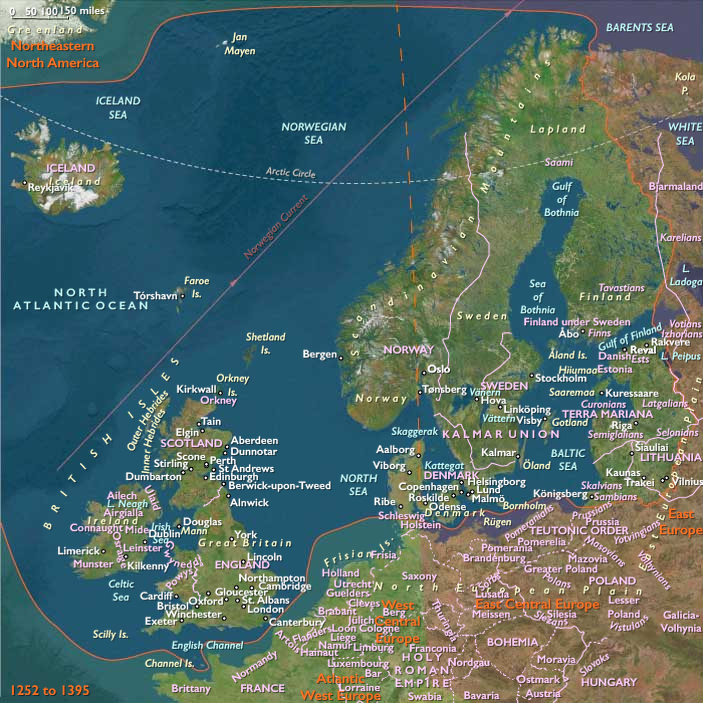
North Europe
View →Subregions
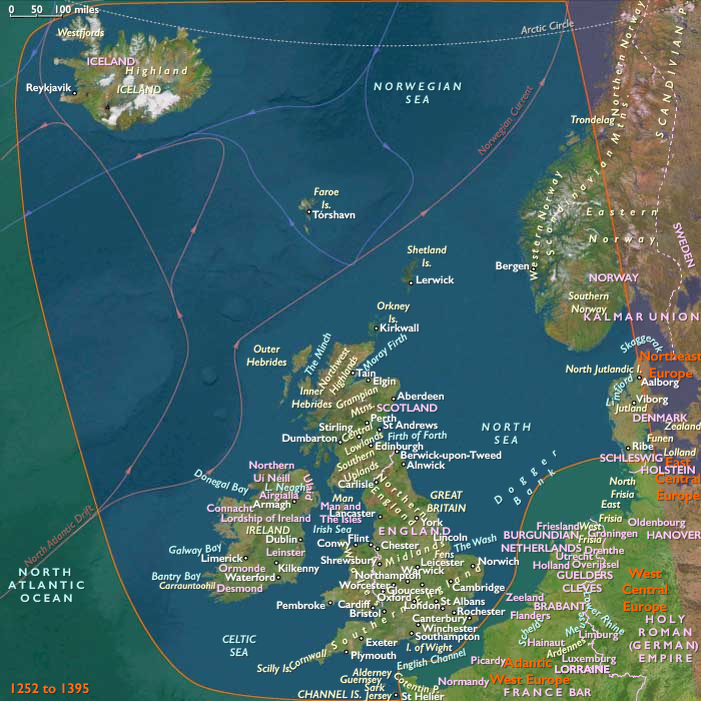
Northwest Europe
View →Related Events
No active filters.
Showing 10 events out of 43985 total
Valdemar IV defeats a Hanseatic fleet that is besieging Helsingborg in 1362 and forces Lübeck to conclude peace.
Murad is the first Ottoman emperor to use Gallipoli for permanent conquests in Europe.
Constantinople itself is bypassed, despite the weakness and disorganization of its defenders, because its thick walls and well-placed defenses remain too strong for the nomadic Ottoman army, which continues to lack siege equipment.
Orhan, second emir of the burgeoning Ottoman empire, has built mosques, medreses (theological colleges), and caravansaries in the newly conquered towns, particularly the Ottoman capital, Bursa, which will later became a major Islamic center.
At his death in 1362, his son Murad, the son of the Greek imperial princess Nilüfer Hatun (the former Theodora), succeeds him.
Philippe de Mézières had come under the influence of the pious legate Peter Thomas; in 1362, both men accompany King Peter of Cyprus on his visit to the princes of western Europe in quest of support for a new crusade, and when the king returns to the east he leaves Mézières and Thomas to represent his case at Avignon and in the cities of northern Italy.
They preach the crusade throughout Germany.
King John II’s Return to English Captivity (1362): A Matter of Honor
After being captured at the Battle of Poitiers (1356), King John II of France ("John the Good") was held captive in England under the terms of the Treaty of Brétigny (1360). His ransom was set at 3 million gold crowns, an immense sum that France struggled to pay.
To allow John to return to France and raise the funds, the English took hostages in his place, including:
- Two of his sons
- Several French princes and nobles
- Four prominent citizens from Paris
- Two citizens from each of the 19 principal towns of France
The Escape of Louis of Anjou and John II’s Response (1362)
- John II returned to France to organize ransom payments, leaving his son, Louis of Anjou, and other nobles as hostages in English-controlled Calais.
- In 1362, Louis of Anjou escaped captivity, violating the terms of the treaty.
- Feeling honor-bound to uphold his agreement with Edward III, John II voluntarily returned to England, despite having the opportunity to remain in France.
John II’s Final Captivity and Death
- John’s decision to return to English captivity was viewed as an extraordinary act of chivalry and personal integrity, reinforcing his reputation as "John the Good."
- However, his return did not lead to the full ransom payment, as France continued to struggle financially.
- John remained in England until his death on April 8, 1364, at Savoy Palace in London, without ever regaining his throne.
Impact and Legacy
- John’s return to captivity was rare among medieval monarchs, as most rulers would avoid imprisonment at all costs.
- His decision emphasized the chivalric code, but also weakened France, as his son, Charles V, had to take full control of a divided and war-torn kingdom.
- The financial burden of the ransom and ongoing war contributed to political instability and economic hardship in France.
King John II’s voluntary return to English captivity in 1362, following his son's escape, remains one of the most famous episodes of medieval kingship, illustrating the weight of honor in royal diplomacy, even at the cost of personal freedom.
John IV de Montfort’s Return to Brittany and the Fragile Peace (1362)
By 1362, under pressure from Pope Innocent VI, the English, French, and Breton factions negotiated a tenuous peace in the War of the Breton Succession (1341–1365). However, while both the House of Blois and the House of Montfort maintained an uneasy balance of power, tensions remained unresolved within Brittany.
John IV de Montfort’s Return to Brittany (1362)
- The younger John de Montfort, son of the late John III, had been raised at the court of Edward III of England after his father’s death in 1345.
- In 1362, at the age of 22, he was permitted by Edward III to return to Brittany, but under strict conditions:
- He was forbidden to marry without Edward’s permission.
- He had to pledge several fortresses as a guarantee of his loyalty to England.
An Attempt at Peace with Charles of Blois
- Upon his arrival in Brittany, John IV sought to negotiate peace with his rival, Charles of Blois, in an attempt to reach a settlement and share power within the duchy.
- His proposal to divide Brittany was meant to end the decades-long conflict and stabilize the region.
Joan of Penthièvre’s Opposition to Peace
- Charles of Blois' wife, Joan of Penthièvre, vehemently opposed any settlement with the Montforts.
- She urged Charles to reject John’s offer and instead push for his total destruction, viewing him as a threat to her family’s claim to the duchy.
- Encouraged by Joan, Charles continued to resist Montfortist claims, ensuring that the war would not end peacefully.
Consequences: A Renewed Conflict
- John IV’s return to Brittany rekindled tensions, as the fragile peace crumbled under the pressure of political rivalries.
- The failure of negotiations set the stage for the final phase of the War of the Breton Succession, culminating in the Battle of Auray (1364), where Charles of Blois would meet his end.
John IV’s return to Brittany in 1362, though an effort toward reconciliation, ultimately led to renewed conflict, as Joan of Penthièvre’s insistence on continuing the fight ensured that the Montfort-Blois struggle would persist until a final military resolution.
The Lithuanians in 1362 and 1363 conquer the remaining lands of southern Kievan Rus', including the territories of Kiev, ...
...Pereiaslav, and ...
…Podolia.
The Lithuanians go on to conquer the Kievan Rus' territory of Novhorod-Siverskyi in the middle Desna River valley in 1363.