
The Lithuanians in 1362 and 1363 conquer…
1363 CE
The Lithuanians in 1362 and 1363 conquer the remaining lands of southern Kievan Rus', including the territories of Kiev, ...
People
Commodities
Subjects
Regions
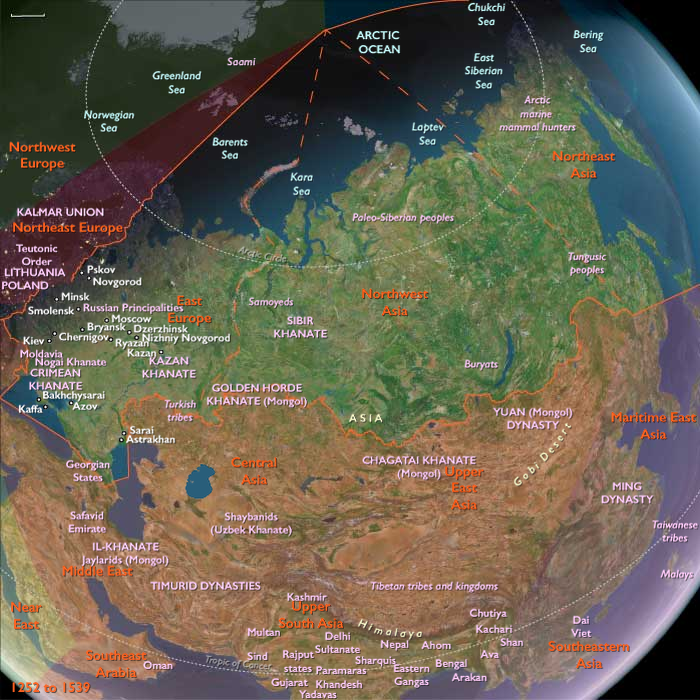
Northeastern Eurasia
View →Subregions
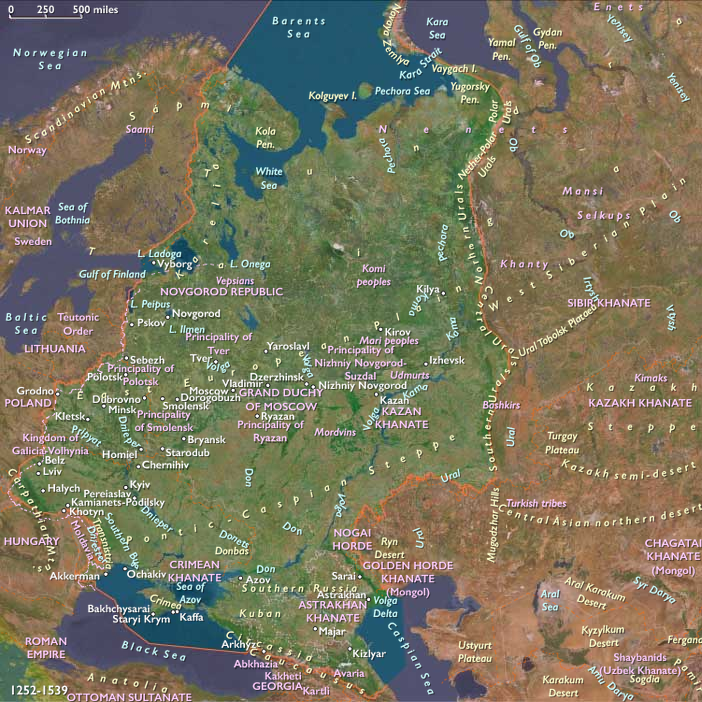
East Europe
View →Related Events
No active filters.
Showing 10 events out of 43978 total
...Pereiaslav, and ...
…Podolia.
The Lithuanians go on to conquer the Kievan Rus' territory of Novhorod-Siverskyi in the middle Desna River valley in 1363.
Valdemar’s forces had employed cannon to repulse the Hanseatic fleets at the battle of Helsingborg in 1362.
Under a treaty concluded in 1363, Valdemar forces the Hanseatic League to accept terms that greatly curtail its trade privileges.
The bridge over the River Inn, which gives Innsbruck its name, has made the eastern Alpine city an important point on the trade routes to Germany from Italy and Switzerland by the twelfth century.
Originally belonging to the counts of Andech, Innsbruck passes to the Habsburgs in 1363 when the Tyrol becomes a Habsburg possession.
Bertrand du Guesclin and the Renewed Breton Conflict (1363–1364)
As the War of the Breton Succession resumed in 1363, Bertrand du Guesclin, a formidable Breton knight known for his guerrilla warfare tactics, once again played a key role in supporting the French-backed claimant, Charles of Blois, against Jean de Montfort and his English allies. However, despite some early successes, Charles' campaign faltered when du Guesclin was drawn away to other fronts, leading to a stalemate in Brittany.
Bertrand du Guesclin: A Ruthless Breton Commander
- Born into the petty nobility of Brittany (the seigneurs of Broons), du Guesclin gained a reputation as a rough and brutal warrior.
- Serving Charles of Blois, he became a key figure in the war, fighting against Jean de Montfort’s English-backed forces.
- He was knighted in 1354 after successfully countering an English raid led by Hugh Calveley on the Castle of Montmuran, while serving Arnoul d'Audrehem.
Du Guesclin’s Earlier Victories: The Siege of Rennes (1356–1357)
- He successfully defended Rennes against an English siege, commanded by Henry of Grosmont, 1st Duke of Lancaster.
- Using guerrilla tactics, he harassed and exhausted the besieging English forces.
- During the siege, he fought and killed English knight William Bamborough in single combat.
The 1363 Campaign: Initial Success, Then Stalemate
- With war resuming in 1363, Charles of Blois launched a new offensive, supported by du Guesclin.
- Du Guesclin, also known as the Black Dog of Brocéliande, helped secure key victories, advancing the Bloisist cause.
- However, when du Guesclin left Brittany to take control of strongholds in Navarre and Normandy, Charles of Blois’ momentum stalled.
- His advance halted at the siege of Bécherel, where Jean de Montfort’s forces successfully resisted.
Failed Negotiations and Joan’s Opposition
- As the siege dragged on, the warring parties agreed to meet near Évran to resolve their differences.
- The bishops intervened, proposing a partition of Brittany between Jean de Montfort and Charles of Blois.
- However, another opportunity for peace was rejected, as Joan of Penthièvre (Charles’ wife) refused to negotiate, insisting on continuing the fight to completely eliminate the Montfortist claim.
The Stage is Set for the Final Battle
- The failure of diplomacy meant that the conflict would continue, culminating in the Battle of Auray (1364)—the decisive engagement of the Breton War of Succession.
- With Charles of Blois refusing to compromise, Brittany remained a divided and war-torn region, further entrenching English and French influence in the duchy.
Despite his skills as a military commander, du Guesclin’s absence from Brittany in 1363 left Charles of Blois vulnerable, and Joan of Penthièvre’s refusal to negotiate peace ensured that the war would continue toward its decisive conclusion at Auray.
The Navarrese Crisis and Edward III’s Strategy (1363)
By 1363, the French Crown was locked in conflict with Navarre, particularly as the Navarrese sought to exploit the captivity of King John II in England and the weakness of the Dauphin (the future Charles V). The Kingdom of Navarre, located near southern Gascony, was ruled by Charles II of Navarre ("Charles the Bad"), a scheming noble with dynastic claims and political ambitions in France.
Navarre’s Power Play Amidst French Instability
- Since 1354, Navarre had been in conflict with the French Crown, resisting Valois control while cultivating alliances with England and other French dissidents.
- With King John II still in English captivity (since Poitiers, 1356) and the Dauphin struggling to consolidate power, Charles II of Navarre sought to expand his influence in northern and western France.
- Seeing an opportunity to weaken France, Edward III of England secretly supported Navarre’s moves, even though no formal treaty existed between them.
Edward III’s Deliberate Stalling of Peace Negotiations
- Edward III, knowing that Navarre’s actions could destabilize France, saw a potential gain for himself:
- If Navarre successfully challenged Valois authority, Edward might secure control over parts of northern and western France.
- The continued instability would make it harder for the French to reclaim lands ceded in the Treaty of Brétigny.
- With this in mind, Edward intentionally slowed down peace negotiations, ensuring that the conflict within France remained unresolved.
Impact on the Hundred Years' War
- Navarre’s rebellion and English interference prolonged France’s internal instability, preventing the Dauphin from immediately restoring royal authority.
- The conflict exacerbated divisions within the French nobility, weakening France’s ability to recover from its defeats.
- Edward’s manipulation of the political crisis further delayed a true resolution of hostilities, ensuring that the Hundred Years’ War remained unresolved.
Edward III’s support for Navarre in 1363 was part of a broader strategy to exploit French weakness, ensuring that France remained politically fractured while England strengthened its foothold on the continent.
The End of the Old Burgundian Line and the Rise of Philip the Bold (1361–1363)
The duchy of Burgundy, ruled by a cadet branch of the Capetian dynasty since 1031, became vacant in 1361 when Philip of Rouvres, the last duke of the older Burgundian line, died without an heir. This led to Burgundy returning to the French Crown, but rather than permanently incorporating it into the royal domain, King John II of France granted the duchy as an appanage to his youngest son, Philip the Bold, in 1363.
Philip the Bold: From Prince to Duke of Burgundy
- Philip the Bold (Philippe le Hardi) was born in Pontoise in 1342, the fourth and youngest son of King John II of France and Bonne of Luxembourg.
- He earned his cognomen "the Bold" for his courage at the Battle of Poitiers (1356), where, at just fourteen years old, he fought beside his father and was captured alongside him by the English.
Previous Title: Duke of Touraine (1360–1363)
- In 1360, John II had granted Philip the Duchy of Touraine, an important territory in central France.
- However, in 1363, as a reward for his loyalty and bravery at Poitiers, Philip returned Touraine to the Crownin exchange for a greater prize—the Duchy of Burgundy.
The New Duke of Burgundy (1363–1404)
- With the death of Philip of Rouvres (1361), King John II took direct control of Burgundy before granting it to Philip the Bold in 1363.
- This marked the foundation of the Valois-Burgundy dynasty, which would become one of the most powerful ruling houses in medieval Europe.
- Philip ruled Burgundy as an independent power base, using it to expand his influence across France, the Low Countries, and beyond.
Impact and Legacy
- Philip the Bold’s rule over Burgundy (1363–1404) transformed the duchy into a major European power, leading to the rise of the Burgundian state, which would play a crucial role in French and European politics for over a century.
- His marriage to Margaret III of Flanders (1369) brought rich Flemish territories under Burgundian control, making the Duchy of Burgundy a rival to the French monarchy.
- The Valois Dukes of Burgundy would eventually challenge the French Crown, culminating in the Burgundian Wars of the 15th century.
The transfer of Burgundy to Philip the Bold in 1363 laid the foundation for a powerful and semi-independent Burgundian state, turning the duchy into a dominant political force that would shape the future of France and the Low Countries.
Members of the Swedish Council of Aristocracy, led by Bo Jonsson Grip, had arrived in the court of Mecklenburg in 1363, after having been banished from the country after a revolt against king Magnus Eriksson.
At the nobles' request, Albert of Mecklenburg launches an invasion of Sweden supported by several German dukes and counts.
Several Hanseatic cities and dukes in Northern Germany express support of the new king.
Stockholm and …
…Kalmar, with large Hanseatic populations, also welcome the intervention.
Albert is proclaimed King of Sweden and crowned on February 18, 1364.
Magnus finds refuge with his younger son in Norway, where he will retain his sovereignty over Iceland until he drowns in 1374 in a shipwreck in Bømlafjorden.