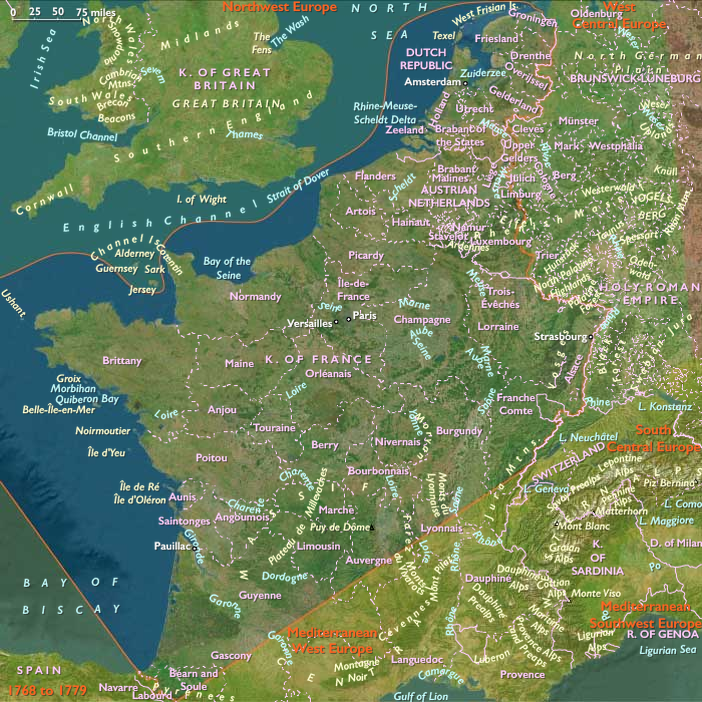
Great Britain and the Dutch Republic have…
January 1777 CE
Great Britain and the Dutch Republic have been allies since the Glorious Revolution of 1688, but the Dutch have become very much the junior partner in the alliance, and have slowly lost their erstwhile dominance of world trade to the British.
During the Second Stadtholderless Period the Dutch Republic had more or less abdicated its pretenses as a major power and this became painfully evident to the rest of Europe during the War of the Austrian Succession.
Near the end of that war in 1747 an Orangist revolution had restored the stadtholderate with vastly increased powers for the stadtholder (the stadtholderate became hereditary).
However, this had not lead to a resurgence of the Republic as a major power because of what many in the Republic saw as the mismanagement of the stadtholderian regency during the minority of stadtholder William V, and subsequently during his own reign
Instead, the Republic had remained stubbornly neutral during the Seven Years' War which enabled it to greatly neglect both its army and navy.
The stadtholderian regime was pro-British (the stadtholder being a grandson of king George I of Great Britain), but his opponents for this reason had favored France, and those opponents had been strong enough in the States General of the Netherlands (the governing body of the Republic whose "first servant" the stadtholder was) to keep Dutch foreign policy neutral.
The British, in their attempt to stamp out the rebellion in their North American Thirteen Colonies, initially consider the Dutch allies.
They attempt to "borrow" the mercenary Scotch Brigade of the Dutch States Army for use in the Americas, in a similar manner to the Hessian and Brunswicker contingents they hire and deploy.
However, this is strongly opposed by the Dutch sympathizers of the American Revolution, led by baron Joan van der Capellen tot den Pol, who manages to convince the States General to refuse the British request.
More importantly, Dutch merchants, especially those from Amsterdam, had became involved in the supply of arms and munitions to the rebels soon after the start of the American Revolutionary War.
This trade is mainly conducted via the entrepôt of St. Eustatius, an island colony of the Dutch West India Company in the Caribbean.
There American colonial wares, like tobacco and indigo, are imported (in contravention of the British Navigation Acts) and re-exported to Europe.
For their return cargo the Americans purchase arms, munitions, and naval stores brought to the island by Dutch and French merchants.
To add insult to injury, in November 1776 the governor of the island, Johannes de Graeff, had been the first to salute the Flag of the United States, leading to growing British suspicions of the Dutch.
People
Groups
Topics
Commodities
Subjects
Regions
West Europe
View →Subregions