
Kongo faces other challenges in the sixteenth …
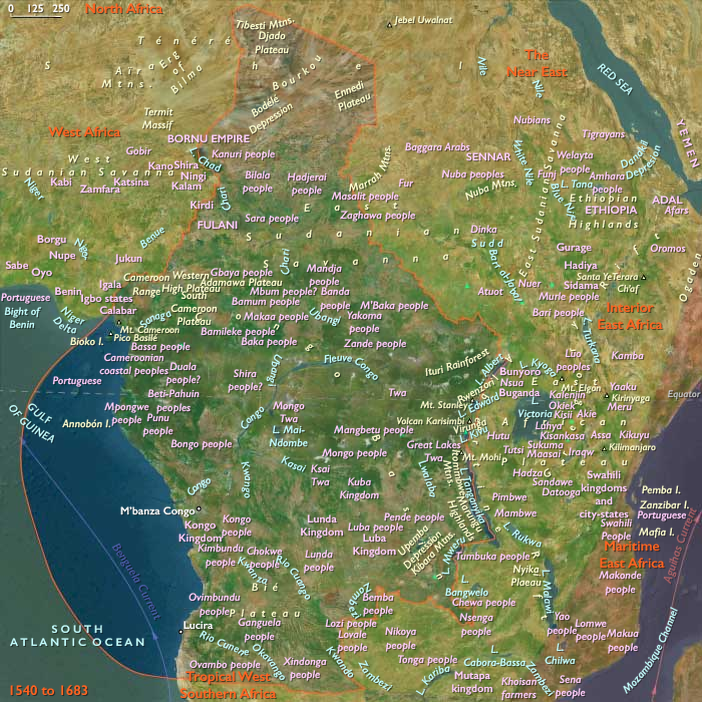
Years: 1540 - 1683
Kongo faces other challenges in the sixteenth century in addition to the slave trade.
After the death of Afonso in the 1540s, the kingdom endures a period of instability that culminates in an upheaval in 1568.
This rebellion will be long attributed by Portuguese sources and others to the invasion by a group of unknown origin called the Jaga.
Others, however, believed that the attack was probably launched by a Bakongo faction opposed to the king that may have been joined or aided by non-Bakongo seeking to gain control over the Kongo slave trade and other trading routes.
In any case, the assault on the capital (which had been renamed São Salvador) and its environs drives the king, Alvaro I, into exile.
The Portuguese governor of São Tome, responding to pleas from Alvaro I, fights the invaders from 1571 through 1573, finally ousting them and occupying the area until the mid-1570s.
A few years earlier, Sebastião, the Portuguese king, had granted the area south of the Bakongo as a proprietary colony to Paulo Dias de Novais, an associate of Portuguese Jesuits and an experienced explorer of the West African coast.
In 1576, in effective control of the countryside and facing no organized Kongo opposition, the Portuguese found the town of Luanda, in effect establishing the colony of Angola.
Other African leaders, however, continue to resist the Portuguese, and the Europeans only manage to establish insecure footholds along the coast.
Concerned that African attacks might impede the stream of slaves to Brazil and Portugal, in 1590 the crown assumes direct control of the colony.
Álvaro I and his successor, Álvaro II, bring stability to the Kongo Kingdom by expanding the domain of their royal authority while keeping at bay encroachment by the Portuguese, whose colony during the late years of the sixteenth century remains confined to the area south of Kongo, but after the death of Alvaro II in 1614, conflicts over access to cultivable land between Kongo and the Portuguese colony of Angola sour formerly amicable relations, and in 1622 the Portuguese governor of Angola launches an attack on Kongo.
Although not entirely successful from the Portuguese point of view, the war has a number of lasting effects. First, the colony captures a large number of slaves, which demonstrates how rewarding slave raiding can be.
Second, the Portuguese come out of the war convinced of the existence of silver and gold mines in Kongo, a belief that encourages a series of conflicts between the colonists and the Kongo Kingdom for the next half century.
The war also creates a xenophobia among the Bakongo of the interior, who drive away many Portuguese.
Because the trading system depends largely on the Bakongo, commerce is greatly disrupted, with effects on the Angolan colony as great as those on the Kongo Kingdom.
Adding to Kongo's troubles in the early 1600s is a general dissatisfaction among the Bakongo with their rulers, some of whom are greedy and corrupt.
Consequently, conflicts arise over succession to the throne, and more and more sections of the kingdom gain substantial degrees of autonomy and establish local control over the trade that had so enriched the monarchy in earlier years.
Locations
People
Groups
- Bantu peoples
- Kongo people
- Portuguese people
- Christians, Roman Catholic
- Portugal, Avizan (Joannine) Kingdom of
- Kongo, Kingdom of
- Portuguese Empire
- São Tomé and Príncipe, Portuguese
- Brazil, Colonial
- Angola (Portuguese colony)
Topics
- Sub-Saharan Africa, Medieval
- Interaction with Subsaharan Africa, Early European
- Age of Discovery
- Colonization of the Americas, Portuguese
- Colonization of Asia, Portuguese
Commodoties
Subjects
Regions
Subregions
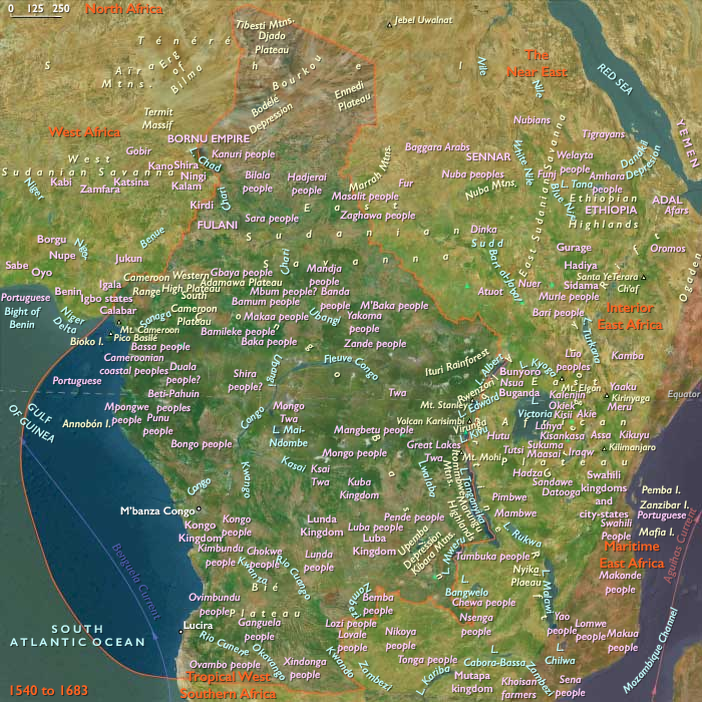
Years: 1540 - 1683
Locations
People
Groups
- Bantu peoples
- Kongo people
- Portuguese people
- Christians, Roman Catholic
- Portugal, Avizan (Joannine) Kingdom of
- Kongo, Kingdom of
- Portuguese Empire
- São Tomé and Príncipe, Portuguese
- Brazil, Colonial
- Angola (Portuguese colony)
Topics
- Sub-Saharan Africa, Medieval
- Interaction with Subsaharan Africa, Early European
- Age of Discovery
- Colonization of the Americas, Portuguese
- Colonization of Asia, Portuguese
Commodoties
Subjects
Regions
Subregions