
…Korsun, and …
1037 CE
…Korsun, and …
Locations
People
Groups
Commodities
Subjects
Regions
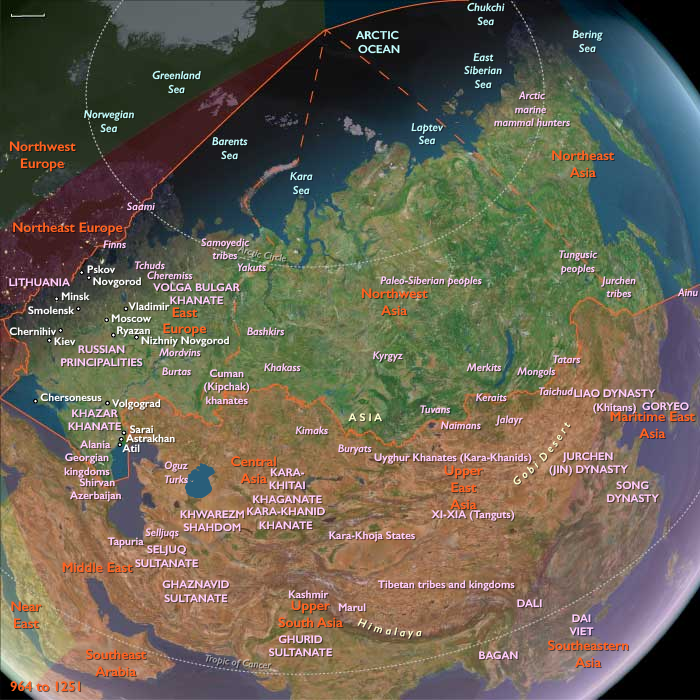
Northeastern Eurasia
View →Subregions
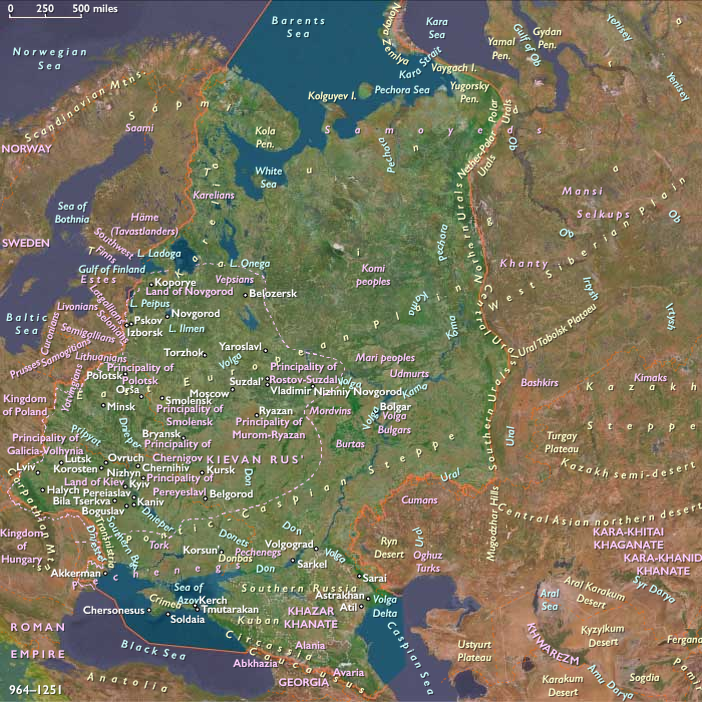
East Europe
View →Related Events
No active filters.
Showing 10 events out of 51466 total
A rime dictionary, rhyme dictionary, or rime book is an ancient type of Chinese dictionary that collates characters by tone and rhyme, instead of by radical.
The most important rime dictionary tradition began with the Qieyun (601), which aimed to reconcile the literary reading traditions and poetic practice of north and south China.
This work became very popular during the Tang dynasty, and went through a series of revisions and expansions, of which the most famous is the Guangyun (1007–1008).
The Jiyun (literally "Collected Rimes") is a Chinese rime dictionary published in 1037 during the Song Dynasty.
The chief editor Ding Du and others expanded and revised the Guangyun.
It is possible, according to Teng and Biggerstaff (1971:147), that Sima Guang completed the text in 1067.
The Jiyun has 53,525 character entries (ibid), approximately twice as many as the Guangyun, and likewise has two hundred and six rime groups.
The apical ancestor of the Seljuqs, a clan of Oghuz Turks moving from the steppes east of the Aral Sea, was their beg, Seljuq, who was reputed to have served in the Khazar army, under whom, circa 950, they had migrated to Khwarezm, near the city of Jend, where they converted to Islam.
The Seljuqs had been allied with the Persian Samanid Shahs against the Kara-khanids.
The Samanids had fallen to the Kara-khanids in Transoxania (992/999), however, whereafter the Ghaznavids had arisen.
The Seljuqs had become involved in this power struggle in the region before establishing their own independent base.
Tughril is the grandson of Seljuq and brother of Chaghri, under whom the Seljuqs wrest an empire from the Ghaznavids.
Very little is known of Chaghri and Tughril's lives until 1025.
Both were raised by their grandfather Seljuq until they were fifteen and fought with Ali Tigin Bughra Khan, a minor Kara-Khanid noble, against Mahmud of Ghazni.
Initially, the Seljuqs had been repulsed by Mahmud and had retired to Khwarezm, but from 1035 to 1037, Chaghri and Tughril have fought against his son and successor Mas'ud I of Ghazni.
In 1037 Tughril and Chaghri lead them in the peaceful takeover of Merv—the Ghaznavid sultan is extremely unpopular in the city.
Later, the Seljuqs repeatedly raid and trade territory with his successors across Khorasan and Balkh and even sack Ghazni in 1037.
Yaroslav, to defend his Kieven Rus' state from the Pechenegs and other nomadic tribes threatening it from the south, has constructed a line of forts, composed of Yuriev, …
…Boguslav, …
…Kaniv, …
…Pereyaslav.
Yaroslav sponsors the construction of the Saint Sophia Cathedral in 1037 to celebrate his decisive victor yin the previous year over the Pechenegs (who will henceforth never be a threat to Kiev).
Other celebrated monuments of his reign, such as the Golden Gates of Kiev, have since perished.
The Empire signs a thirty years' peace with the Fatimid Caliphate in about 1037, thus ending a period of hostilities.
Constantinople and Cairo each agree not to aid the enemies of the other.
Emperor Michael IV receives permission to renovate the Church of the Holy Sepulchre in Jerusalem at his own expense, and he might have received the right to appoint the patriarch of Jerusalem.
In return, the emperor releases five thousand Muslim prisoners.
John the Orphanotrophos had first comes to historical attention as protonotarios and trusted confidant of Basil II..
He had supported Romanos' interests before the latter became emperor.
After his elevation to the imperial throne, Romanos had created John praepositus sacri cubiculi (head of the imperial household and the highest-ranking eunuch position; this title is probably identical with parakoimomenos) and senator.
With the accession of his brother Michael IV in 1034, John had been able to pursue his goal of furthering his family's interest with vigor.
The chronicler John Skylitzes goes so far as to say that 'with John's help all of his brothers became members of the emperor's household'.
John had ensured that his sister Maria's husband, Stephen, was made admiral, his brother Niketas named Duke of Antioch (succeeded by his brother Constantine), and his brother George named protovestiarios in succession to Symeon, who had resigned from his position in protest at John's behavior and retired to Mount Olympus.
Anthony the Fat, a member of John's extended family, had been named Bishop of Nicomedia.
Although John himself ultimately remains only an orphanotrophos, ("caretaker of orphans"), he effectively runs the state as a sort of prime minister.
John attempts in 1037 to have himself made Patriarch of Constantinople by trying unsuccessfully to have Alexius Studites dismissed from the patriarchate.
Ibn Sīnā', or Avicenna, a Persian philosopher, physician, and alchemist who has spent his life as scholar-in-residence at many Islamic courts, has passed the last ten or twelve years in the service of Muhammad ibn Rustam Dushmanziyar, whom he has accompanied as physician and general literary and scientific adviser, even in his numerous campaigns.
During these years he had begun to study literary matters and philology, instigated, it is asserted, by criticisms on his style.
A severe colic, which had seized him on the march of the army against Hamadan, had been checked by remedies so violent that Ibn Sina could scarcely stand.
On a similar occasion the disease had returned; with difficulty he had reached Hamadan, where, finding the disease gaining ground, he had refused to keep up the regimen imposed, and resigned himself to his fate.
His friends have advised him to slow down and take life moderately; he has refused.
On his deathbed remorse seizes him; he bestows his goods on the poor, restores unjust gains, frees his slaves, and reads through the Qur'an every three days until his death.
He dies in June 1037, in his fifty-eighth year, in the month of Ramadan and is buried in Hamadan.
Harald Hardrada, after a few years in Kievan Rus', had moved on south with his force of around five hundred men men to Constantinople (Miklagard), the capital of the Byzantine Empire, probably in 1033 or 1034, where they have joined the Varangian Guard.
Although the Flateyjarbók maintains that Harald at first sought to keep his royal identity a secret, most sources agree that the reputation of Harald and his men was well known in the east at the time.
While the Varangian Guard was primarily meant to function as the emperor's bodyguard, Harald was found fighting on "nearly every frontier" of the empire.
He had first seen action in campaigns against Arab pirates in the Mediterranean, and then in inland towns in Asia Minor that had supported the pirates.
By this time, he had according to Snorri Sturluson become the "leader over all the Varangians".
The Greeks had pushed the Arabs out of Asia Minor by 1035, and Harald had taken part in campaigns that went as far east as the Euphrates, where according to his skald Þjóðólfr Arnórsson (recounted in the sagas) he had participated in the capture of eighty Arab strongholds.
Although not holding independent command of an army as the sagas imply, it is not unlikely that Harald and the Varangians at times could have been sent off to capture a castle or town.
During the first four years of the reign of Emperor Michael IV, Harald probably also fought in campaigns against the Pechenegs.
Harald is reported in the sagas to have gone to Jerusalem and fought in battles in the area; the sagas place this after his expedition to Sicily.
Whether his trip was of a military or peaceful nature would depend on whether it took place before or after the 1036 peace treaty between Michael IV and the Fatimid Caliph Ma'ad al-Mustansir Billah (in reality the Caliph's mother, originally a Greek Christian, since the Caliph is a minor), although it is considered unlikely to have been made before.
Modern historians have speculated that Harald may have been in a party sent to escort pilgrims to Jerusalem (possibly including members of the Imperial family) following the peace agreement, as it was also agreed that the Greeks were allowed to repair the Church of the Holy Sepulchre.
Furthermore, this may in turn have presented Harald with opportunities to fight against bandits who preyed on Christian pilgrims.