
Kublai Khan establishes the Chinese-style Yüan dynasty,…
1252 CE to 1395 CE
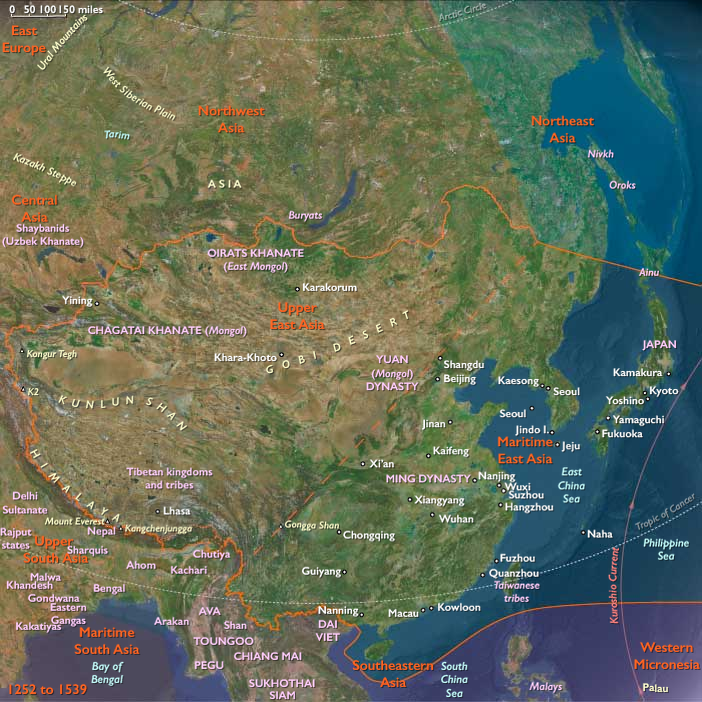
Kublai Khan establishes the Chinese-style Yüan dynasty, with its capital at Beijing, following the capitulation of the Southern Song dynasty to the Mongol.
As khakhan, Kublai pays scant attention to the subsidiary khanates of the far-flung Mongol empire, and so each of these becomes an almost independent kingdom.
The Mongol rulers eventually establish peace throughout East Asia.
Access to China becomes relatively easy, and China enters another age of cosmopolitanism and broad foreign contact, particularly with the West.
The Mongol Yüan dynasty supports foreign mercantile ventures in China, welcomes foreign faiths like Nestorian Christianity and Islam, and patronizes Tibetan Buddhism, or Tantrism.
The Yuan rulers also employ numerous foreigners in the state bureaucracy, but systematically discriminate against the Chinese for government service, saddling them with numerous legal disabilities.
Despite the oppressive nature of Yüan rule, China experiences a flowering of native arts, especially calligraphy and painting produced by the scholar-gentry class, and two literary forms—drama and the novel.
People
Groups
Subjects
Regions
East Asia
View →Subregions
