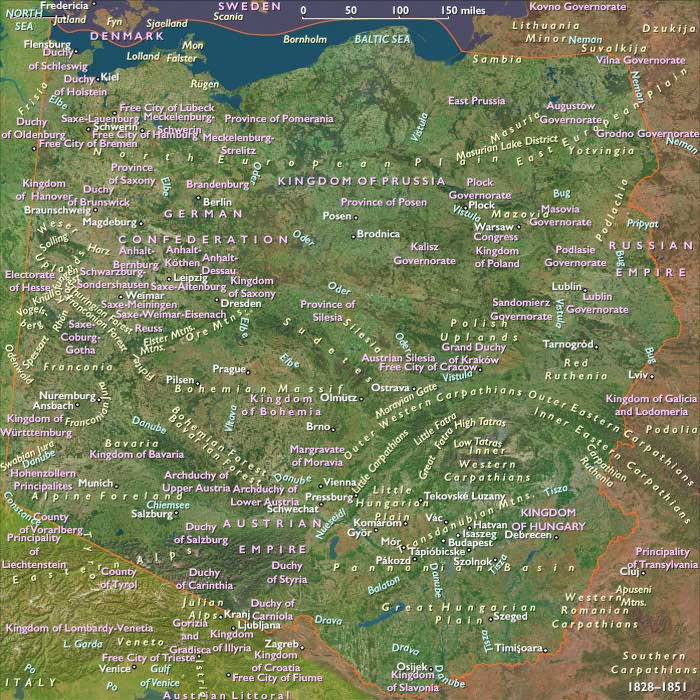
Revolution erupts in Vienna in March 1848,…
1840 CE to 1851 CE
Revolution erupts in Vienna in March 1848, forcing Austria's Chancellor Klemens von Metternich to flee the capital.
Unrest breaks out in Hungary on March 15, when radicals and students storm the Buda fortress to release political prisoners.
A day later, the Diet's liberal-dominated lower house demands establishment of a national government responsible to an elected parliament, and on March 22 a new national cabinet takes power with Count Louis Batthyany as chairman, Kossuth as minister of finance, and Szechenyi as minister of public works.
Under duress, the Diet's upper house approves a sweeping reform package, signed by Ferdinand, that alters almost every aspect of Hungary's economic, social, and political life.
These so-called April Laws create independent Hungarian ministries of defense and finance, and the new government claims the right to issue currency through its own central bank.
Guilds lose their privileges; the nobles become subject to taxation; entail, tithes, and the corvee are abolished; some peasants become freehold proprietors of the land they work; freedom of the press and assembly are created; a Hungarian national guard is established; and Transylvania is brought under Hungarian rule.
The non-Magyar ethnic groups in Hungary fear the nationalism of the new Hungarian government, and Transylvanian Germans and Romanians oppose the incorporation of Transylvania into Hungary.
The Vienna government enlists the minorities in the first attempt to overthrow the Hungarian government.
Josip Jelačić—a fanatic anti-Hungarian—becomes governor of Croatia on March 22 and severs relations with the Hungarian government a month later.
By summer the revolution's momentum begins to wane.
The Austrians order the Hungarian Diet to dissolve, but the order goes unheeded.
In September Jelacic leads an army into Hungary.
Batthyany resigns, and a mob lynches the imperial commander in Pest.
A committee of national defense under Kossuth takes control, authorizes the establishment of a Hungarian army, and issues paper money to fund it.
On October 30, 1848, imperial troops enter Vienna and suppress a workers' uprising, effectively ending the revolution everywhere in the empire except Hungary, where Kossuth's army ha overcome Jelacic 's forces.
In December Ferdinand abdicates in favor of Franz Joseph (1848-1916), who claims more freedom of action because, unlike Ferdinand, he has given no pledge to respect the April Laws.
The Magyars, however, refuse to recognize him as their king because he is never crowned.
Locations
People
Groups
Regions
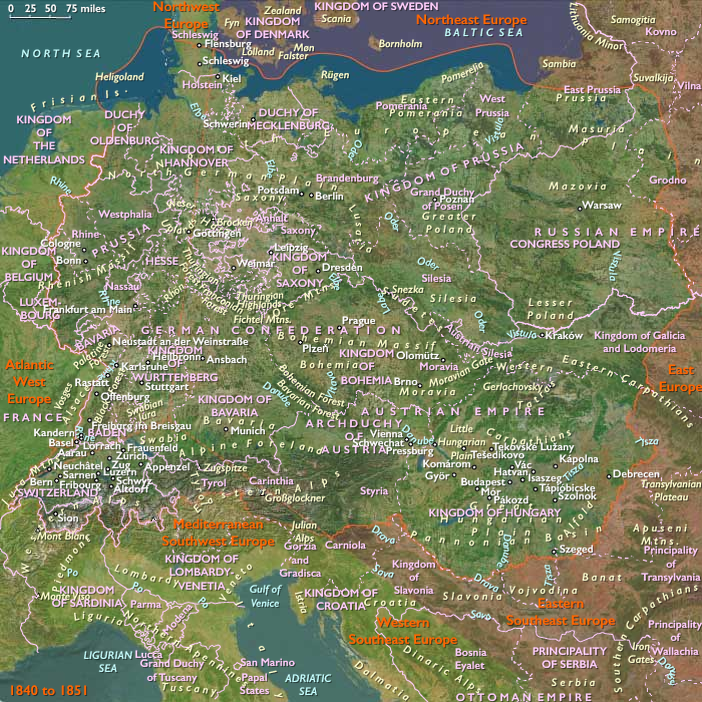
Central Europe
View →Subregions