Leopold has become increasingly concerned about the…
August 1791 CE
Leopold has become increasingly concerned about the safety of his sister, Marie-Antoinette, and her family but feels that any intervention in French affairs will only increase their danger.
At the same time, many French aristocrats are fleeing France and taking up residence in neighboring countries, spreading fear of the Revolution and agitating for foreign support to Louis XVI.
After the Flight to Varennes in June 1791, Louis had been arrested and is imprisoned.
On July 6, 1791, Leopold had issued the Padua Circular, calling on the sovereigns of Europe to join him in demanding Louis' freedom.
With the Turkish war ended, Austria joins with Prussia in the Declaration of Pillnitz on August 27.
Austria renounces any expansion at the expense of the Ottoman Empire.
In return Prussia promises not to expand to the east and not to support the Brabant Revolution.
Both countries pledge to intervene in France if the various powers of Europe all agree it is necessary.
The declaration states that Austria will go to war if and only if all the other major European powers also go to war with France.
Leopold has chosen this wording so that he will not be forced to go to war; he knows the British prime minister, William Pitt, does not support war with France.
Leopold issues the declaration only to satisfy the French emigres who have taken refuge in his country and are calling for foreign interference in their homeland.
Calling on European powers to intervene if Louis is threatened, the declaration is intended to serve as a warning to the French revolutionaries to stop infringing on the king's prerogatives and to permit his resumption of power. (The Pillnitz Conference itself deals mainly with the Polish Question and the war of Austria against the Ottoman Empire.)
Locations
People
Groups
Subjects
Regions
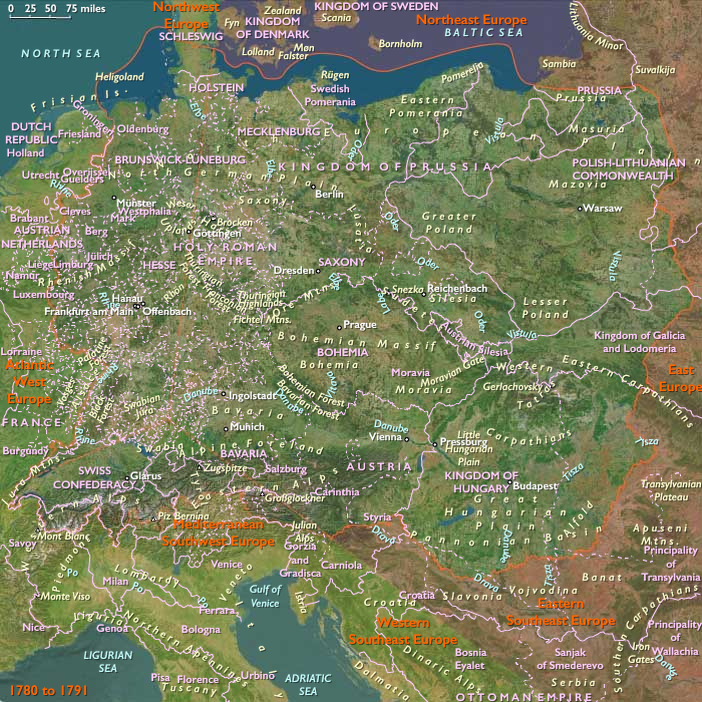
Central Europe
View →Subregions