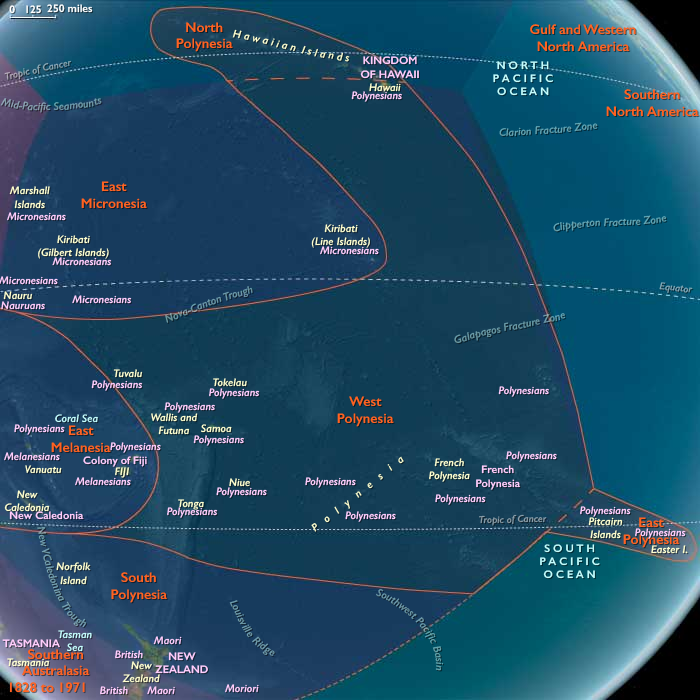
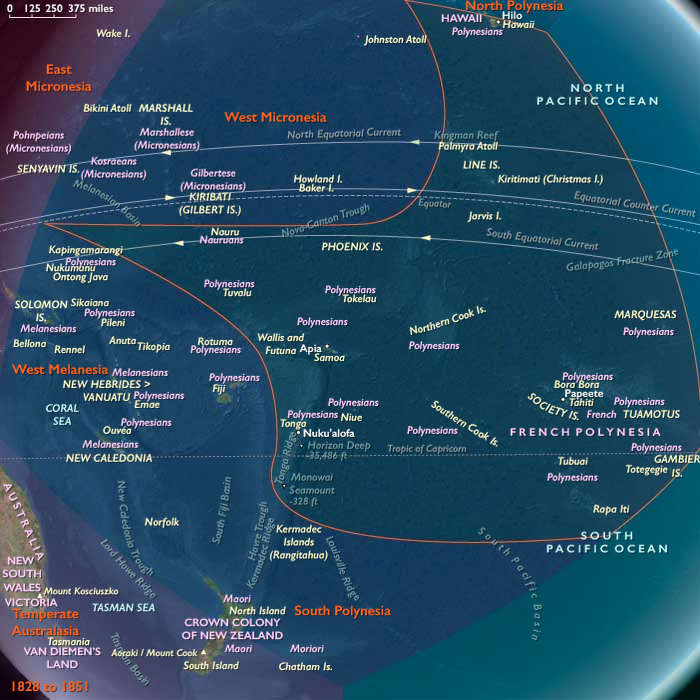
The United States Exploring Expedition, led by…
1841 CE
Locations
People
Regions
Polynesia
View →Subregions
West Polynesia
View →Related Events
No active filters.
Showing 10 events out of 17527 total
He lands at Fort Nisqually, an important fur trading and farming post of the Hudson's Bay Company in the Puget Sound area, part of the Hudson's Bay Company's Columbia Department, on May 11, 1840.
Wilkes holds the first American Independence Day celebration west of the Mississippi River in what is now Dupont, Washington on July 5, 1841.
The Pugets Sound Agricultural Company (PSAC) had been formed in 1840 as a subsidiary of the HBC to meet its contractual obligations with the Russian-American Company in the RAC-HBC Agreement.
Fort Nisqually and Cowlitz Farm are attached to the new venture, though it remains staffed and managed by HBC personnel.
In 1841 mostly Métis families from the Red River colony are hired by the PSAC to become pastoralists and farmers upon its two stations.
After traveling overland to Fort Vancouver by James Sinclair, fourteen Métis emigrant families from the Red River colony choose Fort Nisqually as their final destination.
The New Zealand Company establishes settlements in 1841 at Nelson and ...
...New Plymouth.
Edward Eyre follows his 1840 journey with the crossing of the Nullarbor Plain to Western Australia, arriving in Albany in 1841.
New South Wales has fallen into chaos by the time Britain intervenes and appoints resident magistrate George Grey colonial governor in 1841.
He imposes stringent measures and succeeds in restoring the economy to health.
Western Australia, which has experienced the same sort of rapid economic deterioration as New South Wales, also benefits from official intervention.
Khalid's Wahhabi subjects soon come to resent his subservience to his Egyptian and Ottoman masters.
In 1841, his cousin, 'Abd Allah ibn Thunayan, rebels, captures Riyadh by a bold coup, and expels its garrison.
Khalid, in Al-Hasa at the time, flees by ship to Jiddah.
The Sikh empire has been severely weakened by internal divisions and political mismanagement following the death of Maharaja Ranjit Singh in 1839.
Meanwhile, immediately after the death of Ranjit Singh, the East India Company had begun increasing its military strength, which was, at the time of his death, spread dangerously thin on the borders of the Punjab.
Ranjit's unpopular legitimate son, Kharak Singh, was removed from power within a few months, and later died in prison.
He was replaced by his able son Nau Nihal Singh, who also died within a few months in suspicious circumstances—crushed by a falling archway at the Lahore fort while returning from Kharak Singh's cremation.
There are at this time two major factions within the Punjab contending for power and influence, the Sindhanwalias and the Dogras.
The Dogras succeed in raising an illegitimate son of Ranjit Singh, Sher Singh, to the throne in January 1841.
The most prominent Sindhanwalias have taken refuge on British territory, but have many adherents among the Army of the Punjab.
The army, which has expanded rapidly in the aftermath of Ranjit Singh's death, as landlords and their retainers have taken up arms, now claims itself to be the Khalsa, or embodiment of the Sikh nation.
Its regimental panchayats (committees) form an alternate power source within the kingdom, declaring that Guru Gobind Singh's ideal of the Sikh commonwealth has been revived, with the Sarbatt Khalsa or the Sikh as a whole assuming all executive, military and civil authority in the State.
The British decry this as a "... dangerous military democracy ...".
British representatives and visitors in the Punjab describe the regiments as preserving "puritanical" order internally, but also as being in a perpetual state of mutiny or rebellion against the central Darbar (Court).
In one notorious instance of unrest, Sikh soldiers run riot, looking for anyone who looks as if they can speak Persian (the language used by the clerks who administer the Khalsa's finances) and putting them to the sword.