
Like Corinth, Argos, on the eastern shore…
669 BCE to 658 BCE
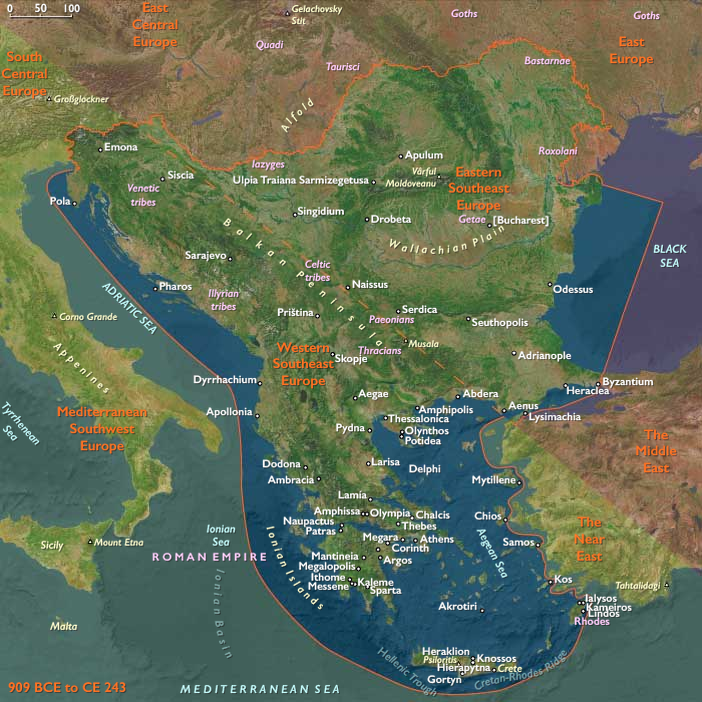
Like Corinth, Argos, on the eastern shore of the Peloponnesus, grows very fast, trade with the Near East begins to flourish, and increased domestic production enables a new, wealthy elite to rise.
Commercial activity centers on the acquisition of metals from the Near East for the manufacture of luxury goods.
In this process, the Greeks encounter and adopt the alphabet of the Phoenicians, as well as other innovations that accelerates change in Greek civilization. (Communities similar in many respects to the early Greek poleis settle the Phoenician coast, and it is arguable that Phoenician influence, and Semitic influence generally, on early Greece has been seriously underrated.)
Under the Argive king Pheidon (seventh century BCE), Argos is the dominant city-state in all the Peloponnese until the rise of Spartan power. (The ancient Greek historian Herodotus will later imply that Pheidon flourished about 600 BCE, but at this time, Corinth and Sicyon, not the Argives, are in the ascendance. Although some later writers assigned Pheidon to the eighth century BCE, most modern scholars place him in the early seventh century.)
Pheidon, said to have been the tenth successor to Temenus, the founder of Argos, and ruler of the whole Argolid peninsula in the northeast Peloponnese, unites this region (the “lot of Temenus”), marches across the Peloponnese, and seizes Olympia (perhaps in 672 or 668).
The Argives defeat Sparta at Hysiae in 669 to gain supremacy in the Peloponnesus.
The first Battle of Hysiae is described by the ancient travel-writer Pausanias (2.24.7), who writes as follows: Here are common graves of the Argives who conquered the Lacedaemonians in battle at Hysiae. This fight took place, I discovered, when Peisistratus was archon at Athens, in the fourth year of the twenty-seventh Olympiad, in which the Athenian, Eurybotus, won the foot-race. On coming down to a lower level you reach the ruins of Hysiae, which once was a city in Argolis, and here it is that they say the Lacedaemonians suffered their reverse.—trans W.H.S. Jones and H.A.Omerod.
The chronology of Pausanias would suggest that the battle was fought in 669/8 BCE.
All that is known is that the Argives defeated the Lacedaemonians.
Some (Andrewes) have suggested that this Argive defeat of Sparta occurred when Pheidon was king (or tyrant) of Argos, since Pheidon was famed for his military success and daring, but this remains conjectural.
Some scholars (Kelly, Hall) have suggested that the first battle of Hysiae was invented by the Argives.
Locations
Groups
Topics
Commodities
Subjects
Regions
Southeast Europe
View →Subregions
