
Louis III, duke of Anjou and Touraine,…
1433 CE
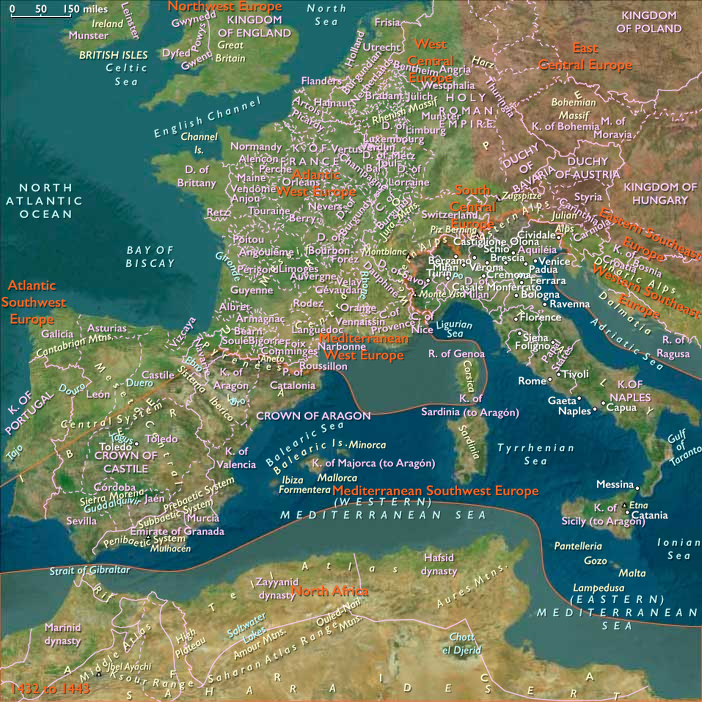
Louis III, duke of Anjou and Touraine, count of Maine and Provence, and titular king of Naples and Sicily, advancing Angevin claims to the throne of Naples, has for a dozen years struggled with the Aragonese claimant Alfonso V, sometimes supported, sometimes opposed by the childless Queen Joan II of Naples, who in 1423 had renounced Alfonso and adopted Louis.
In April 1433, the capricious Joan disinherits Louis, only to readopt him in June.
Locations
Subjects
Regions

Southwest Europe
View →Subregions
Mediterranean Southwest Europe
View →Related Events
No active filters.
Showing 10 events out of 41979 total
The Arakan region, a coastal strip on the Bay of Bengal that had been settled by the Burmese in the tenth century, became the scene of a struggle between rival centers of power at the beginning of the fifteenth century.
Narameikhla, the son of King Rajathu (reigned 1397–1401), had been forced in the first year of his reign to flee to Bengal, where he had become a vassal to King Ahmad Shah of Gaur.
With the aid of Ahmad Shah's successor, he had regained control of Arakan in 1430 and in 1433 builds at Mrohaung a new capital.
As a nominal vassal of the Muslim kings of Gaur, Narameikhla, also called Min Saw Mon, employs Muslim titles in his coins and inscriptions, though he and his subjects are Buddhists.
According to the Arakanese chronicles, the king was warned by court astrologers that he would die within a year of the new capital.
He answered that he would rather die and leave a safer kingdom to posterity than to live long, and leave a weak kingdom.
The king promptly moved to the new capital when it was completed in 1432/33.
Part of the new city, a few miles north of the Mrauk-U Palace, is the Le-myet-hna Temple, which is built in the classical style of the Pagan Kingdom.
He dies soon after on May 9, 1433, and is succeeded by his younger half-brother Khayi.
A Filipino penal code, the so-called Code of Kalantiyaw, is apparently written in 1433. (One of the few written documents to survive from the pre-Spanish culture, it will be discovered on the island of Panay in 1614.)
Eighteen orders decree the proper punishment to be administered for certain moral and social transgressions.
Depending on the gravity of the offense, punishment ranges from a light fine to being cut to pieces and thrown to crocodiles.
Many of the offenses specified—such as cutting sacred trees, singing during night walks, and killing white monkeys—illuminate the ancient Filipino religious beliefs.
Zheng He, the famous Chinese mariner, explorer, diplomat and fleet admiral, who had made the six voyages collectively referred to as the travels of "Eunuch Sanbao to the Western Ocean" makes one more voyage under the Xuande Emperor (reigned 1426–1435), but dies at sea in 1433.
On his seven voyages, Zheng had successfully relocated large numbers of Chinese Muslims to Surabaya, …
…Palembang, …
…Malacca, and other places and converted the natives to Islam.
Malacca has become the Southeast Asian center of Islamic learning and also a large international Islamic trade center of the southern seas.
Yuri assembles an army and attacks Moscow.
Vasili, betrayed by the Muscovite boyarin Ivan Vsevolzhsky, is in 1433 defeated and captured by his enemies.
Upon being proclaimed Grand Duke of Muscovy, Yuri pardons his nephew and ...
…sends him to reign in the town of Kolomna.
This proves to be a mistake, as Vasili immediately starts to plot against his uncle and gather all sorts of malcontents.
Erik of Pomerania, ruler of the Kalmar Union, the united realms of Denmark, Norway, and Sweden, as Erik VII, has imposed on Sweden a harsh system of Danish bailiffs and has levied oppressive troop and monetary requirements to fight the Kalmar War.
An absolutist ruler, his economically ruinous and unconstitutional policies prove intolerable to Swedes in the mining district of Bergslagen, where Engelbrekt Engelbrektsson, a mine owner of German origin and a member of the petty nobility, leads a rebellion of Swedish miners and peasants against the Danish governor in June 1433, attacking and destroying the stronghold of Borghnäs and other castles and ousting bailiffs.
The early successes of Engelbrekt's forces against Erik's troops encourage the nobles and clergy to join the rebellion, “Engelbrekt's Feuds,” and transform it into a truly national struggle.
The provinces of Upland, Vermland, and Sodermanland join the Scandinavian revolt against Danish rule, and the Swedish council invites Norway and some Hanseatic towns to join as well.
A Gothic nave has been under construction since 1304 at the late Romanesque Saint Stephen's Cathedral in Vienna; a Gothic tower and spire on the south transept are completed in 1433.
The sakkos, a short, close-fitting tunic with half sleeves, buttoned or tied with ribbons on the sides, and usually heavily embroidered, is adopted as an outer liturgical vestment by all Greek metropolitans in 1433.
Similar to the dalmatic worn by Roman Catholic deacons and possibly derived from the tunic of Eastern Roman emperors, it may also have been influenced by the Western deacon's dalmatic or the Jewish high priest's sleeveless tunic; small bells on the sleeves or sides imitate those worn by Jewish high priests.