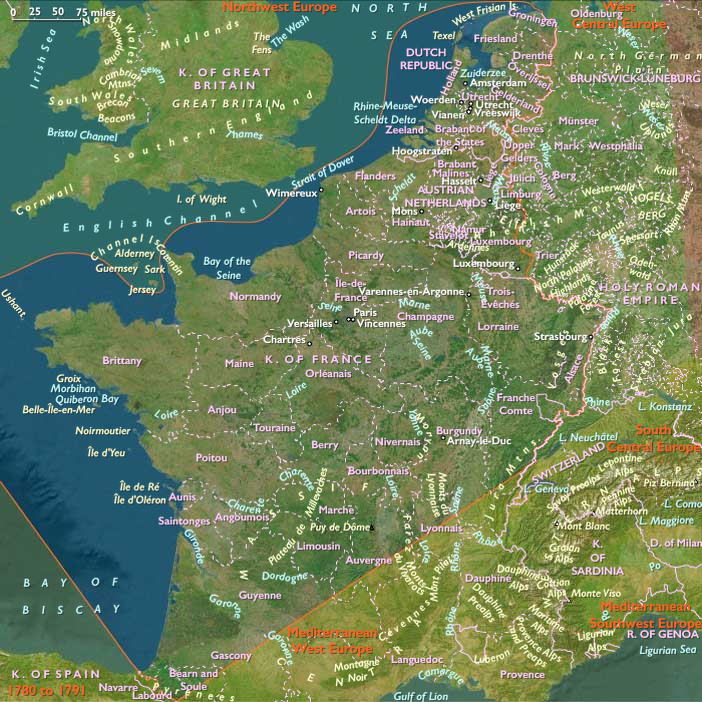
Riots, starting in the later half of…
February 1791 CE
The Parisian inhabitants express their discontent with the National Assembly or an act it has created by taking to the streets and causing a violent commotion.
The violence in Paris results in an increasing number of members of the nobility to emigrate from Paris to seek foreign aid or cause insurrection in the provinces to the south.
French emigration from 1789 to 1815 is a mass movement of thousands of Frenchmen spanning various socioeconomic classes, although it does begin with primarily a migration of members of the first and second estates, the clergy and the nobility.
The violence in Paris is an immediate reason for their leaving the vicinity, but the primary reason is that they fundamentally disagree with the elimination of the old order, which had offered privilege to which the nobility had grown accustomed.
Among the emigrating nobles are the aunts of King Louis XVI: Madame Adélaïde and Madame Victoire.
Madame Adélaïde and her sister had been present at Versailles during the Parisian women's march to Versailles on 6 October 1789, and belonged to those gathered in the king's apartment the night on the attack on Marie Antoinette's bedroom.
They had participated in the wagon train leaving the Palace of Versailles for Paris; however, their carriage had separated from the rest of the procession on the way before they reached Paris, and they never took up residence at the Tuileries with the royal family, but preferred to retire to the Château de Bellevue at Meudon.
Revolutionary laws against the Catholic Church caused them to apply for passports from their nephew the king to travel on pilgrimage to the basilica of Saint Peter in Rome, and Louis XVI signed their passports and notified the Cardinal de Bernis, the French Ambassador to Rome, of their arrival.
On February 3, 1791, when they were about to leave, anonymous intimation of their intention had been sent to the Jacobin Club, which caused a deputation of protest to the National Assembly.
On February 19, a crowd of women assembled at Palais Royal and agreed to march out to Château de Bellevue and stop the Mesdames from departing.
The Mesdames had been warned and left the chateau in the carriage of a visitor before having the time to bring their baggage wagons, which were, however, protected and sent after them by general Alexandre Berthier.
They leave for Italy in a procession of wagons on February 20, 1791 with a large entourage.
Their departure is given attention in the press.
The Chroniqle de Paris wrote: "Two Princesses, sedentary by condition, age, and taste, are suddenly possessed by a mania for traveling and running about the world. That is singular, but possible. They are going, so people say, to kiss the Pope's slipper. That is droll, but edifying. [...] The Ladies, and especially Madame Adelaide, want to exercise the rights of man. That is natural. [...] "The fair travelers are followed by a train of eighty persons. That is fine. But they carry away twelve millions. That is very ugly."
Locations
Topics
Subjects
Regions
West Europe
View →Subregions