
Maritime East Asia (1840–1851 CE): Opium Wars, …
Years: 1840 - 1851
Maritime East Asia (1840–1851 CE): Opium Wars, Rebellion, and Isolation
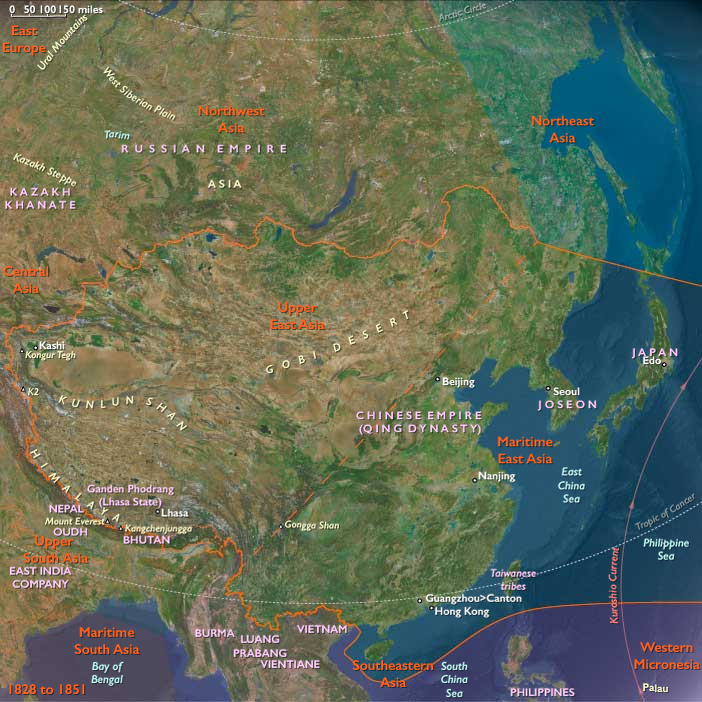
Between 1840 and 1851 CE, Maritime East Asia—encompassing lower Primorsky Krai, the Korean Peninsula, the Japanese Archipelago south of northern Hokkaido, Taiwan, and southern, central, and northeastern China—faces intense internal crises, major rebellions, and the challenge of Western intrusion, resulting in profound shifts in regional stability and political dynamics.
China: The First Opium War and Unequal Treaties
After a decade of ineffective anti-opium campaigns, the Qing government adopts severe measures in 1839 to eradicate the opium trade. The emperor dispatches Commissioner Lin Zexu to Guangzhou, where Lin dramatically seizes and destroys approximately twenty thousand chests of illicit British opium. The British retaliate forcefully, initiating the First Opium War (1839–1842).
China, unprepared and severely underestimating British military capabilities, suffers a humiliating defeat. The resulting Treaty of Nanjing (1842)—signed aboard a British warship—marks the first of China's infamous "unequal treaties."Under its terms, China cedes Hong Kong to Britain, opens five treaty ports to foreign trade, grants extraterritorial rights to British nationals, fixes low tariffs favorable to British interests, and pays a substantial indemnity. This treaty significantly weakens Qing authority, initiating a prolonged period China later terms the "Century of Humiliation."
The Taiping Rebellion
Economic distress, compounded by natural disasters such as severe droughts, floods, and famines, fuels widespread social discontent. In this volatile climate, the largest rebellion in modern Chinese history—the Taiping Rebellion—erupts in 1851 under the leadership of Hong Xiuquan, a village teacher influenced by Protestant beliefs and anti-Manchu sentiment.
Hong proclaims the establishment of the Heavenly Kingdom of Great Peace (Taiping Tianguo), advocating radical social reforms, including communal land ownership, abolition of slavery and concubinage, rejection of opium use, and the elimination of traditional practices like footbinding and ancestor worship. Despite capturing major cities such as Nanjing and advancing toward Tianjin, the movement ultimately alienates the Confucian scholar-gentry and fails to sustain a stable administration. Its radical ideology, internal conflicts, and external pressure from foreign powers assisting Qing forces lead to its eventual suppression, though not before massive devastation and the loss of millions of lives.
Japan: Defensive Reforms and Increased Vigilance
In Japan, the Tokugawa shogunate becomes increasingly alarmed by Western powers’ successful encroachments into China. Seeking to avoid similar exploitation, the bakufu undertakes additional economic reforms aimed at strengthening Japan's defenses against potential Western threats, emphasizing isolationist policies to resist external influence.
Joseon Korea: Intensified Isolation
Joseon Korea responds to these regional threats by intensifying its isolationist policies. Awareness of China's humiliating defeat in the Opium War reinforces Korea’s determination to resist all Western overtures, which had previously been banned after harsh reactions against Western, especially Catholic, influences in earlier decades. This intensified isolation lays groundwork for future conflicts as Korea struggles to maintain its traditional structures amid increasing external pressures.
Legacy of the Era: Humiliation, Rebellion, and Isolation
Thus, the period from 1840 to 1851 CE leaves a profound legacy in Maritime East Asia marked by China’s deep humiliation following the Opium War and the upheaval of the Taiping Rebellion, Japan's defensive isolationism, and Korea's reinforced seclusion. These developments set the stage for significant transformations in the region's political, social, and international relations.
People
Groups
- Shinto
- Christians, Roman Catholic
- Joseon (Yi) kingdom of
- Japan, Tokugawa, or Edo, Period
- Chinese Empire, Qing (Manchu) Dynasty
- Britain (United Kingdom of Great Britain and Ireland)
- Hong Kong, British Crown Colony of
- Taiping (Heavenly Kingdom)
Topics
Commodoties
Subjects
Regions
Subregions

Related Events
Showing 10 events out of 18028 total
Years: 1840 - 1851
People
Groups
- Shinto
- Christians, Roman Catholic
- Joseon (Yi) kingdom of
- Japan, Tokugawa, or Edo, Period
- Chinese Empire, Qing (Manchu) Dynasty
- Britain (United Kingdom of Great Britain and Ireland)
- Hong Kong, British Crown Colony of
- Taiping (Heavenly Kingdom)
Topics
Commodoties
Subjects
Regions
Subregions