
Luca Cambiasi, born at Moneglia, then part…
1570 CE
Luca Cambiasi, born at Moneglia, then part of the Republic of Genoa, the son of a painter named Giovanni Cambiasi, had been a precocious youth, and at the age of fifteen he had painted, along with his father, some subjects from Ovid's Metamorphoses on the facade of a house in Genoa.
He had in 1544, at the age of seventeen, been involved in the decoration of the Palazzo Doria, now the Prefettura, perhaps working with Marcantonio Calvi, a painter of his father's generation.
He aided in the vault decoration of the church of San Matteo, in collaboration with Giovanni Battista Castello.
His Resurrection and Transfiguration altarpieces for San Bartolomeo degli Armeni date from around 1560.
He painted a Resurrection for San Giovanni Battista in Montalto Ligure in 1563, followed by frescoes for the Villa Imperiale at Genoa-Turalba (also called the Palazzo Imperiali Terralba) with a Rape of the Sabines (circa 1565) and the Palazzo Meridiana (formerly Grimaldi; also in 1565).
In the Capella Lercari of the Duomo di San Lorenzo, Cambiasi had frescoed a Presentation and Marriage of the Virgin in 1569.
He paints Vanity of Earthly Love in about 1570.
A prolific draftsman, he had begun in the mid-1560s to draw in a simplified, geometric style that may have been inspired by similar works by Albrecht Dürer and other German artists.
A bold designer in a Raphaelesque mode, his main influences are said to have been Correggio and the Late Renaissance Venetian school.
His extreme facility astonishes the Spanish painters.
It is said that Philip II, watching one day with pleasure the offhand zest with which Cambiasi was painting a head of a laughing child, was allowed the further surprise of seeing the laugh changed, by a touch or two upon the lips, into a weeping expression.
The artist paints sometimes with a brush in each hand, and with a certainty equaling or transcending that even of Tintoretto.
Images

Luca Cambiasi: Vanity of Earthly Love, c. 1570. New Orleans Museum of Art, New Orleans
Locations
Subjects
Regions
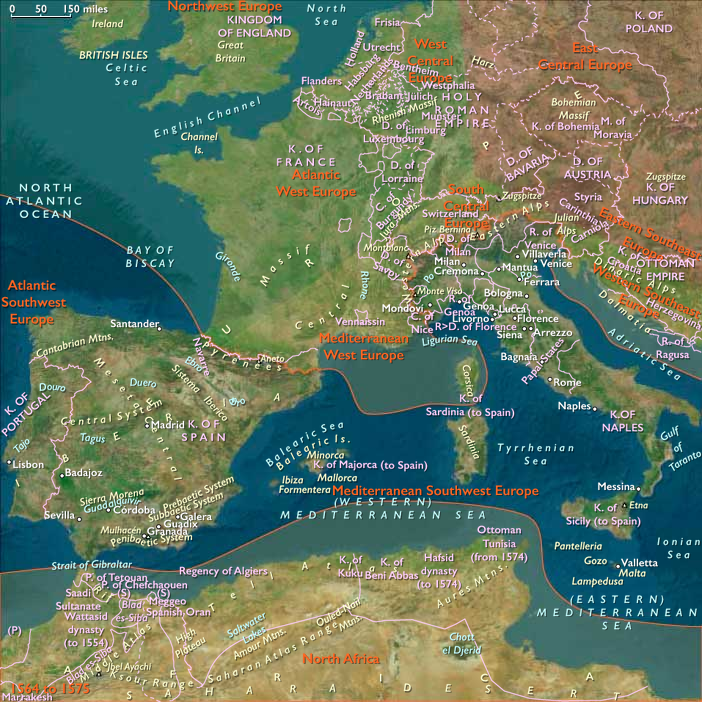
Southwest Europe
View →Subregions
