
Luchino, with an army of northern Europe…
1341 CE
Luchino, with an army of northern Europe mercenaries who he has entrusted to the sons of his brother Stefano, continues to expanded his territory, capturing Pisa and ...
Locations
Regions

Southwest Europe
View →Subregions
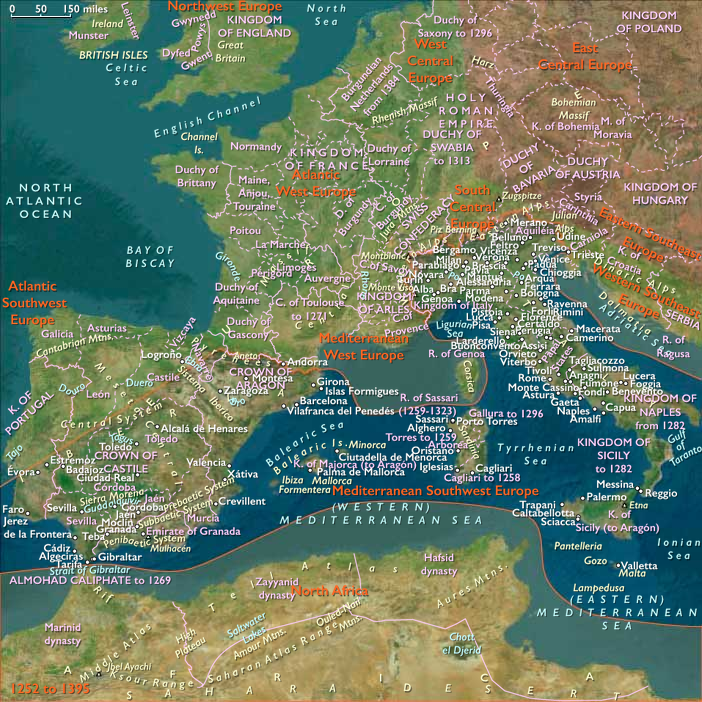
Mediterranean Southwest Europe
View →Related Events
No active filters.
Showing 10 events out of 44473 total
Ivan I (Ivan Kalita), ruler of Moscow from 1328, is granted the title grand duke of Vladimir by the Khanate of the Golden Horde as well as the right to collect tribute for the Mongols from neighboring principalities.
Ivan dies in 1341; his eldest son succeeds him as grand duke.
The internal administration of Grand Duke Gediminas of Lithuania bears all the marks of a wise ruler.
He protects the Catholic as well as the Orthodox clergy; he rhas aised the Lithuanian army to the highest state of efficiency at this time attainable; defended his borders with a chain of strong fortresses and built numerous castles in towns including Vilnius.
At first he had moved the capital to the newly built town of Trakai, but in about 1320 reestablished a permanent capital in Vilnius.
He dies in 1341 and is succeeded by one of his sons, Jaunutis, who will prove unable to control the unrest in the country.
Al-Malik an-Nasir is the most outstanding Mamluk sultan after Baybars.
During his long reign, the Mamluks had concluded a truce with the Mongols in 1232 after several major battles and, despite widespread famine, outbreaks of religious strife, and Bedouin uprisings, has maintained economic prosperity in Egypt and peaceful relations with foreign powers, both Muslim and Christian.
The Mamluks' failure to find an able successor after his death weakens the strength and stability of their realm, which begins to decline politically and economically.
The declining Empire, with Andronikos dead, once more falls prey to family quarrels and civil war.
Dushan, arriving before the gates of Salonika, receives an unexpected ally in Kantakouzenos, who takes up arms against the regents of the young successor, and …
… at Didymoteicho on October 26, 1341, proclaims himself emperor as John VI.
Francesco Petrarca (generally known in the English-speaking world as Petrarch) had moved with his family from his native Arezzo to Avignon, where his father, a Florentine notary in political exile, had taken up residence.
Petrarch had begun legal studies in nearby Montpellier in 1316, and from 1320, with his brother, Gherardo, he attended the University of Bologna.
The Petrarca brothers had returned to Avignon after their father's death in 1326, where Petrarch had for some time led the life of a fashionable young man-about-town and came in contact with members of the Roman Colonna family, who had become his patrons.
In the Church of Santa Clara, on April 6, 1327, Petrarch had seen, and fallen in love with, a woman he calls Laura (but whose true identity remains uncertain).
Despite this emotional event, he had decides to enter the church, taking the minor orders in 1330.
In the employ of Cardinal Giovanni Colonna, he had traveled in 1333 to France, Belgium, and Germany.
Petrarch had moved in 1337 to Vaucluse, at the source of the river Sorgue; while living there, he wrote or began many of his works.
His unfinished “Africa,” on which he worked from 1338 to 1341, is an epic in Latin hexameters on the Second Punic War and the exploits of Scipio Africanus.
In 1341, Petrarch is crowned poet laureate in Rome.
Boccaccio, writing in the courtly and stylized atmosphere of the Neapolitan court, creates the mythical Fiammetta, a lady who dominates his prose and poetry (and who is traditionally but questionably identified as Maria d'Aquino, daughter of King Robert of Anjou).
He writes, possibly between 1336 and 1338, The Most Pleasant and Delectable Questions of Love, a prose romance.
From, possibly, 1339 to 1341, he composes The Book of Theseus, a collection of epic poems in octava rima; in addition, Boccaccio pens numerous short lyrics.
…buying Parma from Obizzo III d'Este.
A three-ship expedition sponsored by King Afonso IV of Portugal sets out from Lisbon for the Canary Islands in 1341, commanded by Florentine captain Angiolino del Tegghia de Corbizzi and Genoese captain Nicoloso da Recco, and employing a mixed crew of Italians, Portuguese and Castilians.
Cruising the archipelago for five months, the expedition maps thirteen islands (seven major, six minor) and surveys the primeval aboriginal inhabitants, the 'Guanches', bringing back four natives to Lisbon. (This expedition will become the basis of later Portuguese claims of priority on the islands.)
The ruinous expense of the war with France forces England’s Edward III to conclude a one year truce in 1341, thus provoking a crisis at home.
The war probably would have ended were it not for the death of the Duke of Brittany precipitating a succession dispute between the duke's half brother John of Montfort and Charles of Blois, nephew of Philip VI.
The Breton dukes have both a historical and ancestral connection to England and are also Earls of Richmond in Yorkshire.