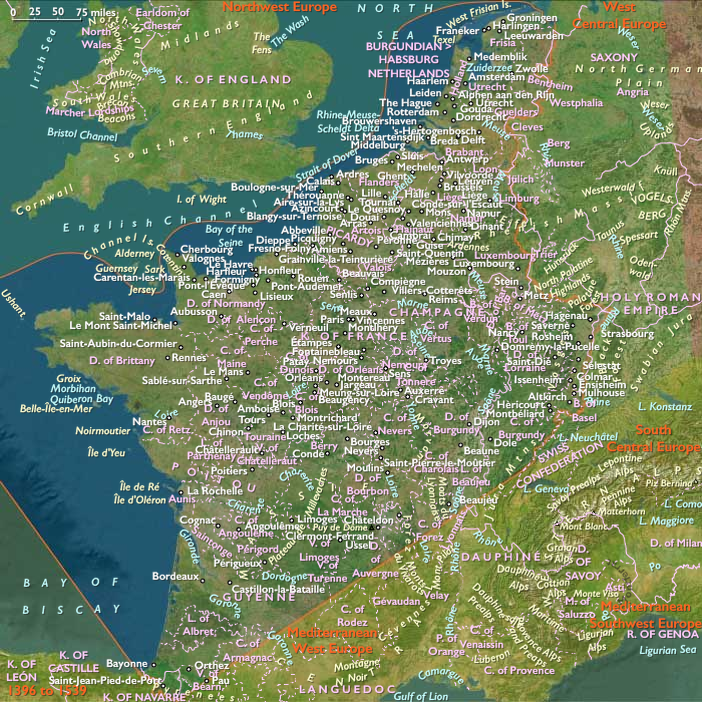
...the County of Luxembourg, strategically located at…
September 1477 CE
...the County of Luxembourg, strategically located at the crossroads of European trade and political influence, represented a significant territorial gain. Luxembourg’s strategic fortresses and central geographic position enhanced Habsburg military and political reach, particularly vis-à-vis neighboring France and the territories of the Holy Roman Empire.
Political Integration under the Habsburgs
Douai and Luxembourg’s incorporation into Habsburg domains in 1477 symbolized the profound shift occurring in European geopolitics following the Burgundian inheritance. The political structures of both territories were quickly adapted to Habsburg rule, reinforcing their positions as integral components of the emerging trans-European Habsburg empire.
This realignment strengthened Maximilian’s position significantly, providing crucial resources—financial, military, and political—to counterbalance the aggressive territorial expansion pursued by the French crown under Louis XI. The acquisition further solidified the Habsburg presence in the Low Countries and set the stage for enduring Austrian dominance in the region.
Economic and Cultural Impact
Under Habsburg rule, Douai continued to flourish culturally and economically, benefiting from integration into a wider European trade and political network. The city retained its significance as an economic center, even as political loyalties shifted. Similarly, Luxembourg’s inclusion into the Habsburg sphere enhanced its strategic and cultural prominence, as it became a central node connecting diverse territories across Europe.
Long-Term Historical Consequences
The passage of Douai and Luxembourg into Habsburg hands represented a critical turning point in European history. It marked the beginning of a lengthy era of Habsburg rule over the Low Countries and nearby territories, fundamentally reshaping the balance of power in late medieval and early modern Europe. These acquisitions directly contributed to the rise of Habsburg dominance, catalyzing long-term geopolitical rivalries—most notably between the House of Habsburg and the French monarchy—that shaped European affairs for centuries thereafter.
Thus, the incorporation of Douai and Luxembourg into Habsburg territory was a defining moment, facilitating the emergence of the Habsburg dynasty as a central player in the political, economic, and cultural history of Atlantic West Europe for generations.
Locations
People
Groups
Commodities
Subjects
Regions
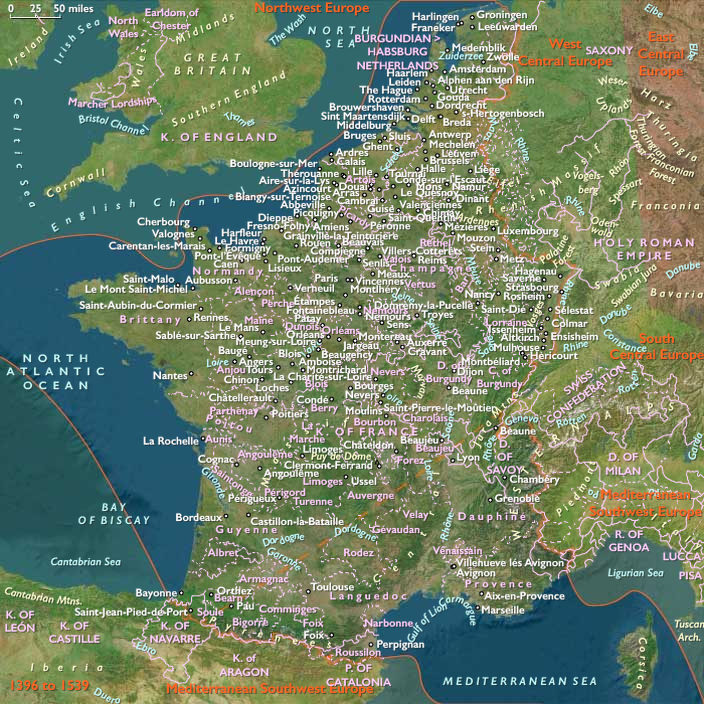
West Europe
View →Subregions