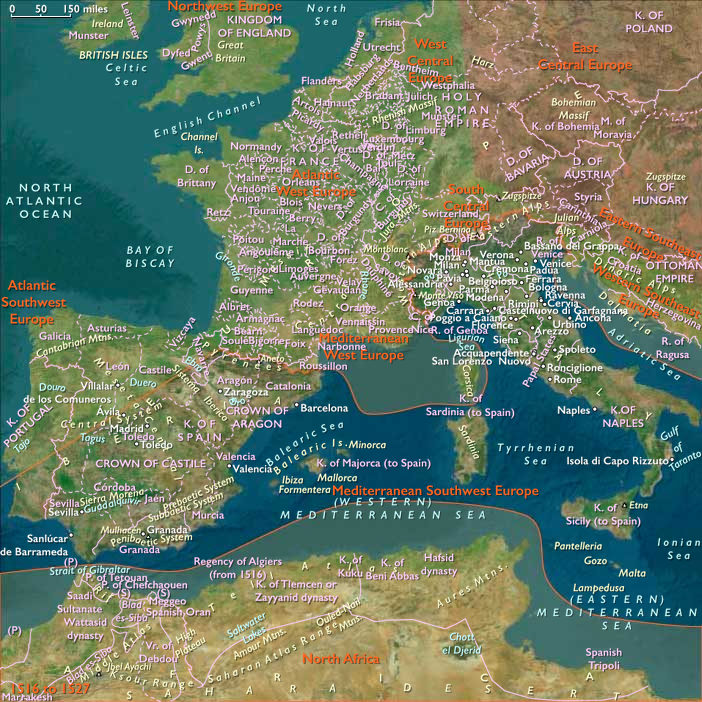
Machiavelli's relationship with the Medici family after…
1526 CE
Machiavelli's relationship with the Medici family after the Florentine crisis of 1513, with arrests for conspiracy, torture and after being sentenced to house arrest, had passively begun to mend itself.
If the dedication of Il Principe to Lorenzo II de' Medici in 1513 had not any effect, part of the then dominant faction of the Florence was not against him, and had instead granted him an appointment.
In his letter he deplores of his idle state, offering his precious political experience to the new lord.
To sustain that timid request Machiavelli, with a considerably courtier-like spirit, had set his satirical Mandragola for the wedding of Lorenzino de' Medici in 1518.
In 1520 he had been invited to Lucca for a mission of a semiprivate character, indicating that the ostracism was to be raised up.
At the end of that year, Giulio Cardinal de Medici had commissioned him to write a History of Florence.
Although this was not exactly the charge he desired, Machiavelli had accepted it as the only possible way to come back into the graces of the Medici.
The intent of the work, although semiofficially, was to recover the city's charge of historic officiality.
The wage for the appointment was not large (fifty-seven florins per year, later increased to one hundred).
The finished eight-volume work is presented officially to Giulio de' Medici, now Pope Clement VII, in May 1526.
The Pope likes the work and rewards him, albeit moderately, and asks for his support in the creation of a national army, in the wake of his theoretical work The Art of War, as a part of the the preparations for the War of the League of Cognac.
After a dozen years as a scholarly recluse, Machiavelli remains temperamentally unsuited to such a life, and has never abandoned the hope of returning to active political service, a hope that is fulfilled in 1525 when the Medici recall the fifty-six-year-old Machiavelli to service.
Locations
Topics
Commodities
Subjects
Regions
Southwest Europe
View →Subregions