
Many of the unsuccessful Spanish Muslim participants…
May 818 CE
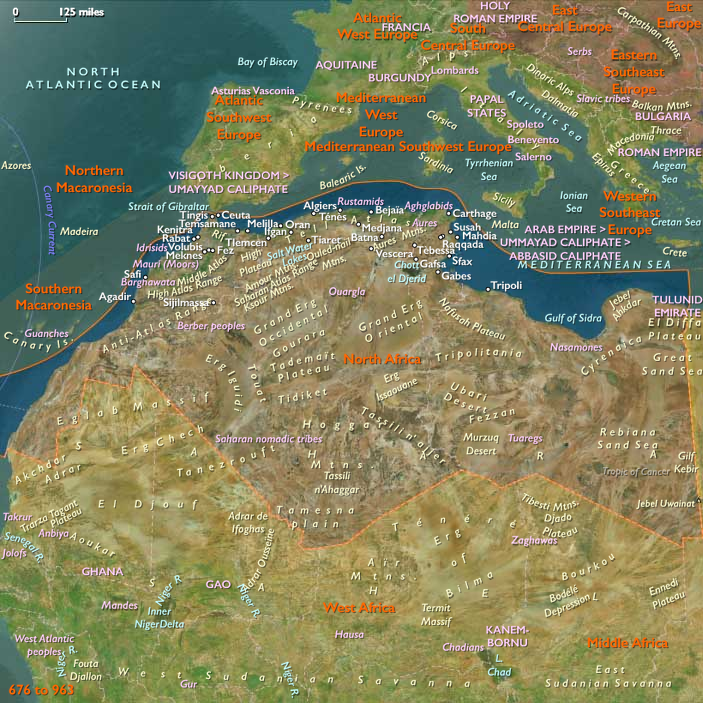
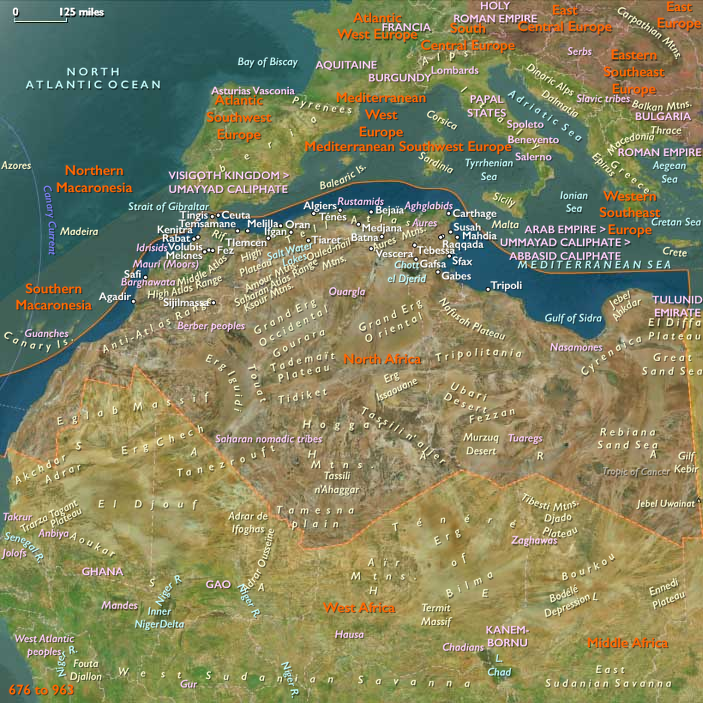
Many of the unsuccessful Spanish Muslim participants in the 818 “Revolt of the Arrabal” emigrate from Córdoba to North Africa to settle in Fés.
Locations
Groups
Subjects
Regions
North Africa
View →Subregions
North Africa
View →Related Events
No active filters.
Showing 10 events out of 54700 total
A requirement of Tantric Buddhism, that rites be performed in secret but with the congregation present, leads to the development of forehalls in Tantric “kondos,” such as the one built at Koryuji in about 818.
Ashot is the son of the Iberian nobleman Adarnase who had founded the Bagratoni hereditary fiefdom in Tao-Klarjeti (now northeast Turkey) and bequeathed to his son extensive possessions acquired upon the extinction of his Guaramid and Chosroid cousins.
Ashot initially had failed to gain a foothold in central Iberia (Shida Kartli), his efforts being dashed by the Arab control of Tiflis.
Ashot has established himself in his patrimonial duchy of Klarjeti, where he has restored the castle of Artanuji said to have been built by the Iberian king Vakhtang I Gorgasali in the fifth century, and received imperial protection, being recognized as the presiding prince and curopalates of Iberia.
To revive a country devastated by the Arabs and cholera epidemics, he patronized the local monastic communities established by Grigol Khandzteli, and encouraged the settlement of the Georgians in the region.
As a result, the political and religious center of Iberia is effectively transferred from central Iberia to the southwest, in Tao-Klarjeti.
From his base in Tao-Klarjeti, Ashot fights to recover more Georgian lands from the Arab hold and, though not always successful, succeeds in taking much of the adjoining lands from Tao in the southwest to Shida Kartli in the northeast, including Kola, Artani, Javakheti, Samtskhe, and Trialeti.
Of the former Chosroid possessions, only Kakheti to the east eludes him.
With local Arab emirs in the Caucasus growing ever more independent, the Caliph recognizes Ashot as the prince of Iberia in order to counter the rebellious emir of Tiflis Isma’il ibn Shu’aib around 818.
The emir had enlisted support of Ashot’s foe—the Kakhetian prince Grigol—and the Georgian highland tribes of Mtiulians and Tsanars.
Ashot, joined by Constantinople’s vassal king of Abasgia, Theodosius II, meets the emir on the Ksani, winning a victory and pushing the Kakhetians from central Iberian lands.
Al-Hakam crushes a rebellion led by clerics in the suburb (“arrabal” in Spanish; hence the incident’s name “Revolt of the Arrabal”) of al-Ribad on the south bank of the Guadalquivir river in 818.
The rebels storm the palace in March, but the palace guards slaughter the attackers.
Some three hundred of the suburb’s notables are captured and crucified.
The emir’s troops sack the suburb and demolish it, expelling the rest of its approximately sixty thousand inhabitants from Spain.
Some move to Alexandria in Egypt, some to Fez and Crete.
Others join the Levantine pirates.
The Revolt of Bernard of Italy and His Surrender (817)
In 817, Louis the Pious issues the Ordinatio Imperii, a decree intended to regulate the succession of the Frankish Empire and prevent dynastic fragmentation. The ordinance formally designates Lothair I, Louis’ eldest son, as co-emperor, while his younger sons Pepin and Louis the German receive Aquitaine and Bavaria as subordinate kingdoms.
However, the Ordinatio Imperii places Bernard of Italy, Charlemagne’s illegitimate grandson and ruler of the Kingdom of Italy, in an uncertain and subordinate position. Though still nominally King of Italy, Bernard is now clearly subordinate to Lothair I, threatening his autonomy. Upon learning of this development, Bernard begins plotting for independence, fearing the gradual absorption of his kingdom into the empire.
Louis the Pious’ Swift Response
Louis, learning of Bernard’s discontent and suspected rebellion, acts decisively. Instead of allowing time for Bernard to gather support, Louis mobilizes his army immediately and marches toward Italy. By moving swiftly, he prevents Bernard from organizing an effective resistance.
Stopping at Chalon-sur-Saône, Louis sends an invitation to Bernard, offering him a meeting. Realizing he is outmatched and unprepared for war, Bernard, intimidated by the emperor’s rapid action, has no choice but to surrender at Chalon.
This surrender, however, will not save him from Louis' wrath, as the emperor seeks to eliminate any potential challenge to his authority. What follows is one of the most tragic episodes of Louis the Pious' reign.
Bernard is taken to Aachen by Louis, who here has him tried and condemned to death for treason.
Louis has the sentence commuted to blinding, which is duly carried out; Bernard does not survive the ordeal, however, dying after two days of agony.
Others also suffer: Theodulf of Orléans, in eclipse since the death of Charles, is accused of having supported the rebellion, and is thrown into a monastic prison, where he dies soon after—poisoned, it is rumored.
The fate of his nephew will deeply mark Louis's conscience for the rest of his life.
A number of the exiled Córdoban revolutionaries sail to Alexandria and take control here until their expulsion, to Crete, in 827.
The vizier had been assassinated in February 818 during al-Fadl’s long journey from Merv to Baghdad, and 'Ali ar-Rida dies in August 818, after a brief illness, at Tus. (Shi'ite historians attribute his death to poison, possibly administered by the caliph himself. His shrine (mashhad) at Tus becomes a pilgrimage place and gives its name to the city Mashhad, or Meshed. The Shi'ites attribute many miracles to 'Ali ar-Rida.)
Tribal feuds have weakened the Arabs.
According to tradition, Asad ibn Samad, the son of Saman Khuda, the founder of the Samanid dynasty, had been named by his father in honor of the Caliphal governor of Khurasan, Asad ibn 'Abd-Allah al-Qasri (723-727), who had converted Saman to Islam.
Asad’s son Nuh is in 819 granted authority over the city of Samarkand by Caliph Al-Ma'mun's governor of Khurasan, Ghassan ibn 'Abbad, as a reward for his support against the rebel Rafi' ibn Laith This is the beginning of the Samanid dynasty, the first native Persian dynasty to arise after the Muslim Arab conquest.
The four grandsons of the dynasty's founder, Saman Khuda, had been rewarded with provinces for their faithful service to the Abbasid caliph al-Mamun: Nuh obtains Samarkand; …
…Ahmad, Fergana; …
…Yahya, Shash; and …