An assembly meeting in Bogotá adopts a…
1828 CE to 1839 CE
An assembly meeting in Bogotá adopts a new constitution for the Republic of Great Colombia in April 1830.
It bears little resemblance to the one Bolivar had drafted for Bolivia, even though he at one time had placed his hopes on this assembly to reform Colombian institutions in line with his ideas.
The constitution of 1830 strengthens the executive and increases the presidential term (even if not to life) but is little different in fundamentals from that of 1821, and with the republic already in process of dissolution, it is an exercise in futility.
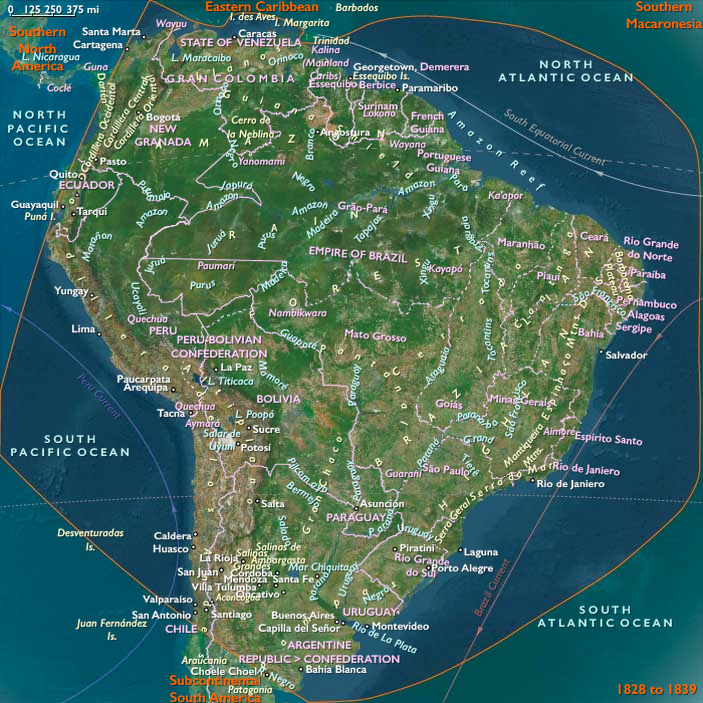
The rump that is left of Great Colombia—present-day Colombia plus Panama—reconstitutes itself as the Republic of New Granada (1832-58), and in 1832 it adopts another constitution closely following the 1821 model.
The new charter slightly liberalizes the conditions for suffrage and gives the provincial assemblies a limited right to enact ordinances on local affairs.
One of its articles abolishes the fuero, a royal charter bestowing special judicial privileges on the military.
There is no similar action on the ecclesiastical fuero because the clergy is still too powerful to antagonize unnecessarily, but the prestige of the military has suffered in New Granada from overly close association with Venezuelan influence during Bolivar's Republic of Colombia.
In addition, many top officers, being Venezuelan, had gone home after the collapse of the union.
The military establishment is thus reduced in size and vulnerable, and its treatment in the first New Granadan constitution is a foretaste of the subordinate role it will continue to play in Colombian history.
Locations
Groups
Subjects
Regions
South America
View →Subregions