
Event
The Constitutional Revolution in Portugal and the…
The Constitutional Revolution in Portugal and the Independence of Brazil (1820–1822)
By 1820, Portugal was undergoing a major political transformation, as liberal forces pushed for a constitutional monarchy, challenging the existing absolutist system. Meanwhile, across the Atlantic, Brazil was moving toward independence, influenced by liberal ideas and anti-colonial movements in the Americas.
The Constitutional Cortes of 1821
- In December 1820, indirect elections were held to form a constitutional cortes, which convened in January 1821.
- The elected deputies were mostly constitutional monarchists, committed to:
- Replacing absolutism with a constitutional government.
- Abolishing feudal privileges and the Inquisition.
- Establishing legal and civil rights under a new constitution.
- On September 23, 1821, the cortes approved a new constitution, marking a major step toward liberal governance in Portugal.
João VI Returns to Portugal – A King Under a Constitution
- As Portugal moved toward constitutional rule, King João VI decided to return to Lisbon, leaving his son Pedro in Brazil as regent.
- Upon his arrival in Portugal, João swore an oath to uphold the new constitution, making Portugal a constitutional monarchy.
Brazil’s Path to Independence (1822)
- With João VI’s departure from Brazil, tensions grew between Portuguese authorities and Brazilian liberals.
- Inspired by:
- The American Revolution (1776).
- The independence movements in Spanish America.
- The spread of liberal ideals in Europe.
- Brazilian nationalists pushed for full independence.
- On October 12, 1822, Pedro declared Brazil’s independence, taking the title Emperor Pedro I of Brazil, establishing a constitutional empire.
Conclusion – A Dual Transformation
- Portugal transitioned to a constitutional monarchy, while Brazil broke free to become an independent empire.
- João VI’s return to Lisbon confirmed Portugal’s shift to liberal governance, while his son Pedro embraced independence, ensuring Brazil’s sovereignty.
- This period marked the end of Portugal’s colonial dominance over Brazil, replacing it with an independent Brazilian monarchy that would later shape the country’s political development.
The revolutions of 1820–1822 reflected the global wave of liberalism, reshaping Portugal and Brazil into distinct constitutional states.
-
{# Image navigates to the detail page; the magnifying-glass chip is the only Fancybox lightbox trigger (kept a separate sibling — anchors can't nest). #}
 The North Atlantic Lands
World
-
{# Image navigates to the detail page; the magnifying-glass chip is the only Fancybox lightbox trigger (kept a separate sibling — anchors can't nest). #}
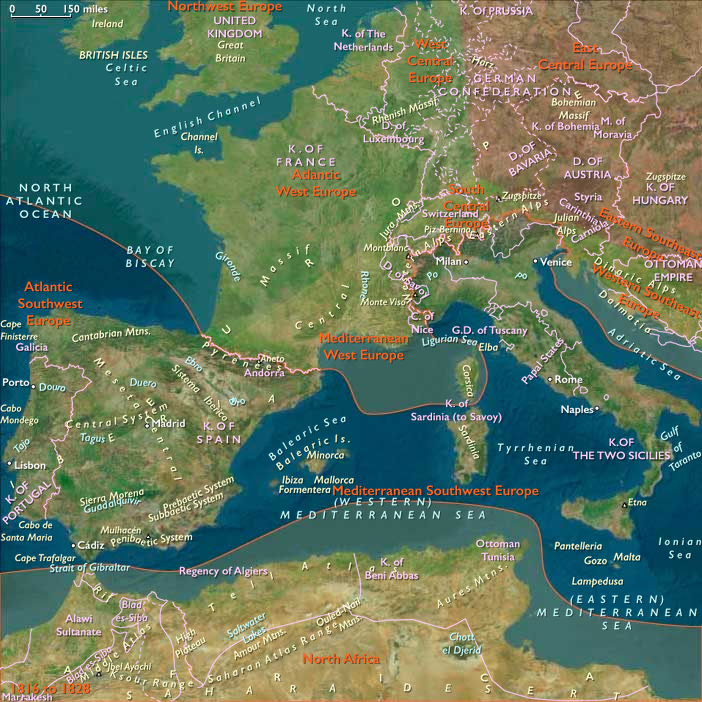 Southwest Europe
Region
-
{# Image navigates to the detail page; the magnifying-glass chip is the only Fancybox lightbox trigger (kept a separate sibling — anchors can't nest). #}
 Atlantic Southwest Europe
Subregion
