
East Africa (909 BCE – 819 CE): …
Years: 909BCE - 819
East Africa (909 BCE – 819 CE): Aksum’s Highlands, Great Lakes Villages, and the Birth of the Swahili Littoral
Regional Overview
From the basalt terraces of Aksum to the mangrove-fringed coasts of Zanzibar and the floodplains of the Great Lakes, early East Africa was a continent within a continent — where highland kingdoms, inland farmers, and maritime voyagers forged new pathways of exchange and identity.
Between the late first millennium BCE and the early first millennium CE, this region became a crossroads of African innovation and interoceanic contact, knitting together the Red Sea, Indian Ocean, and central savannas through iron, agriculture, and long-distance trade.
By 819 CE, its dual systems — the highland–inland chiefdoms and the coastal canoe polities — had formed the environmental and cultural bedrock of medieval Aksum, the Swahili city-states, and the Great Lakes monarchies to come.
Geography and Environment
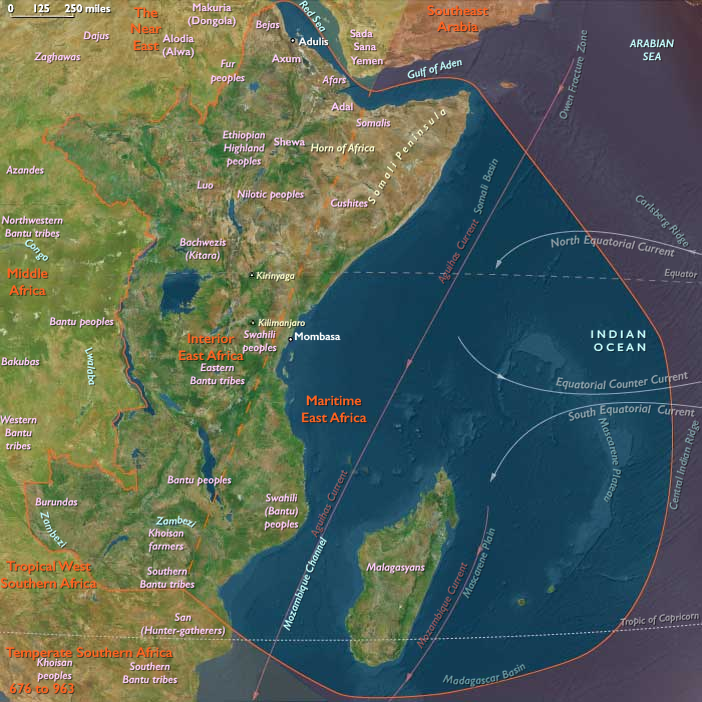
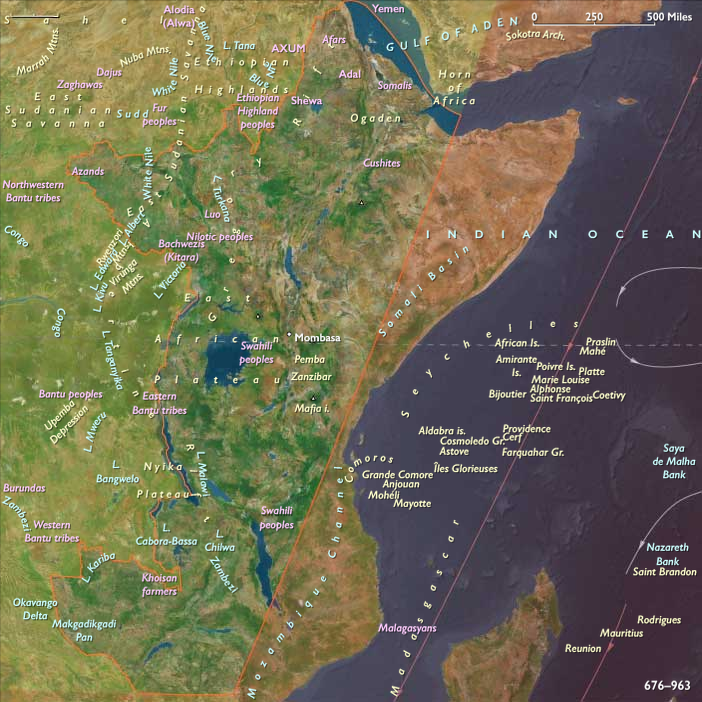
East Africa divides naturally between its interior highlands and lakes and its Indian Ocean rim.
-
The Ethiopian and Eritrean highlands, crowned by the Tigray and Simien plateaus, received regular monsoon rains and controlled the headwaters of the Blue Nile.
-
Southward lay the Rift Valley and the Great Lakes basin — Victoria, Tanganyika, Malawi — bordered by fertile escarpments.
-
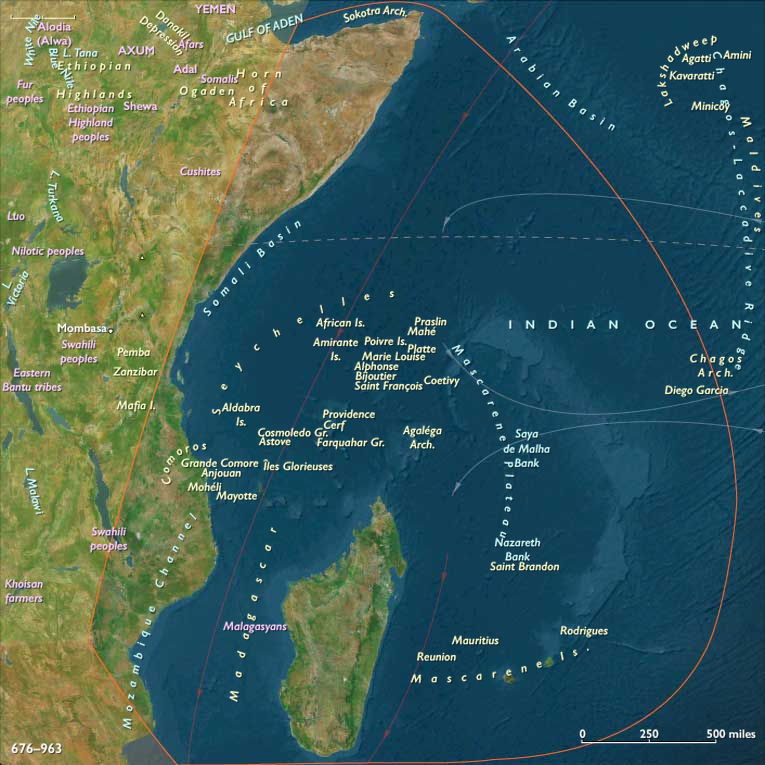
To the east stretched the coastal plains and offshore archipelagos of Kenya, Tanzania, Mozambique, and the Comoros, facing monsoon winds that connected Africa to Arabia, India, and Island Southeast Asia.
Seasonal monsoons governed both climate and commerce: the northeast winds of November–March carried vessels toward Africa, while the southwest winds of April–September returned them home. Periodic droughts tested inland farmers, but the diversity of altitudes and crops provided ecological stability across the region.
Societies and Political Developments
Highlands and Interior Chiefdoms
The Aksumite kingdom (1st–7th centuries CE) dominated the Ethiopian and Eritrean highlands, controlling trade from the Red Sea ports of Adulis and Zula.
Aksum’s kings minted gold and silver coins, carved monumental stelae, and adopted Christianity in the 4th century CE — making Aksum one of the world’s earliest Christian monarchies.
Farther west, Nilotic groups in South Sudan practiced pastoralism and riverine agriculture around the Sudd swamps, while to the south the Great Lakes region saw the rise of iron-farming villages organized into clans and proto-chiefdoms in Rwanda, Burundi, and Uganda.
By the first centuries CE, small agrarian communities in Zambia, northern Zimbabwe, and inland Mozambiquecultivated millet and sorghum, herded cattle, and smelted iron — forming the southern frontier of the East African farming complex.
Coasts and Islands
Along the Indian Ocean littoral, Bantu-speaking settlers met Austronesian voyagers arriving from Island Southeast Asia.
Their fusion on Madagascar produced new languages, crops (banana, yam, rice), and technologies (outrigger canoes, sewn-plank craft).
On the mainland coast, canoe villages at Lamu, Zanzibar, and Kilwa organized around lineage elders and specialized in fishing, ironworking, and bead exchange.
By the late first millennium CE, these settlements had evolved into maritime chiefdoms, linking the African interior to the Red Sea and Indian Ocean worlds.
Economy and Trade
The region’s wealth rested on ecological complementarity:
-
Highlands and lakes produced grain, cattle, and iron tools.
-
Coasts and islands provided fish, salt, resin, and marine shell ornaments.
-
Long-distance trade moved ivory, gold, and slaves northward to Aksum and eastward to Arabia and India, returning with beads, glass, and cloth.
Aksum controlled the Red Sea corridor, mediating between African, Arabian, and Indian markets.
Further south, a chain of coastal and island settlements — Comoros, Zanzibar, Madagascar — formed the embryonic Swahili exchange system, its sailing calendars synchronized with monsoon rhythms.
Technology and Material Culture
Iron technology unified the region. Highland furnaces smelted ore into hoes and spearheads; lowland smiths produced fishhooks and knives.
Terrace agriculture and tank irrigation stabilized Aksumite highlands, while hoe-farming and slash-and-burn horticulture spread through the lakes and coasts.
Canoe construction reached new sophistication: the outrigger and sewn-plank vessels of Madagascar and the Comoros fused Austronesian design with African seamanship.
Stone architecture flourished in Aksum’s stelae and temples, while coastal communities produced distinctive red-slipped pottery that blended African and Asian forms.
Belief and Symbolism
Religious life was kaleidoscopic:
-
In the north, Aksumite Christianity and older South Arabian solar cults coexisted.
-
In the interior, ancestor veneration, fertility rites, and clan totems ordered social life.
-
Along the coast, syncretic rituals merged African spirit traditions with Austronesian sea worship — canoe shrines and ancestral effigies honored voyagers and wind deities.
Everywhere, water and ancestry framed cosmology: the Nile, the lakes, and the sea were living entities mediating between human and divine realms.
Adaptation and Resilience
The region’s strength lay in diversity and interdependence.
-
The highlands offset coastal droughts through caravan trade in grain and livestock.
-
When Red Sea or Indian Ocean routes faltered, interior iron and ivory sustained exchange.
-
Flexible kin networks bridged ecological zones, ensuring the flow of goods and information.
Technological hybridization — combining African metallurgy with Austronesian navigation — created one of the most adaptive cultural systems of the ancient world.
Regional Synthesis and Long-Term Significance
By 819 CE, East Africa had matured into a twofold world:
-
The interior and highlands — agrarian, iron-based, and ritually anchored in ancestry — extended from Aksum’s Christian kingdom to the banana gardens of the Great Lakes.
-
The coasts and islands — maritime, hybrid, and cosmopolitan — linked African economies to Arabia, India, and Island Southeast Asia.
Together they forged an enduring Indian Ocean civilization, rooted in African soil yet open to global exchange.
From these foundations arose the Swahili city-states, the Ethiopian Christian kingdoms, and the Great Lakes monarchies — each inheriting the environmental versatility, cross-cultural imagination, and spiritual pluralism first crystallized in this early age.
Groups
Commodoties
Subjects
Regions
Subregions
Related Events
Showing 10 events out of 66848 total
Years: 909BCE - 819
Groups
Commodoties
Subjects
Regions
Subregions