Northeastern North America (909 BCE–819 CE): Watersheds,…
909 BCE to 819 CE
Northeastern North America (909 BCE–819 CE): Watersheds, Ceremonial Landscapes, and Regional Woodland Traditions
Geographic Parameters
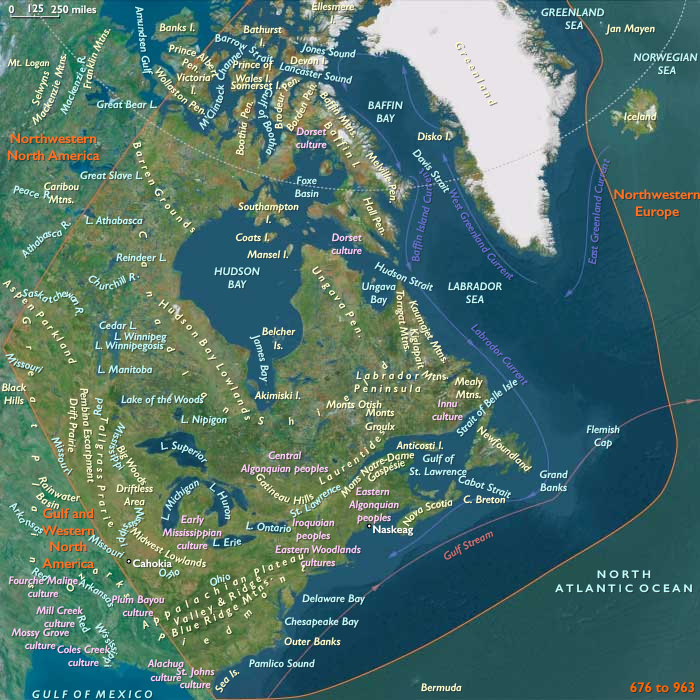
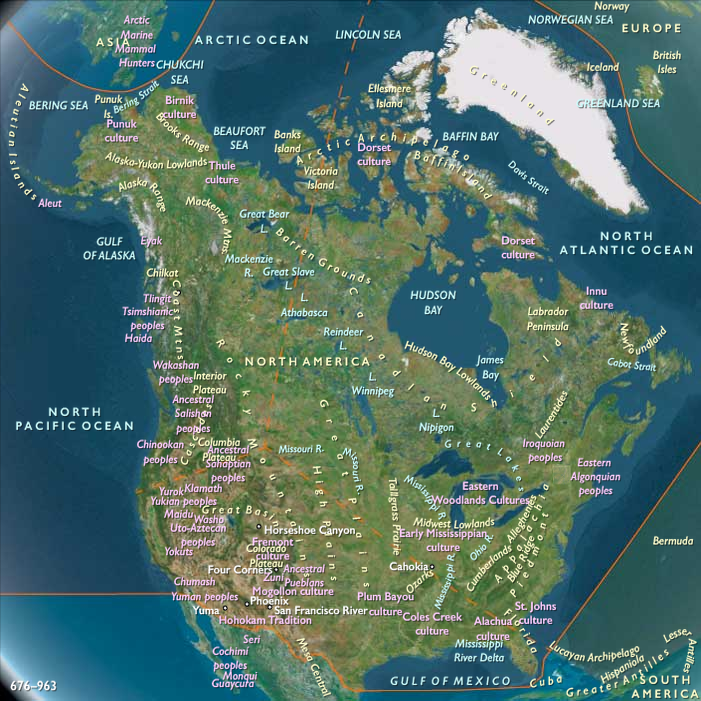
Northeastern North America extends from the Atlantic coast between present-day Jacksonville, Florida, and St. John's, Newfoundland, westward across the Appalachian Highlands, Ohio Valley, Great Lakes basin, and prairie–forest transition to the Saskatchewan–Alberta boundary. It also includes the St. Lawrence watershed, Hudson Bay lowlands, Labrador, the Canadian Arctic Archipelago, Baffin Island, and Greenland. Major environmental corridors include the Chesapeake, Delaware, Hudson, and Gulf of Maine coasts; the St. Lawrence River; the Great Lakes; the Ohio, Illinois, and upper Mississippi river systems; the Appalachian Plateau; the Canadian Shield; and the Arctic coasts of Labrador and Greenland.
Environmental Continuity
Throughout the epoch, Northeastern North America's immense environmental diversity remained the principal force shaping human life. Hardwood forests dominated the temperate interior, giving way northward to vast boreal forests, muskeg, tundra, and polar coasts. Thousands of rivers and lakes linked inland watersheds into one of the world's greatest freshwater transportation systems, while Atlantic estuaries, tidal marshes, and productive fisheries sustained dense coastal populations. Seasonal cycles of fish migrations, waterfowl, mast harvests, and large game continued to organize settlement rhythms across much of the region, ensuring that waterways remained the primary framework for communication and exchange.
Human Adaptation
Communities increasingly combined hunting, fishing, gathering, and horticulture in ways adapted to local environments rather than following a single economic model. Inland societies cultivated indigenous crops—including squash, sunflower, goosefoot, and other members of the Eastern Agricultural Complex—while continuing to rely heavily upon wild resources. During the later centuries of the epoch, improved varieties of maize spread gradually into parts of the Ohio Valley, lower Great Lakes, and adjacent regions, although its importance varied considerably and remained far from universal.
Coastal peoples developed sophisticated maritime adaptations based upon shellfish harvesting, fishing, and canoe travel, while northern populations refined specialized Arctic and subarctic hunting economies centered upon marine mammals, caribou, musk oxen, and seasonal coastal resources. Across the continent, birchbark canoes, dugout canoes, snow travel, and river navigation allowed communities to exploit highly varied landscapes without fundamentally altering them.
Economic Organization
The continent's interconnected watersheds supported increasingly extensive regional exchange. Native copper from the Great Lakes, marine shells from the Atlantic and Gulf coasts, high-quality cherts, mica from the Appalachians, pigments, ornamental stones, and other valued materials circulated across enormous distances through overlapping networks of reciprocal exchange rather than centralized commerce.
During the Middle Woodland period, these interaction systems reached their greatest geographical extent through the Hopewell Interaction Sphere, which linked diverse societies while allowing each region to maintain its own cultural traditions. In later centuries these long-distance ceremonial exchanges gradually gave way to stronger regional economies rooted in local production, village networks, and watershed-scale interaction.
Institutions
Permanent villages became more common in many temperate regions while seasonal mobility remained important elsewhere. Early Woodland communities introduced ceramic traditions that gradually diversified into distinctive regional styles. Mortuary practices evolved from modest burial mounds into increasingly elaborate ceremonial landscapes associated with Adena and later Hopewell traditions, particularly within the Ohio Valley.
These earthworks were not urban centers or political capitals but ceremonial gathering places that brought dispersed communities together for ritual, exchange, and social reaffirmation. Following the decline of Hopewell ceremonial networks after the fourth century CE, institutions increasingly became localized. Village communities assumed greater importance, regional pottery traditions diversified, and new ceremonial landscapes—including the Late Woodland effigy mounds of the Upper Mississippi region—emerged alongside enduring local religious practices.
Across the northern forests and Arctic, communities maintained institutions closely tied to seasonal mobility, kinship, and ecological knowledge, demonstrating that increasing complexity did not require permanent monumental architecture.
Political Systems
Political authority remained predominantly local throughout the epoch. Leadership generally rested with kin groups, respected elders, ritual specialists, and temporary community leaders rather than centralized states. Even the largest ceremonial earthworks reflected cooperation among autonomous communities instead of permanent governments.
As Hopewell interaction networks contracted, political organization became increasingly regionalized. Village communities strengthened local leadership while maintaining alliances through exchange, marriage, and shared ceremonial traditions. During the final centuries of the epoch, larger Late Woodland villages, expanding horticulture in portions of the interior, and increasingly organized settlement networks foreshadowed the later emergence of Mississippian centers in the Mississippi Valley and the nucleated Iroquoian communities of the lower Great Lakes, developments that would fully mature only after 820 CE.
Legacy of the Epoch
Between 909 BCE and 819 CE, Northeastern North America evolved from a mosaic of Early Woodland societies into a continent-spanning network of diverse regional cultures linked by rivers, lakes, and coastlines. Ceramics, horticulture, ceremonial earthworks, long-distance exchange, and increasingly permanent villages transformed many landscapes without displacing the ecological systems that sustained them. By the close of the epoch, the great Hopewell ceremonial networks had given way to resilient regional traditions, maize cultivation was expanding unevenly across portions of the interior, and localized village societies had established the environmental and institutional foundations from which the Mississippian world, Iroquoian confederacies, and later Arctic expansions would emerge during the following epoch.
Groups
Commodities
Subjects
Regions
Northern North America
View →Subregions