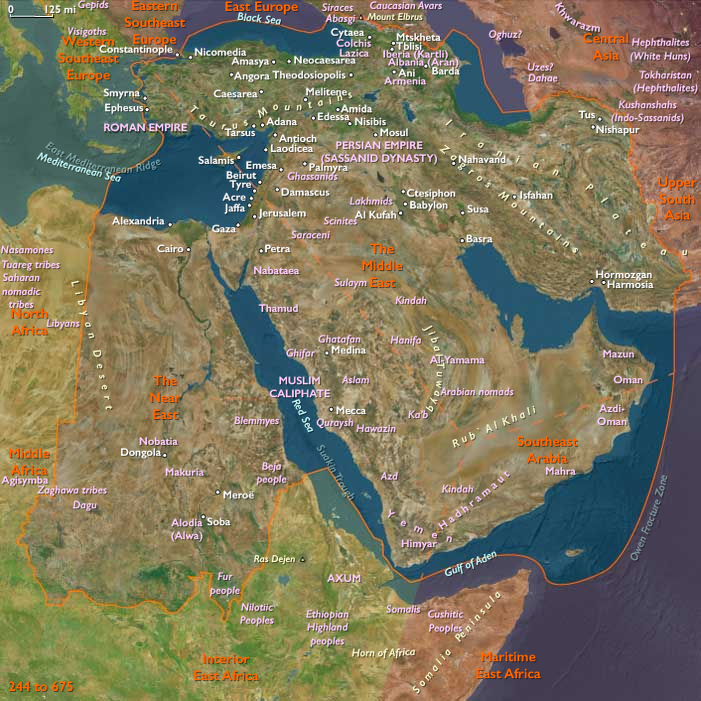
…Martyropolis. Additionally, he agrees to a new…
591 CE
…Martyropolis.
Additionally, he agrees to a new partition of the Caucasus by which the Sassanids hand over to the Romans many cities, including Tigranokert, …
Groups
Commodities
Subjects
Regions
The Near and Middle East
View →Subregions
Middle East
View →Related Events
Showing 10 events out of 25 total
The Frankish invasion of Lombard lands in 590 probably results in the establishment of some sort of Frankish supremacy; the Lombards pay tribute, at least for a time.
Agilulf manages to unify the duchies of the north into a single kingdom on the on the basis of the lands ceded to his predecessor.
East Central Europe (592–603 CE): Avar Pressure, Slavic Territorial Solidification, and Early State Formation in Bohemia and Moravia
Between 592 and 603 CE, East Central Europe—encompassing Poland, Czechia, Slovakia, Hungary, and those portions of Germany and Austria lying east of 10°E and north of a line stretching from roughly 48.2°N at 10°E southeastward to the Austro-Slovenian border near 46.7°N, 15.4°E—experienced continued geopolitical evolution marked by the dominant presence of the Avar Khaganate, intensified Slavic settlement, and the early stages of state formation in the distinct West Slavic territories of Bohemia and Moravia. During this period, the Avars further strengthened their hold over the Carpathian Basin, increasing diplomatic and military pressure on neighboring territories, notably the emerging Slavic polities to their northwest and Bavarian duchy to the west.
Political and Military Developments
Avar Dominance and Expansion
-
The Avar Khaganate further consolidated its position in East Central Europe, exerting influence and pressure across territories ranging from Hungary and Slovakia southward into the northern Balkans.
-
Frequent Avar military campaigns and diplomatic pressures influenced regional stability, causing localized disruptions while prompting smaller neighboring powers, especially Bavarians and early Slavic communities, to develop stronger defensive measures.
Early Bohemian and Moravian Polities
-
In Bohemia, West Slavic communities increasingly unified under local leadership, establishing stronger, centralized tribal structures and fortifying settlements against potential Avar incursions. This period saw the roots of a distinct early Czech identity and leadership hierarchy forming in the region.
-
Similarly, in Moravia, emerging local polities consolidated under tribal chieftains, organizing effective defense and diplomatic responses to pressure from Avars to the southeast and interactions with Bavarians to the west.
Bavarian Diplomatic Role
-
Bavaria (Baiuvarii) continued to act as an influential political intermediary between Frankish, Slavic (especially Moravian), and Avar interests, carefully balancing regional alliances and trade partnerships.
Economic and Technological Developments
Expanded Trade Networks
-
Bohemia and Moravia played increasingly pivotal roles in regional trade networks, facilitating commercial interactions between Avar-controlled southern regions, Bavarian-controlled western territories, and Slavic groups to the north and east. Key commodities included agricultural products, textiles, iron goods, and luxury items from Byzantium.
Infrastructure Maintenance and Fortification
-
Local leadership in Bohemia and Moravia actively improved fortifications and settlements, reflecting growing political organization and providing protection against raids and external threats, particularly from the Avars.
Cultural and Artistic Developments
Distinct West Slavic Identities
-
Bohemian and Moravian Slavic communities further solidified their distinct cultural identities, evidenced by unique styles in pottery, jewelry, settlement patterns, and burial customs clearly differentiated archaeologically from other Slavic and neighboring cultures.
Avar Cultural Synthesis
-
The Avars continued to significantly influence regional culture through their distinctive artistic expressions, especially metallurgy and decorative arts, merging Central Asian steppe traditions with local European influences.
Settlement and Urban Development
Strengthened Bohemian and Moravian Settlements
-
Bohemia and Moravia experienced the growth of fortified settlements (hillforts) and stable villages, indicating increasing social organization and early signs of political centralization essential to future state formation.
Avar-Controlled Regional Centers
-
Important cities and strategic settlements, including Augusta Vindelicorum (Augsburg), Vindobona, and Aquincum, continued flourishing under Avar rule as vital administrative and trade hubs.
Social and Religious Developments
Bohemian and Moravian Social Hierarchies
-
In both Bohemia and Moravia, clear hierarchical structures emerged, featuring tribal chieftains, warrior aristocracies, and organized communal practices, establishing firm social foundations for future medieval duchies.
Avar Social and Political Stability
-
The Avars maintained highly organized social and military structures under the Khagan’s authority, further securing their regional dominance and stabilizing the extensive territories under their control.
Long-Term Consequences and Historical Significance
The era 592–603 CE was pivotal in shaping East Central Europe's early medieval landscape. Continued Avar dominance and intensified pressure catalyzed defensive and political developments among Slavic communities, particularly in Bohemia and Moravia, where early state structures began forming. Simultaneously, Bavaria's diplomatic and economic interactions with neighboring regions set essential patterns of commerce and alliance-building. These developments significantly influenced future medieval state formation and cultural identities, creating lasting frameworks that would define East Central Europe's historical trajectory.
Atlantic West Europe (592–603): Consolidation of Frankish Realms, Queenly Rivalries, and Ecclesiastical Ascendancy
Between 592 and 603, Atlantic West Europe—encompassing Neustria, Austrasia, Burgundy, Aquitaine, and the emerging territories in the Low Countries—continued to experience intense Merovingian dynastic rivalries, shaped by powerful regencies, particularly those of Queens Brunhilda and Fredegund. This era was characterized by shifting political alliances, military confrontations, the strengthening of the church’s political and social influence, and gradual stabilization after decades of turmoil.
Political and Military Developments
Resolution of the Neustrian–Austrasian Conflict
- Fredegund, regent in Neustria, decisively defeated the Austrasian forces at the Battle of Droizy in 593, reaffirming Neustrian independence and power.
- Her victory temporarily stabilized Neustria’s position and laid foundations for her son, Chlothar II, to eventually reunify the Frankish kingdoms.
Regency and Influence of Brunhilda
- After Fredegund’s death in 597, Brunhilda solidified her position as the dominant power behind her grandson, Theudebert II of Austrasia, and his brother, Theuderic II of Burgundy.
- Brunhilda's policies sought to centralize royal power and strengthen administrative control, encountering fierce resistance from the Austrasian nobility, who opposed her growing influence.
Diplomatic and Dynastic Maneuvering
- Continuous political intrigue characterized this period, as Brunhilda and Austrasian-Burgundian interests worked to undermine Neustria’s influence, preparing for further power struggles after Fredegund’s death.
- Regional tensions continued, particularly around Aquitaine and the frontiers between Austrasia, Neustria, and Burgundy.
Economic and Social Developments
Stable Agrarian Economy and Urban Resilience
- Agricultural production continued to thrive in areas less directly affected by warfare, notably Burgundy, Aquitaine, and Loire valley estates, preserving economic stability.
- Important trade centers—Tours, Paris, Bordeaux, Lyon—remained resilient, sustaining regional commerce and providing continuity despite political uncertainty.
Localized Governance and Nobility
- The nobility solidified regional autonomy, establishing networks of localized governance in response to central political instability.
- Aristocratic families increasingly wielded significant local authority, laying the foundation for future feudal fragmentation.
Religious and Cultural Developments
Continued Ecclesiastical Strengthening
- Church councils, notably the Council of Auxerre (595), reinforced ecclesiastical authority, regulating clerical behavior, and reinforcing episcopal control over secular matters.
- Bishops such as Gregory of Tours (d. 594) left enduring legacies, shaping religious life, documenting history, and advocating for church involvement in political mediation.
Monastic Expansion and Cultural Patronage
- Monastic communities expanded further, becoming significant landowners and influential cultural centers, particularly in Burgundy, Neustria, and Austrasia.
- Institutions such as Luxeuil, under the influence of Columbanus, experienced substantial growth, reinforcing religious education, manuscript production, and intellectual life.
Cultural and Intellectual Activity
- Frankish-Gallo-Roman cultural synthesis continued to shape regional identity, reflected in art, architecture, and manuscript illumination.
- Ecclesiastical and monastic scriptoria fostered Latin literacy and scholarship, preserving and transmitting classical and early Christian texts.
Legacy and Significance
The period from 592 to 603 marked critical stages in the eventual reunification of the Frankish kingdoms under Chlothar II. The influential roles of powerful queens, combined with regional aristocratic autonomy and strengthened ecclesiastical authority, helped shape the political and cultural landscape of Atlantic West Europe. This era’s consolidation set the groundwork for future political unity and cultural flourishing in the Frankish realms.
The Death of King Guntram and the Succession of Childebert II (592 CE)
After a thirty-one-year reign, King Guntram of Burgundy dies in 592 CE, leaving his kingdom to his nephew, Childebert II of Austrasia. Guntram's death marks the unification of Burgundy and Austrasia under Childebert, fulfilling the terms of the Treaty of Andelot (587 CE).
1. Guntram’s Death and Burial
- Guntram, the last surviving son of Chlothar I, had ruled Burgundy since 561 CE.
- He is buried at St. Marcel Church in Chalon-sur-Saône, one of the key religious centers of his kingdom.
- His pious reputation and support for the Catholic Church ensure that he is later venerated as Saint Guntram.
2. The Succession of Childebert II
- According to the Treaty of Andelot (587 CE), Guntram had previously adopted Childebert II as his heir, ensuring a smooth transition of power.
- Upon Guntram’s death in 592 CE, Childebert II inherits the Burgundian throne, now ruling both Austrasia and Burgundy.
- This temporary unification of the two kingdoms strengthens Frankish control, although Childebert’s early death in 595 CE will soon lead to renewed dynastic conflicts.
3. The Legacy of Guntram’s Reign
- A skilled diplomat, Guntram had acted as a mediator between his feuding nephews, Childebert II and Chlothar II.
- He was a strong supporter of the Catholic Church, earning the favor of the clergy.
- His reign stabilized Burgundy, laying the foundation for its later integration into the Frankish realm.
Conclusion: A Temporary Unification of the Frankish Kingdom
Guntram’s death in 592 CE and Childebert II’s inheritance of Burgundy briefly strengthen Austrasia’s position, but the division of Frankish lands upon Childebert’s own death in 595 CE will lead to new power struggles among the Merovingian rulers. Guntram’s reign, however, remains significant as a period of relative peace and consolidation in an era otherwise dominated by civil wars and dynastic rivalries.
The Reign and Death of Childebert II (570–595 CE): Conflicts, Alliances, and Fredegund’s Assassination Attempts
Childebert II, the adopted heir and successor of his uncle Guntram, inherits Burgundy in 592 CE, briefly ruling both Austrasia and Burgundy. His reign is marked by imperial alliances, wars in Italy, and assassination attempts orchestrated by Fredegund, the widow of his father’s murderer, Chilperic I. His early death in 595 CE leaves his mother, Brunhilda, as regent for his two young sons, leading to continued political instability.
1. Relations with the Byzantine Empire and Wars Against the Lombards
- Childebert II maintains ties with Emperor Maurice of the Eastern Roman (Byzantine) Empire.
- He wages campaigns against the Lombards in Italy on behalf of Maurice, seeking to weaken Lombard control and expand Frankish influence.
- His efforts, however, achieve only limited success, failing to permanently drive out the Lombards.
- These campaigns reflect the Byzantine-Frankish military cooperation during Maurice’s reign.
2. Fredegund’s Assassination Attempts
- Fredegund, regent of Neustria for her son Chlothar II, repeatedly attempts to assassinate Childebert II to secure Neustria’s survival and expansion.
- She aims to prevent him from consolidating all Frankish lands under his rule, as she fears he will seize Chlothar’s inheritance.
- These assassination plots highlight the ongoing power struggle between Austrasia and Neustria, continuing the dynastic blood feud between Fredegund and Brunhilda.
3. The Annexation of Burgundy and Plans for Frankish Unification
- Upon Guntram’s death in 592, Childebert II annexes the Burgundian kingdom, expanding his domain.
- With control over both Austrasia and Burgundy, he contemplates seizing Neustria, aiming to become sole ruler of the Frankish realm.
- However, his plans are cut short by his sudden death in 595 CE, raising suspicions of poisoning, possibly orchestrated by Neustria or rival nobles.
4. The Aftermath: Brunhilda’s Regency and the Division of Childebert’s Realm
- With Childebert’s death, his mother Brunhilda assumes the regency, ruling Austrasia and Burgundy on behalf of his two young sons:
- Theudebert II, King of Austrasia.
- Theuderic II, King of Burgundy.
- Her efforts to control both kingdoms lead to further internal conflicts and aristocratic opposition, setting the stage for continued Merovingian civil wars.
Conclusion: Childebert II’s Unfulfilled Ambitions and Continued Dynastic Struggles
Childebert II’s reign was marked by:
- Frankish-Byzantine cooperation against the Lombards.
- Multiple assassination attempts by Fredegund, reflecting the Neustria-Austrasia feud.
- The annexation of Burgundy, making him one of the most powerful Merovingian kings.
His untimely death in 595 CE prevented the unification of the Frankish realm, leading to further instability under his sons, Theudebert II and Theuderic II, and ensuring that the Merovingian civil wars would continue for another generation.
There has been but one minor action in the Balkans for the past eighteen months after the only moderately successful Avar raid into Dalmatia.
The Avars, discouraged by the lack of success, see more prospect for booty in the West and therefore raid the Franks in 596.
Meanwhile, the Romans use Marcianopolis near Odessos as a base of operations on the lower Danube against the Slavs, rather than exploiting the Avar absence.
No notable Slav raids take place in this time, either.
The Avars, strengthened by Frankish payoffs, resume their Danubian campaigns in autumn 597, surprising the Romans.
They even manage to besiege Priscus' army in the imperial fortress city of Tomis on the Black Sea coast.
Fredegund’s Final Victory Over Brunhilda and Her Death (597 CE)
By 597 CE, Queen Fredegund of Neustria, after years of political intrigue, assassinations, and open warfare, defeats her old rival Brunhilda of Austrasia. Brunhilda had been supporting the claims of her grandsons, Theudebert II (Austrasia) and Theuderic II (Burgundy), against Fredegund’s son, Chlothar II.
Shortly after securing Neustria’s position, Fredegund dies in Paris and is buried in the Basilica of Saint Denis, leaving her thirteen-year-old son, Chlothar II, as the sole ruler of Neustria.
1. The Struggle Between Fredegund and Brunhilda
- Fredegund had long been at war with Brunhilda, seeking to secure the Frankish throne for her own lineage.
- While Brunhilda ruled Austrasia and Burgundy through her grandsons, Fredegund maneuvered politically and militarily to eliminate her influence.
- By 597, Fredegund achieves her final victory, though the war with Austrasia is far from over.
2. The Death of Fredegund and Chlothar II’s Rise to Power
- After securing Neustria’s stability, Fredegund dies in Paris.
- She is buried in the Basilica of Saint Denis, one of the first Merovingian rulers to receive this honor.
- Her thirteen-year-old son, Chlothar II, inherits the throne of Neustria and is immediately thrust into the ongoing civil war against Austrasia and Burgundy.
3. Chlothar II Prepares for War Against Austrasia
- As a young king, Chlothar II is advised by his mother’s loyalists to continue her feud with Brunhilda and her grandsons.
- Austrasia remains the primary obstacle to his ambitions, and he begins preparing for war against the eastern Frankish kingdom.
- This conflict will culminate in 613 CE, when Chlothar II captures Brunhilda and brutally executes her, marking the final victory of Neustria over Austrasia.
Conclusion: Fredegund’s Legacy and the Continued Frankish Civil War
Fredegund’s death in 597 CE does not end the Neustrian-Austrasian conflict—rather, it passes into the hands of her son, Chlothar II. Under his reign, the war escalates, leading to further bloodshed, betrayals, and the eventual downfall of Brunhilda. Fredegund’s ruthless ambition ensures that her dynasty survives, shaping the course of Merovingian politics for decades to come.
The Avars lift the siege of Tomis on March 30, 598, since Comentiolus has led an army of largely inexperienced soldiers over the Haemimons and is moving along the Danube up to Zikidiba, near modern-day Medgidia, just thirty kilometers (nineteen miles) from Tomis.
Priscus, for reasons unknown, does not pursue the Avars and aid Comentiolus.
The latter is forced to evade to Iatrus, where his troops are nonetheless routed and have to fight their way south over the Haemus range.
The Avars, after ravaging many cities in the Balkan peninsula, utilize this victory and advance to Drizipera near Arkadiopolis, between Adrianople and Constantinople, where a large part of their army and seven sons of the Avar Khagan are killed by the plague.
Comentiolus is temporarily relieved of his command and replaced by Philippicus, whereas …