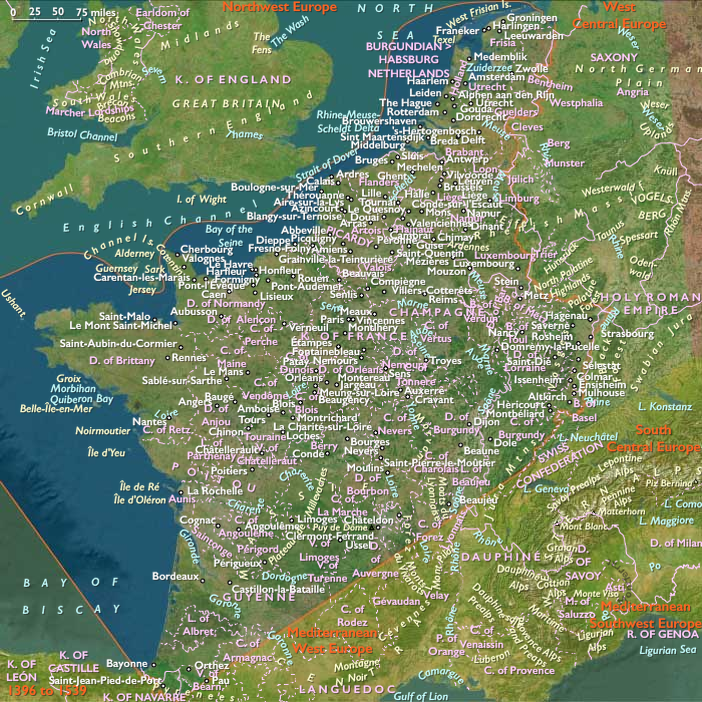
Maximilian of Austria and the Securing of…
October 1492 CE
Maximilian of Austria and the Securing of the Burgundian Inheritance (1477–1492)
The sudden death of Charles the Bold, Duke of Burgundy, at the Battle of Nancy on January 5, 1477, plunged the extensive Burgundian domains into turmoil. His daughter, Mary of Burgundy, inherited vast lands stretching from Burgundy proper to the rich commercial centers of the Low Countries. Her marriage to Archduke Maximilian of Austria immediately transformed the Burgundian succession crisis into an intense struggle for regional dominance, intertwining Habsburg and French dynastic ambitions and dramatically shaping the political landscape of Atlantic West Europe.
Dynastic Ambitions and the Struggle for Burgundian Domains
Maximilian was determined, even before his coronation as King of the Romans in 1486, to secure these valuable Burgundian territories permanently within the House of Habsburg. His marriage to Mary, formalized in 1477, had explicitly limited inheritance rights exclusively to their offspring rather than allowing claims from the surviving spouse. Despite this contractual arrangement, Maximilian sought to ensure lasting control of Burgundian lands, aiming particularly to secure their inheritance for his son, Philip the Handsome.
The Franco-Habsburg Rivalry and the Battle of Guinegate (1479)
The French crown, however, vigorously contested Maximilian’s ambitions, claiming parts of the Burgundian inheritance through feudal rights and Salic law. Maximilian decisively repelled French ambitions at the Battle of Guinegate (Enguinegatte) on August 7, 1479, a victory that temporarily secured Habsburg authority and confirmed Maximilian's military capabilities in defending his family’s claims.
Flemish Revolts and Challenges to Habsburg Rule (1482–1492)
The death of Mary of Burgundy in 1482 plunged the region into deeper instability. Flemish cities such as Bruges and Ghent, resentful of Maximilian’s heavy taxation and centralizing policies, erupted in open revolt and actively aligned themselves with King Louis XI of France. Under the Treaty of Arras (1482), these rebels compelled Maximilian to cede strategically important provinces—including Franche-Comté and Artois—to France, severely weakening his authority in the region.
Maximilian's attempts at centralization and imposing high taxes triggered further rebellions, notably between 1482 and 1492, during which the rebellious provinces challenged Habsburg rule twice more, emphasizing their determination to retain local autonomy against Austro-Burgundian authority.
Final Suppression of the Flemish Revolts (1492)
The prolonged conflict culminated in 1492, when Maximilian’s forces decisively suppressed the Flemish revolt. Austro-Burgundian troops, demonstrating Maximilian’s determination and military leadership, successfully besieged the rebel-held port city of Sluis, a vital commercial and strategic hub. The decisive capture of Flemish rebel leader Philip of Cleves on October 12, 1492, marked the turning point. With their leader imprisoned, the rebels were compelled to negotiate peace on Maximilian’s terms, effectively ending organized resistance.
Consequences and Long-Term Significance
The successful suppression of this revolt decisively secured the Burgundian inheritance for Maximilian’s son, Philip the Fair, firmly embedding Burgundian territories within the growing Habsburg empire. Although Burgundy proper had been ceded to France, Maximilian succeeded in holding onto the Netherlands, paving the way for the emergence of the powerful Habsburg Netherlands, a core of future geopolitical and economic influence in Europe.
Moreover, Maximilian’s campaigns reinforced the Habsburg reputation as a major European power, laying the groundwork for later territorial expansions through strategic dynastic marriages, notably Philip’s eventual marriage to Joanna of Castile, which would dramatically shape European history through the rise of Habsburg Spain.
Long-term Consequences
The Flemish revolts and their eventual suppression by Maximilian had profound long-term consequences, notably solidifying the Netherlands' integration into the Habsburg domains. The conflicts also highlighted ongoing tensions between local autonomy and centralized power, themes which would resurface dramatically during the later Dutch Revolt in the sixteenth century.
In securing his son's inheritance and asserting Habsburg hegemony in the Low Countries, Maximilian significantly influenced the geopolitical trajectory of late-medieval and early modern Atlantic West Europe, setting the stage for the Habsburg ascendancy that reshaped European political dynamics for centuries.
Locations
Groups
Commodities
Subjects
Regions
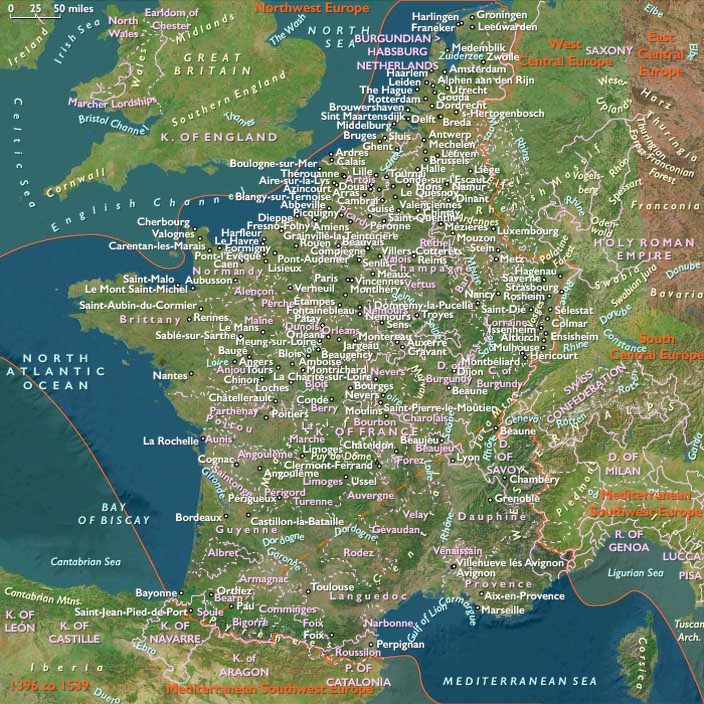
West Europe
View →Subregions