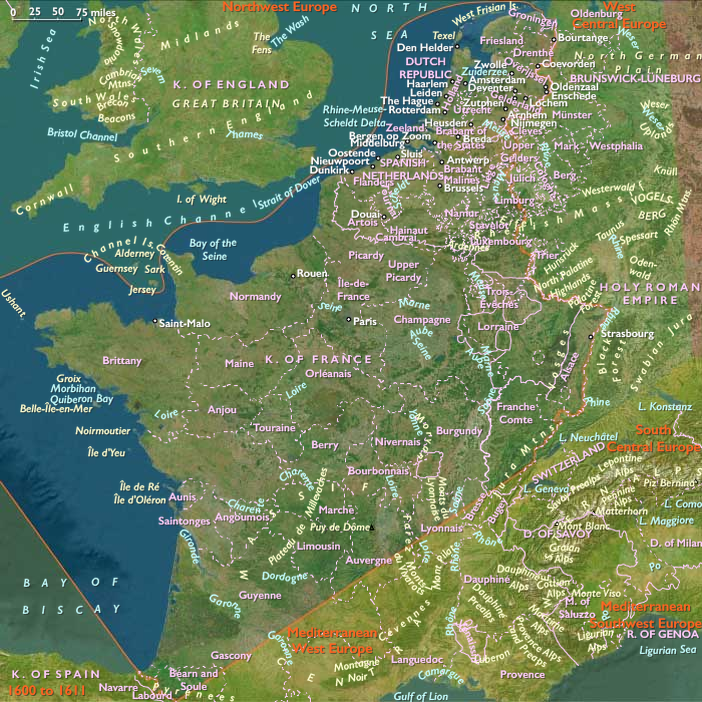
Maurice had organized the rebellion against Spain…
June 1600 CE
Maurice had organized the rebellion against Spain into a coherent, successful revolt.
He had reorganized the Dutch States Army together with Willem Lodewijk, studied military history, strategy and tactics, mathematics and astronomy, and has proved himself to be among the best strategists of his age.
Paying special attention to the siege theories of Simon Stevin, he has taken valuable key fortresses and towns: Breda in 1590, Steenwijk in 1592, and Geertruidenberg in 1593.
These victories have rounded out the borders to the Dutch Republic, solidifying the revolt and allowing a national state to develop behind secure borders.
They also have established Maurice as the foremost general of his time.
Many of the great generals of the succeeding generation, including his brother Fredick Henry and many of the commanders of the English Civil War, learned their trade under his command.
The training of his army is especially important to early modern warfare.
Previous generals had made use of drill and exercise in order to instill discipline or to keep the men physically fit, but for Maurice, they "were the fundamental postulates of tactics."
This change affects the entire conduct of warfare, since it requires the officers to train men in addition to leading them, decreasing the size of the basic infantry unit for functional purposes since more specific orders have to be given in battle, and the decrease in herd behavior requires more initiative and intelligence from the average soldier.
Against Maurice's complaints, the States General under Johan van Oldenbarneveldt has ordered Maurice to take the army, march south along the coast and take the pirate nest of Dunkirk.
The divergence of opinion on this matter between Maurice and van Oldenbarneveldt are the first signs that the two de facto leaders of the Dutch Republic are beginning to drift apart.
This rivalry will eventually lead to the arrest and execution of Van Oldenbarneveldt in 1619.
It is thought that the vicious and long-continued mutiny of a great part of the Spanish troops would make it impossible for Archduke Albrecht of Austria to collect an army for the relief of Nieuwpoort.
By June 21 Maurice has collected an army for the operation of twelve infantry regiments and twenty-ive cavalry cornets: some twelve thousand foot and two thousand horse.
He crosses the Scheldt Estuary on the 22nd in a multitude of small vessels and moves to Ostend; his base of operations.
He leaves there half a regiment and four cornets to reinforce the garrison and on the 30th starts for Nieuwpoort.
Groups
Topics
Commodities
Subjects
Regions
West Europe
View →Subregions