
Maximilian, Holy Roman Emperor from 1493, has…
January 1519 CE
Maximilian, Holy Roman Emperor from 1493, has sought to extend his sphere of influence through his own marriages and those of his descendants (attempted unsuccessfully and successfully alike), as is current practice for dynastic states at this time.
The marriages he had arranged for both of his children had more successfully fulfilled the specific goal of thwarting French interests, and after the turn of the sixteenth century, his matchmaking had focused on his grandchildren, for whom he had looked away from France towards the east.
These political marriages are summed up in the following Latin elegiac couplet: Bella gerant aliī, tū fēlix Austria nūbe/ Nam quae Mars aliīs, dat tibi regna Venus, "Let others wage war, but thou, O happy Austria, marry; for those kingdoms which Mars gives to others, Venus gives to thee.”
Maximilian had appointed his daughter Margaret as both Regent of the Netherlands and the guardian and educator of his grandsons Charles and Ferdinand (their father, Philip, having predeceased Maximilian), and she has fulfilled this task well.
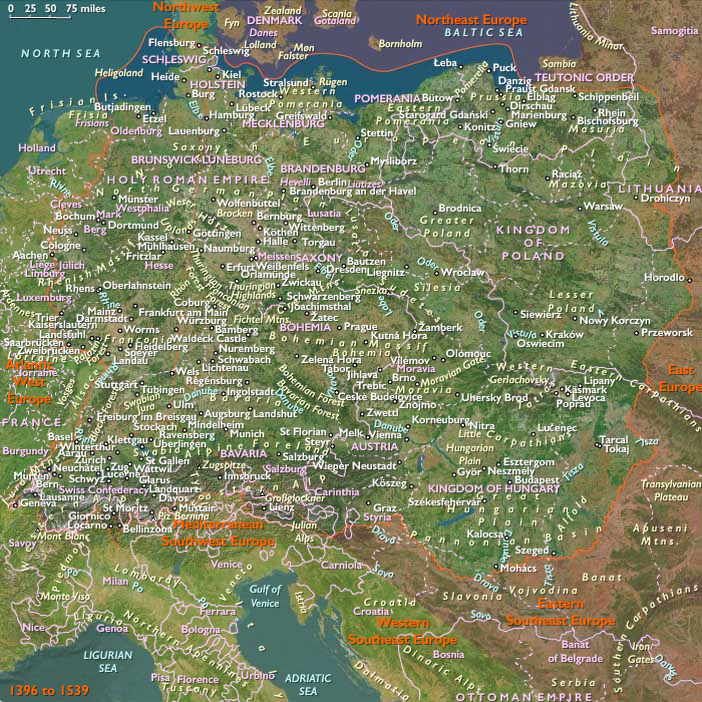
Through wars and marriages he has extended the Habsburg influence in every direction: to the Netherlands, Spain, Bohemia, Hungary, Poland, and Italy.
This influence will last for centuries and shape much of European history.
After it became clear that Maximilian's policies in Italy had been unsuccessful, and after 1517 Venice reconquered the last pieces of their territory from Maximilian, the emperor has now started to focus entirely on the question of his succession.
His goal is to secure the throne for a member of his house and prevent Francis I of France from gaining the throne; the resulting "election campaign" is unprecedented due to the massive use of bribery.
The Fugger family has provided Maximilian a credit of one million gulden, which has been used to bribe the prince-electors.
At first, this policy seemed successful, and Maximilian had managed to secure the votes from Mainz, Cologne, Brandenburg and Bohemia for his grandson Charles V.
The death of Maximilian on January 2, 1519, seems to put the succession at risk, but in a few months the election of Charles V will be secured.
Locations
People
Groups
Regions
Central Europe
View →Subregions
