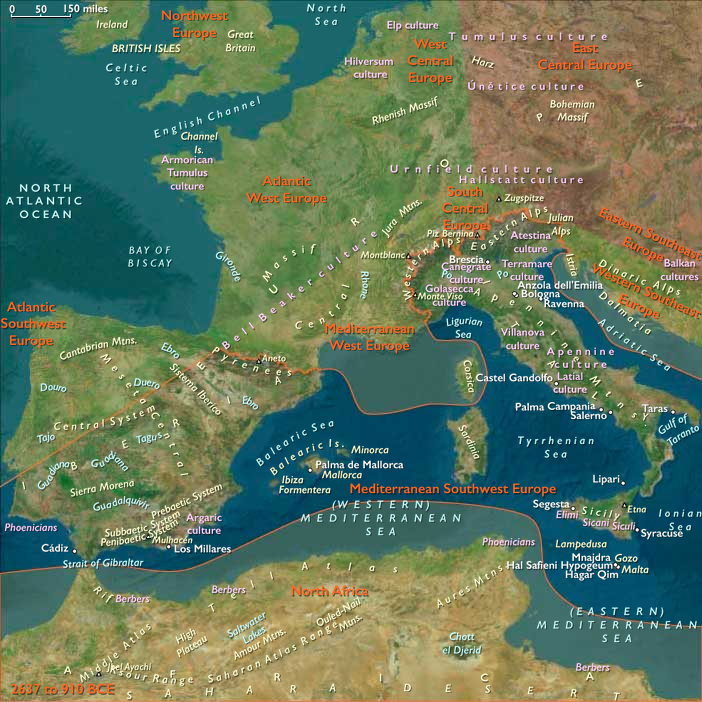
Mediterranean Southwest Europe (1197–1054 BCE): Cultural Diversification,…
1197 BCE to 1054 BCE
Mediterranean Southwest Europe (1197–1054 BCE):
Cultural Diversification, Urbanization, and Iron Age Transitions
Between 1197 and 1054 BCE, Mediterranean Southwest Europe—including Andorra, Italy, the Western Mediterranean Islands (except Corsica), and southwestern Spain—experiences notable diversification and profound cultural shifts as regional variations intensify and new peoples introduce significant technological and social innovations.
Villanovan Culture: Dawn of the Iron Age
The introduction of iron around 1100 BCE by the Villanovan culture, the earliest Iron Age society in central and northern Italy, marks a pivotal transition from the Bronze Age Terramare culture. Originating possibly from the Eastern Alps, the Villanovans demonstrate strong cultural links to the contemporaneous Hallstatt culture. Known for their distinct double-cone-shaped pottery urns, the Villanovans practice cremation, signaling a significant shift in burial customs.
Villanovan settlements notably center in the Po River valley and Etruria, especially around the future Etruscan heartland near Bologna, with additional presence in Emilia Romagna, Tuscany, and Lazio.
The Etruscan Question: Origins and Identity
Debates over the origins of the Etruscan civilization highlight two main hypotheses: local development from the Villanovan culture and external colonization from Anatolia. Genetic studies link modern Tuscans with Anatolian populations, suggesting possible migrations or extensive trade connections. Etruscan linguistic ties to Rhaetic and Lemnian further illustrate complex intercultural exchanges during this period.
Legendary Foundations: Aeneas and Alba Longa
Mythologically, this era sees the purported founding of Alba Longa around 1152 BCE by Ascanius, son of the Trojan hero Aeneas, as recounted by Virgil's Aeneid. Although legendary, archaeological evidence from the Alban Hillsregion indicates settlements consolidating into more organized communities by this time, reflecting broader social developments in central Italy.
Phoenician Expansion: Establishment of Gadir
Phoenician traders significantly impact Iberia by establishing Gadir (modern-day Cádiz), traditionally founded in 1104 BCE. Initially serving as a seasonal trading post, Gadir soon becomes an essential hub for commerce, connecting the western Mediterranean with Tartessos, an influential, albeit elusive, city-state.
Migration and Settlement in Southern Italy and Sicily
Around the eleventh century BCE, the arrival of the Oenotrians from Greece initiates important migratory movements. Their settlement in southern Italy is contemporaneous with the displacement of the indigenous Elymians, who migrate to western Sicily. The Elymians, possibly linked to Anatolian or Sea Peoples migrations, intermix with the native Sicanians, leading to distinct cultural amalgamations.
Sicily: Arrival of the Sicels
The Sicels (Siculi), Italic peoples originally from central Italy, arrive in Sicily by the twelfth century BCE, pushing the Sicanians westward and reshaping the island’s demographic landscape. Introducing iron-working techniques and domesticated horses, the Sicels significantly influence local economic and cultural practices, leaving archaeological evidence such as the extensive necropolis at Pantalica near Syracuse.
Legacy of the Age
The period from 1197 to 1054 BCE establishes crucial precedents for later historical developments, marked by complex cultural interactions, technological advancements, and significant demographic shifts. This dynamic era sets the stage for Mediterranean Southwest Europe's subsequent historical trajectory into increasingly sophisticated urban civilizations.
Groups
Topics
Commodities
Regions
Southwest Europe
View →Subregions