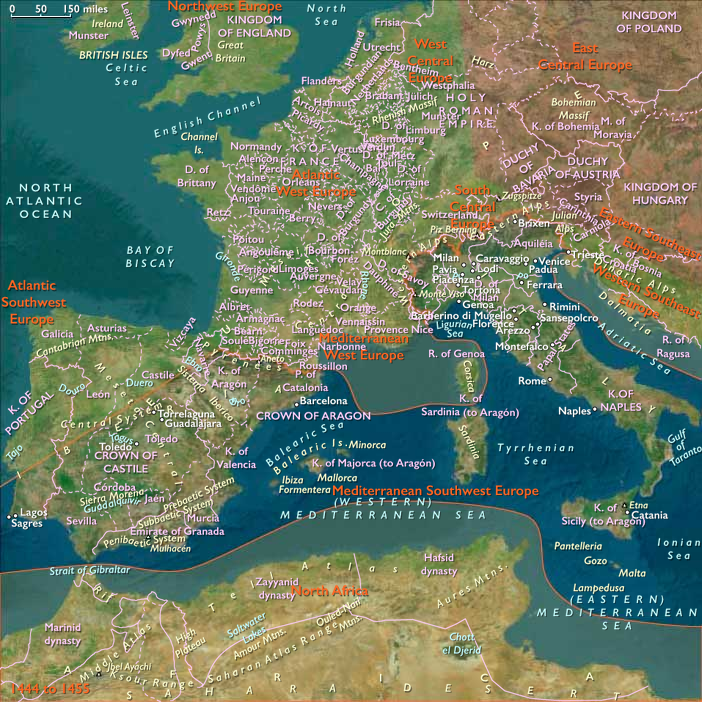
Mediterranean Southwest Europe (1444–1455 CE): Cultural Innovations…
1444 CE to 1455 CE
Mediterranean Southwest Europe (1444–1455 CE): Cultural Innovations and Economic Developments
The era 1444–1455 CE in Mediterranean Southwest Europe is characterized by distinctive shifts in fashion and cultural expression, innovative developments in recreational activities such as lotteries, and continued economic dynamics in Italy and the Iberian Peninsula.
Evolution in Fashion and Personal Appearance
Italian costume undergoes notable changes around the mid-fifteenth century, transitioning away from the international Gothic style predominant in northern Europe toward a more natural and refined aesthetic. Women's attire sees the introduction of the robe—essentially a dress combining an attached bodice and skirt. Men's fashion evolves with doublets becoming notably shorter, emphasizing fitted hose.
Women's headwear also experiences a shift; the previously favored peaked Gothic headdresses fall out of fashion, giving way to hairstyles elaborately adorned with thin veils, ribbons, and jewels. The increasing popularity of lace and perfumes during this period further highlights Renaissance Europe's evolving standards of beauty and personal grooming.
Emergence and Popularity of the Italian Lottery
The first recorded Italian lottery takes place on January 9, 1449, in Milan, organized by the Golden Ambrosian Republic to raise funds for its war against the Republic of Venice. The practice quickly becomes especially popular in Genoa, where a variant known as "Lotto" emerges. Genoese citizens initially wager on the names of five Great Council members randomly drawn every six months from a pool of ninety candidates. Over time, to accommodate more frequent betting, participants substitute the councilors' names with numbers, laying the foundations for the modern game of Lotto, ancestor to contemporary lotteries and even the informal "Numbers game."
Continued Economic and Maritime Activity
Italian city-states, including Genoa, Venice, and Florence, sustain their economic prosperity during this era through continued maritime trade and commercial expansion, reinforcing their dominance in Mediterranean and Atlantic trade networks. These robust economic activities significantly support cultural patronage and urban growth across the region.
Cultural and Intellectual Flourishing
The intellectual and cultural vibrancy initiated in earlier periods persists. Humanist scholars further explore classical texts, influencing contemporary art, literature, and philosophy. Florence, as a cultural center, continues to produce influential artistic and intellectual figures, significantly shaping Renaissance culture and ideals.
Legacy of the Era
The era 1444–1455 CE is marked by significant cultural innovations in fashion and recreation, particularly through the widespread adoption of lotteries. Combined with sustained economic vigor and cultural patronage, these developments notably contribute to the region's evolving cultural identity and socio-economic dynamics, leaving enduring impacts on European history.
Groups
Subjects
Regions
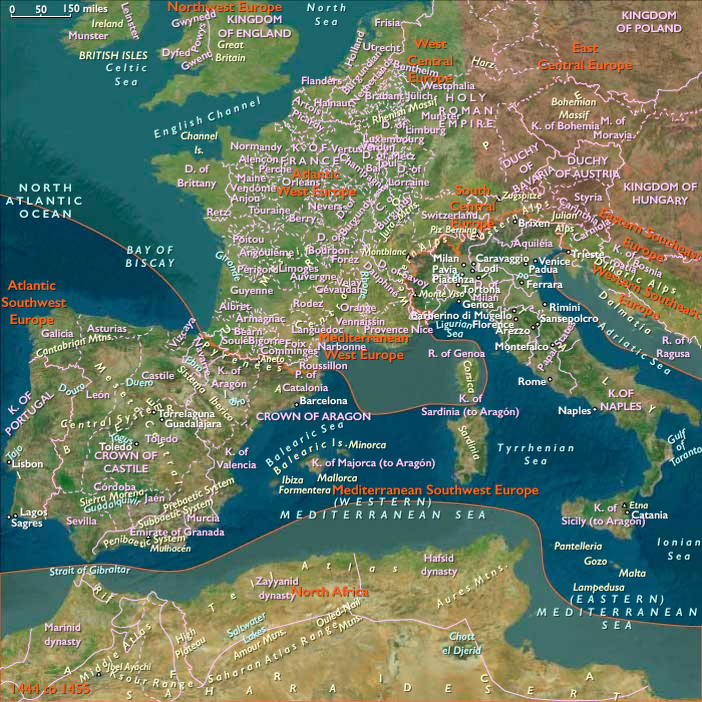
Southwest Europe
View →Subregions