
Mediterranean Southwest Europe (1492–1503 CE): Cultural Renaissance, …
Years: 1492 - 1503
Mediterranean Southwest Europe (1492–1503 CE): Cultural Renaissance, Religious and Political Conflict, and Artistic Flourishing
The era 1492–1503 CE in Mediterranean Southwest Europe is characterized by remarkable cultural advancements, artistic and architectural achievements, intense religious and political conflicts, and important scholarly innovations.
Artistic and Architectural Achievements
Fra Giovanni Giocondo, a skilled engineer and architect, plays a significant role during this period. His earlier engagements include Verona's Loggia del Consiglio and fortifications in Treviso. Giocondo significantly impacts Venice with his successful redirection of the Brenta River, enhancing the city's safety and economic stability. His scholarly contributions include detailed studies of Roman antiquities, influencing Renaissance architectural thought profoundly.
Architecturally, the exuberant Spanish Gothic, known as the Isabelline style, emerges prominently, exemplified by Valladolid’s Colegio di San Gregorio, characterized by elaborate decoration and intricate designs influenced by Moorish Mudejar artistry.
Religious and Political Conflicts
The Italian Wars (1494–1559) significantly reshape the political landscape. Initiated by dynastic claims, particularly those of Charles VIII of France and Louis XII, these conflicts expand into broader European power struggles involving Spain, France, the Holy Roman Empire, and the Papal States. These wars reflect shifting alliances and continual betrayals, underscoring the volatility of political power in the region.
Simultaneously, the completion of the Reconquista in Spain with the fall of Granada in 1492 marks a critical religious and political milestone. This era sees increased religious tensions, reflected in the completion and compilation of the Extravagantes communes, further solidifying canon law within Christendom.
Literary and Scholarly Innovations
The printing of the first complete Hebrew Bible at Soncino in 1488 by Joshua Solomon ben Israel Nathan Soncino represents a significant scholarly achievement, symbolizing advancements in printing technology and religious scholarship.
Matteo Maria Boiardo's epic poem, Orlando Innamorato, continues to influence literary circles significantly, merging chivalric romance with classical humanist traditions, setting a foundation for later Renaissance literature.
Economic and Technological Advances
Economic growth, particularly in Genoa, is illustrated by the emergence of modern lottery systems. Initially a political mechanism, the Genoese lottery evolves into a widespread financial and gambling institution across Europe, impacting both economic and cultural practices.
Legacy of the Era
The era 1492–1503 CE in Mediterranean Southwest Europe encapsulates an essential transition from medieval structures to Renaissance innovations, significantly shaped by cultural, artistic, religious, and political developments. This dynamic period lays crucial foundations for Europe's intellectual, cultural, and political landscapes well into the sixteenth century.v
People
Groups
- Papal States (Republic of St. Peter)
- Italy, Kingdom of (Holy Roman Empire)
- Genoa, (Most Serene) Republic of
- Venice, (Most Serene) Republic of
- Aragon, Crown of
- Castile, Crown of
- Granada, Emirate of, or Nasrid Kingdom of
- France, (Valois) Kingdom of
- Florence, Medici-ruled
- Holy Roman Empire
- Naples, Aragonese Kingdom of
- Milan, Duchy of
- Ottoman Empire
- Ferrara, Duchy of
Topics
- Reconquista, the
- Humanism, Renaissance
- Renaissance, Italian
- Italian War of Charles VIII
- Italian War of Louis XII
Subjects
- Commerce
- Language
- Writing
- Architecture
- Painting and Drawing
- Decorative arts
- Conflict
- Mayhem
- Games and Sports
Regions
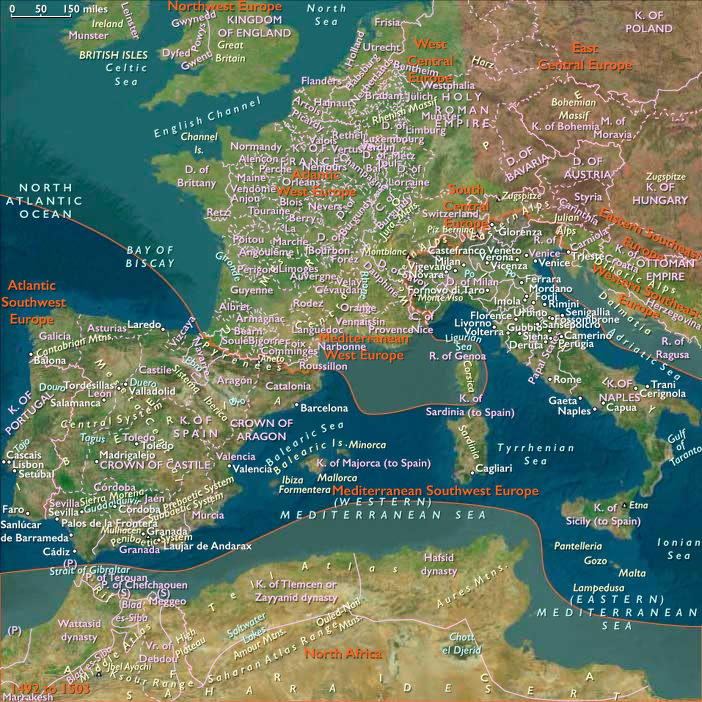
Subregions
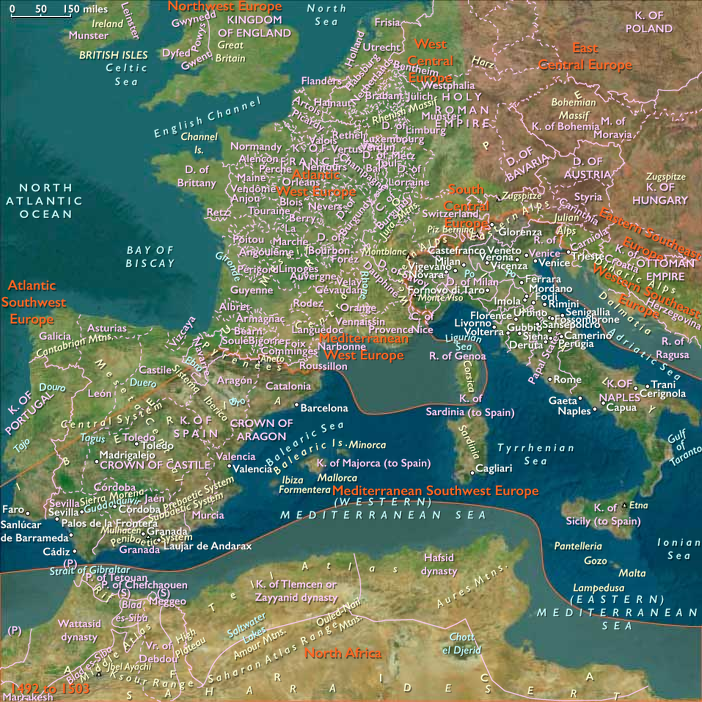
Years: 1492 - 1503
People
Groups
- Papal States (Republic of St. Peter)
- Italy, Kingdom of (Holy Roman Empire)
- Genoa, (Most Serene) Republic of
- Venice, (Most Serene) Republic of
- Aragon, Crown of
- Castile, Crown of
- Granada, Emirate of, or Nasrid Kingdom of
- France, (Valois) Kingdom of
- Florence, Medici-ruled
- Holy Roman Empire
- Naples, Aragonese Kingdom of
- Milan, Duchy of
- Ottoman Empire
- Ferrara, Duchy of
Topics
- Reconquista, the
- Humanism, Renaissance
- Renaissance, Italian
- Italian War of Charles VIII
- Italian War of Louis XII
Subjects
- Commerce
- Language
- Writing
- Architecture
- Painting and Drawing
- Decorative arts
- Conflict
- Mayhem
- Games and Sports
Regions
Subregions