
Mediterranean Southwest Europe (1552–1563 CE): Cultural Flourishing …
Years: 1552 - 1563
Mediterranean Southwest Europe (1552–1563 CE): Cultural Flourishing and Religious Transformation
The era 1552–1563 CE in Mediterranean Southwest Europe sees notable developments in artistic, cultural, and religious spheres. While Italy's commedia dell'arte emerges as a defining theatrical innovation, the Iberian Peninsula experiences significant social and religious transformations, and key Mediterranean islands witness the consolidation of Spanish rule and continued integration into broader European trends.
Emergence of Commedia dell'Arte in Italy
The innovative theatrical tradition of commedia dell'arte, meaning "professional comedy," flourishes significantly after 1550 among actors outside courtly and academic traditions. Although Ruzzante (Angelo Beolco; 1502–1542) is regarded as an influential precursor, the fully improvisational nature of commedia dell'arte distinguishes it from his partially scripted performances.
Unlike the refined commedia erudita, commedia dell'arte features spontaneous dialogue (commedia all'improviso) performed around a loosely defined scenario (a soggetto). Stock characters like the boastful captain, lecherous old men, passionate lovers, spirited young women, and humorous servants (zanni, notably Arlecchino or Harlequin) captivate audiences through lively wit, energetic performances, and comedic routines called lazzi. Actors rigorously train in mime, acrobatics, dialects, and classical literature, emphasizing ensemble dynamics and improvisational skill.
Religious and Social Transformations in Iberia
The Iberian Peninsula witnesses important religious and cultural developments amid the ongoing Counter-Reformation. The Council of Trent, nearing completion in this era, deeply influences religious practice, leading to intensified measures against perceived heresies and heightened scrutiny of converted populations. This religious climate reinforces social conservatism, significantly shaping Iberian culture and society.
In 1559, King Philip II of Spain reinforces the Spanish Inquisition’s authority, culminating in increased persecution of conversos, moriscos, and other marginalized groups. Cultural expression and intellectual activities become highly regulated, marking a significant shift toward conservative orthodoxy.
Artistic Developments and Influences
This period witnesses significant artistic contributions that further shape the Mannerist style across Italy and Iberia. The Spanish artist El Greco (Domenikos Theotokopoulos) begins his early training, later revolutionizing Spanish painting with his elongated figures and dramatic use of color and light. In Italy, artists like Giorgio Vasari continue to define and document Mannerist ideals, contributing profoundly to European artistic heritage.
Mediterranean Islands under Spanish Rule
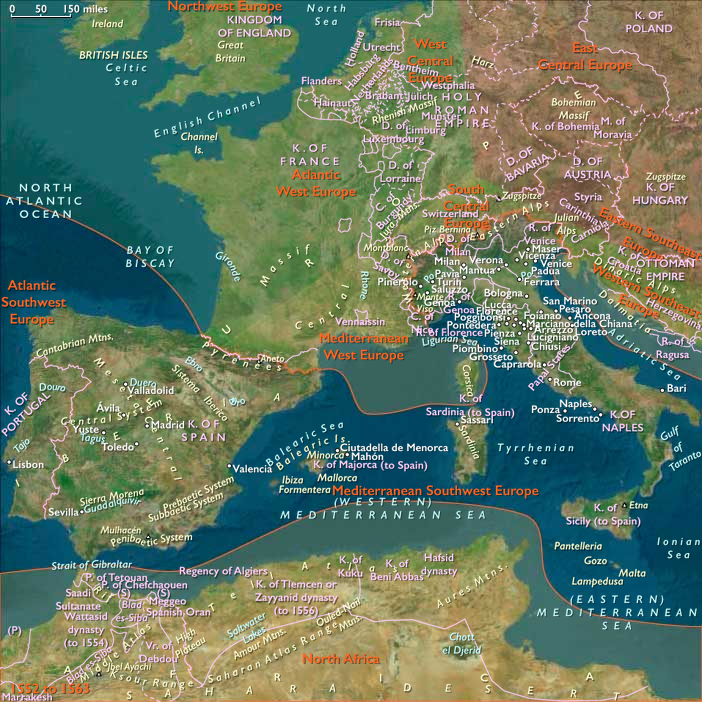
In the broader Mediterranean region, Sicily, Sardinia, and the Balearic Islands experience strengthened integration into the Spanish empire, further embedding Spanish administrative practices, language, and cultural influences. The University of Messina, established earlier, gains prominence, serving as a center for learning and the dissemination of Spanish and Catholic influence throughout Sicily.
Legacy of the Era
The period 1552–1563 CE profoundly shapes the cultural, social, and religious landscape of Mediterranean Southwest Europe. The rise of commedia dell'arte significantly influences European theatre, while religious conservatism in Iberia defines cultural and social structures that persist for generations. Concurrently, artistic innovation and strengthened Spanish governance across the Mediterranean islands establish enduring cultural and administrative legacies.
People
Groups
- Jews
- Italy, Kingdom of (Holy Roman Empire)
- Christians, Roman Catholic
- Venice, (Most Serene) Republic of
- Holy Roman Empire
- Inquisition, Spanish
- Moriscos
- Spain, Habsburg Kingdom of
Topics
- Humanism, Renaissance
- Renaissance, Italian
- Counter-Reformation (also Catholic Reformation or Catholic Revival)
Subjects
Regions
Subregions
Years: 1552 - 1563
People
Groups
- Jews
- Italy, Kingdom of (Holy Roman Empire)
- Christians, Roman Catholic
- Venice, (Most Serene) Republic of
- Holy Roman Empire
- Inquisition, Spanish
- Moriscos
- Spain, Habsburg Kingdom of
Topics
- Humanism, Renaissance
- Renaissance, Italian
- Counter-Reformation (also Catholic Reformation or Catholic Revival)
Subjects
Regions
Subregions