
Mediterranean Southwest Europe (1564–1575 CE): Cultural Innovations …
Years: 1564 - 1575
Mediterranean Southwest Europe (1564–1575 CE): Cultural Innovations and Artistic Transformation
The period 1564–1575 CE in Mediterranean Southwest Europe witnesses notable innovations and artistic transformations, highlighted by developments in music, theater, continued shifts in religious and cultural spheres across Italy, the Iberian Peninsula, key Mediterranean islands, and significant advances in Malta under the Knights Hospitaller.
Rise and Influence of the Castrati
The emergence of castrati—male singers castrated before puberty to preserve their soprano or contralto voice ranges—becomes a prominent, though controversial, phenomenon in Italy. Initially referenced vaguely, by this era castrati gain substantial prominence. Their distinctive vocal power arises from the combination of an unbroken voice and mature lungs and chest capacity, enabling extraordinary musical performances. Notably, Cardinal Ippolito II d'Este, famed builder of Villa d'Este at Tivoli, had introduced castrati to other Italian courts, reflecting their growing desirability and status in elite musical circles. By 1574, castrati have spread as far as the ducal chapel at Munich, significantly influencing European music traditions.
Artistic Developments and Mannerism
Artistic trends in this period continue to embrace and evolve Mannerist aesthetics, characterized by elongated figures, dynamic poses, and intensified emotional expressions. Prominent figures, such as El Greco (Domenikos Theotokopoulos), further develop this style, influencing painting significantly across Spain and Italy. In Florence and Rome, artistic circles actively debate classical versus Mannerist ideals, profoundly shaping European artistic tastes.
Cultural and Social Dynamics in Iberia
In Iberia, cultural life remains deeply shaped by the Counter-Reformation and the continued strengthening of conservative religious policies under King Philip II of Spain. The Spanish Inquisition remains a powerful force, exerting strict control over intellectual and cultural expressions. Despite this restrictive atmosphere, significant literary and artistic creativity continues, often navigating carefully within established orthodox boundaries.
Mediterranean Integration and Governance
Throughout this era, the Mediterranean islands—including Sicily, Sardinia, and the Balearic Islands—continue their integration under Spanish rule. These territories increasingly reflect Spanish cultural and administrative practices, reinforced through centralized governance and consistent enforcement of Catholic orthodoxy.
Malta and the Knights Hospitaller
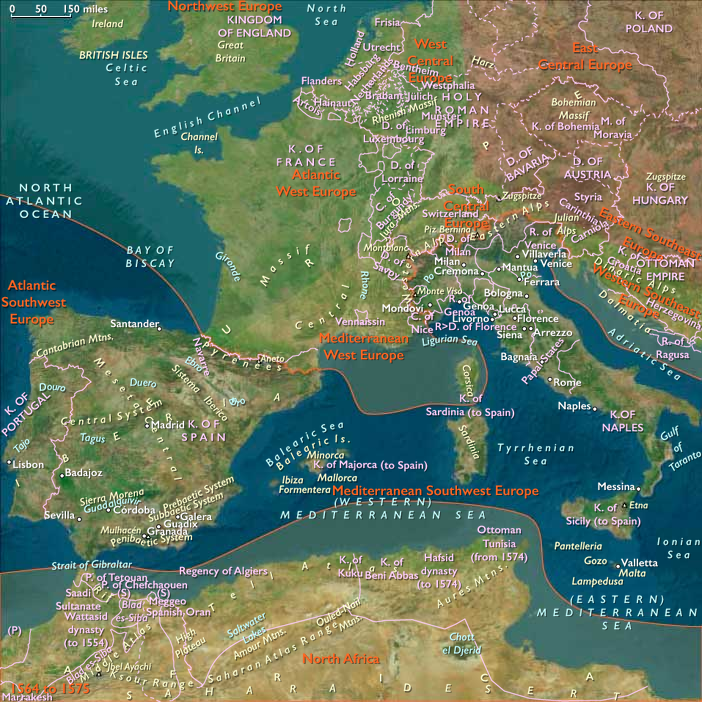
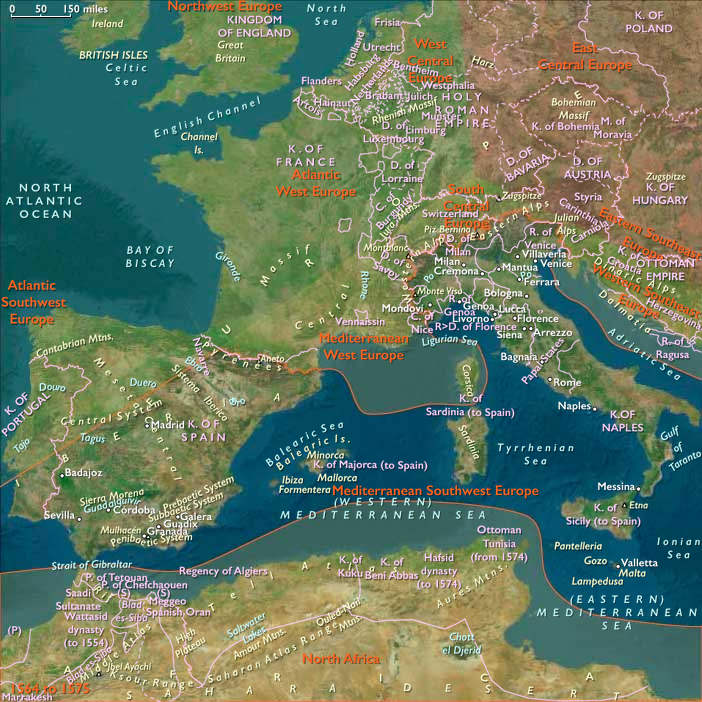
Significant developments occur in Malta, which has become the strategic home of the Knights Hospitaller. After being granted the island by Emperor Charles V in 1530, the Knights establish formidable fortifications, hospitals, and infrastructure. The building and fortification of Valletta, named after Grand Master Jean de la Valette, begin in 1566 under the supervision of military engineer Francesco Laparelli and continue under Girolamo Cassar, who completes the city in 1571. Valletta quickly becomes the home port of one of the Mediterranean’s most powerful navies and is known as Superbissima, "Most Proud." Its hospitals, particularly the renowned Sacra Infermeria, become advanced centers for medical education and care, housing Schools of Anatomy, Surgery, and Pharmacy. The city emerges as a vibrant hub of art and culture, notably with the completion of the Conventual Church of St. John in 1577, later renowned for works by Caravaggio and other masters.
Legacy of the Era
The period 1564–1575 CE stands out for its profound cultural innovations, particularly through the controversial yet influential rise of the castrati, contributions to the ongoing artistic evolution of Mannerism, and remarkable advancements in Malta under the Hospitaller Order. Simultaneously, Iberia’s complex cultural climate and the deeper integration of Mediterranean islands into the Spanish empire set lasting social and cultural foundations for the region
People
- El Greco (Doménikos Theotokópoulos)
- Francesco Laparelli
- Giorgio Vasari
- Girolamo Cassar
- Philip II of Spain
Groups
- Jews
- Papal States (Republic of St. Peter)
- Italy, Kingdom of (Holy Roman Empire)
- Christians, Roman Catholic
- Venice, (Most Serene) Republic of
- Holy Roman Empire
- Inquisition, Spanish
- Moriscos
- Spain, Habsburg Kingdom of
Topics
- Humanism, Renaissance
- Renaissance, Italian
- Counter-Reformation (also Catholic Reformation or Catholic Revival)
Subjects
Regions
Subregions
Years: 1564 - 1575
People
- El Greco (Doménikos Theotokópoulos)
- Francesco Laparelli
- Giorgio Vasari
- Girolamo Cassar
- Philip II of Spain
Groups
- Jews
- Papal States (Republic of St. Peter)
- Italy, Kingdom of (Holy Roman Empire)
- Christians, Roman Catholic
- Venice, (Most Serene) Republic of
- Holy Roman Empire
- Inquisition, Spanish
- Moriscos
- Spain, Habsburg Kingdom of
Topics
- Humanism, Renaissance
- Renaissance, Italian
- Counter-Reformation (also Catholic Reformation or Catholic Revival)
Subjects
Regions
Subregions