
Mediterranean Southwest Europe (1576–1587 CE): Cultural Flourishing …
Years: 1576 - 1587
Mediterranean Southwest Europe (1576–1587 CE): Cultural Flourishing and Trans-Mediterranean Exchanges
The era 1576–1587 CE in Mediterranean Southwest Europe marks a vibrant cultural flourishing, with significant advancements and exchanges across Italy, the Iberian Peninsula, and the strategic island of Malta. This period is highlighted by the dynamic expansion of the commedia dell'arte, the introduction of coffee to European society, and continued infrastructural and cultural growth in Malta under the Knights Hospitaller.
Commedia dell'Arte and Theatrical Innovation
This era sees major Italian commedia dell'arte companies flourish, notably the Gelosi (the "Jealous"), Confidenti (the "Confident"), Uniti (the "United"), Desiosi (the "Desired"), Accesi (the "Inspired"), and Fideli (the "Faithful"). The Compagnia dei Gelosi, formed around 1568 under the leadership of scenario writer Flaminio Scala, gains immense popularity throughout Italy and beyond. Renowned for improvisational performances, quick wit, and social commentary, these troupes significantly influence European theatre. Another leading troupe, the Compagnia degli Uniti, emerges prominently under the guidance of Drusiano Martinelli and his wife, Angelica. Their performances are celebrated for their sophisticated wit and cultural refinement, and notable actor Silvio Fiorillo gains recognition for his innovative portrayals of stock characters like the boastful Capitano Mattamoros and the quirky Pulcinella.
Introduction of Coffee to Europe
Coffee arrives in Europe for the first time during this era through the vibrant trade connections between Venice and the Ottoman Empire. Initially imported from North Africa, Egypt, and the Levant, coffee becomes a luxury beverage for Venice's elite. Venetian merchants capitalize on its exotic appeal, charging premium prices and helping to popularize the beverage across Europe, laying the foundations for the continent’s enduring coffee culture.
Continued Developments in Malta
Under the stewardship of the Knights Hospitaller, Malta continues its transformation into a fortified bastion and cultural hub. The newly established capital city, Valletta, completed in 1571, solidifies its reputation as Superbissima("Most Proud"). Valletta's formidable fortifications, designed initially by Francesco Laparelli and completed by Girolamo Cassar, secure the island against persistent Mediterranean threats. Concurrently, the island's Sacra Infermeria advances as a leading European medical facility, housing prominent schools of anatomy, surgery, and pharmacy. Malta becomes renowned not only for its defensive might but also as a center of Renaissance art and culture, particularly with the completion of the ornate Conventual Church of St. John in 1577, which soon houses masterpieces by artists such as Caravaggio.
Iberian Cultural Dynamics and Artistic Trends
In Iberia, cultural activities unfold amidst continuing strictures imposed by the Spanish Inquisition and the Counter-Reformation. Nevertheless, this era sees sustained literary and artistic output, carefully navigating the balance between orthodoxy and creative expression. The visual arts, especially influenced by the enduring Mannerist style, continue to flourish, reflecting the complex socio-political environment under the reign of King Philip II of Spain.
Integration of Mediterranean Islands
Spanish administrative and cultural practices deepen their roots across Mediterranean islands such as Sicily, Sardinia, and the Balearic Islands. These territories increasingly reflect Castilian norms, consolidating Spain's political and cultural hegemony in the region.
Legacy of the Era
The period 1576–1587 CE epitomizes a rich cultural and intellectual dynamism. From the transformative impact of the commedia dell'arte and the introduction of coffee into European life, to the fortified and culturally enriched landscape of Malta, these years represent a critical intersection of artistic, social, and political developments that significantly influence subsequent European cultural history.
People
Groups
- Jews
- Papal States (Republic of St. Peter)
- Italy, Kingdom of (Holy Roman Empire)
- Christians, Roman Catholic
- Venice, (Most Serene) Republic of
- Holy Roman Empire
- Inquisition, Spanish
- Moriscos
- Spain, Habsburg Kingdom of
Topics
- Humanism, Renaissance
- Renaissance, Italian
- Counter-Reformation (also Catholic Reformation or Catholic Revival)
Commodoties
Subjects
Regions
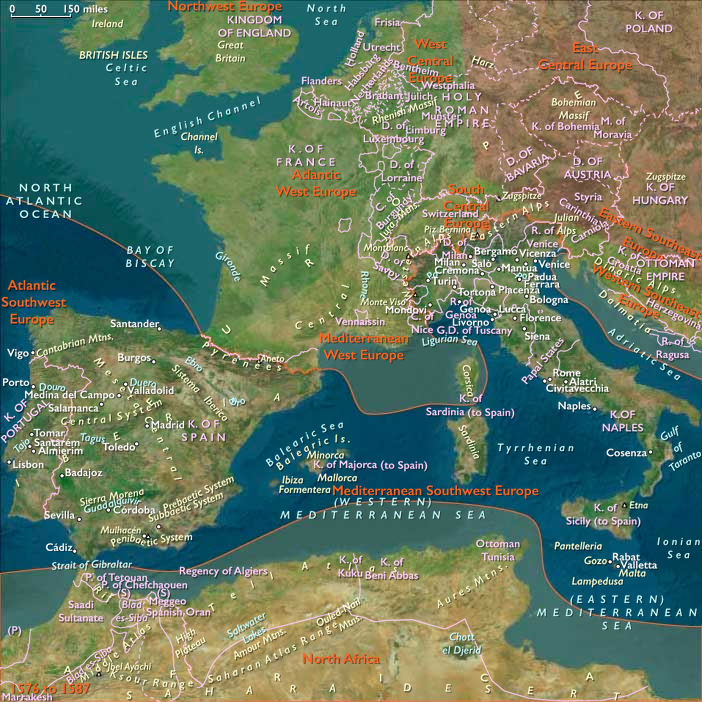
Subregions
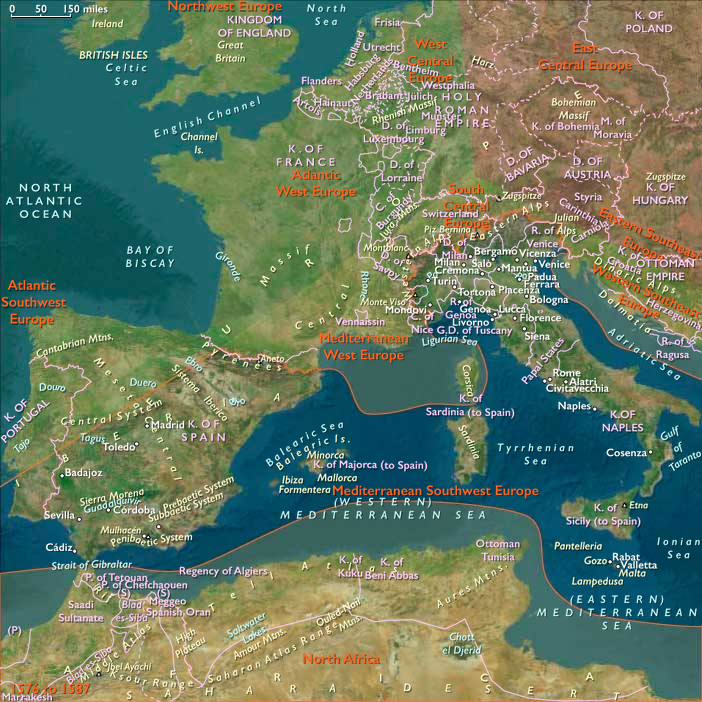
Years: 1576 - 1587
People
Groups
- Jews
- Papal States (Republic of St. Peter)
- Italy, Kingdom of (Holy Roman Empire)
- Christians, Roman Catholic
- Venice, (Most Serene) Republic of
- Holy Roman Empire
- Inquisition, Spanish
- Moriscos
- Spain, Habsburg Kingdom of
Topics
- Humanism, Renaissance
- Renaissance, Italian
- Counter-Reformation (also Catholic Reformation or Catholic Revival)
Commodoties
Subjects
Regions
Subregions